
pixel

ADHD and Sleep Revenge: Why Nighttime Feels Like Your Only Quiet (and What to Do Instead)

It’s 11 PM. You’re exhausted. Your body is basically screaming at you to go to bed. But instead, you’re scrolling through your phone, reorganizing your bookshelf, or suddenly deciding tonight is the night you’re finally going to learn how to make sourdough bread from scratch.

Sound familiar?

Welcome to revenge bedtime procrastination ADHD style, where the only time your brain feels like it actually belongs to you is when you should be sleeping.

What Is Revenge Bedtime Procrastination (And Why Does It Have Such a Dramatic Name)?

Let’s start with the term itself. “Revenge bedtime procrastination” sounds like something out of a dramatic thriller, right? But it’s actually pretty spot-on.

The concept originated in China, where people with demanding work schedules started staying up late just to reclaim some personal time. It’s not really about being a night owl or being more productive at night (though those can play a role). It’s about taking back control of your time when you feel like the whole day has been stolen from you.

For those of us with ADHD, this hits different. We’re not just dealing with long work hours. We’re dealing with:

  • A brain that never quite feels “caught up”
  • Days where everyone wants something from us
  • Constant task-switching and interruptions
  • Decision fatigue from hundreds of micro-choices
  • That feeling that we spent all day being productive for everyone else but never got to the stuff we actually wanted to do

So when nighttime rolls around? That’s when we finally get our time back. That’s when nobody is asking us questions, sending us emails, or expecting us to remember things. The phone stops buzzing. The demands stop coming. And suddenly, staying awake until 2 AM feels less like self-sabotage and more like self-care.

Except… it’s not. And we know it’s not. But we do it anyway.

The Real Reason Nighttime Feels Like Your Only Quiet

Here’s what most sleep advice gets wrong: it treats revenge bedtime procrastation like it’s just bad habits or poor time management. Like if you just tried harder or set better boundaries during the day, you’d magically go to bed on time.

But that’s not what’s happening.

For people with ADHD, nighttime serves three critical psychological needs that aren’t being met during the day:

1. Autonomy: Finally, Nobody Wants Anything From You

During the day, your ADHD brain is constantly being interrupted. Even if you work from home alone, you’re still dealing with notifications, emails, the dog needing to go out, that package delivery, the dentist calling to confirm your appointment, and your brain randomly remembering you never responded to that text from three days ago.

Every interruption costs you. Not just the two minutes it takes to deal with it, but the 15-20 minutes it takes your ADHD brain to get back into whatever you were doing before.

By the time the day is over, you haven’t had a single uninterrupted moment that belonged completely to you. Nighttime becomes the only space where you get to decide what happens next. Nobody is making demands. You’re not “on call” for anyone. And that feeling of autonomy? It’s intoxicating.

This isn’t about being selfish. It’s about finally getting to exist without having to perform, respond, or produce for someone else.

2. Nervous System Regulation: You’re Finally Coming Down

Let’s talk about what your nervous system has been doing all day.

If you have ADHD, your nervous system is likely running hot most of the time. You’re constantly in a state of mild (or not-so-mild) activation because your brain is working overtime to:

  • Focus on things that don’t naturally interest you
  • Remember tasks and appointments
  • Regulate emotions that come in waves
  • Filter out distractions and stay on track
  • Make decisions about everything from what to eat to which email to respond to first

That’s exhausting. And most of us don’t realize how revved up we are until everything finally stops.

Nighttime is when your nervous system finally gets permission to downregulate. The demands stop. The stimulation decreases. And even though you’re tired, your body is still trying to process and release all that built-up activation from the day.

ADHD sleep delay isn’t just about procrastination, it’s often your nervous system trying to find equilibrium after spending 12+ hours in overdrive.

3. Lack of Boundaries During the Day: You Never Actually Stopped

Here’s the hard truth: many of us with ADHD struggle with boundaries. Not because we don’t want them, but because our brains make it really hard to enforce them.

We say yes when we mean no. We respond to texts immediately even when we don’t have the bandwidth. We keep working past when we said we’d stop because we hyperfocused and lost track of time. We let other people’s urgency become our emergency because rejection sensitivity makes it hard to disappoint people.

By the time nighttime rolls around, we haven’t actually had boundaries all day. We’ve just been available. Responsive. “On.”

So staying up late becomes our way of creating a boundary after the fact. It’s not healthy or sustainable, but it’s the only boundary we feel like we can actually control. Nobody can ask us for anything if they’re all asleep.

Why ADHD Night Productivity Is a Double-Edged Sword

Now, I know what you’re thinking. “But I actually am more productive at night! That’s when I get my best work done!”

And you might be right. A lot of people with ADHD genuinely do experience ADHD night productivity. There are real reasons for this:

  • Fewer distractions: The world is quieter, notifications have slowed down, and there’s less sensory input competing for your attention
  • Delayed circadian rhythm: Many people with ADHD have a naturally delayed sleep-wake cycle, meaning they’re biologically more alert later in the evening
  • Hyperfocus opportunities: With fewer interruptions, it’s easier to drop into that deep focus state that feels impossible during the day

But here’s the catch: even if you can be productive at night, it doesn’t mean this pattern is sustainable or healthy. Sleep deprivation compounds ADHD symptoms in ways that make everything harder:

  • Worse executive function
  • More emotional dysregulation
  • Increased impulsivity
  • Poorer working memory
  • More difficulty with focus and attention

So you might get stuff done at midnight, but you’re paying for it with interest the next day. And the next. And the cycle continues.

What to Do Instead (That’s Not Just “Go to Bed Earlier”)

Okay, so if the answer isn’t just forcing yourself to go to bed earlier or trying harder to have better sleep hygiene, what actually works?

The key is addressing the root causes: autonomy, nervous system regulation, and boundaries. Here’s how:

Create Protected Time During the Day

If nighttime is appealing because it’s the only time that feels like “yours,” then you need to carve out protected time during the day that serves the same purpose.

This isn’t about productivity. It’s about autonomy.

Set aside 30-60 minutes where:

  • You don’t check email or messages
  • You’re not “on call” for anyone
  • You get to do something purely because you want to
  • Nobody can interrupt you

It might be early morning before anyone else is awake, a lunch break where you actually leave your desk, or a specific hour in the afternoon where you’re unavailable. The timing matters less than the consistency and the boundary.

Help Your Nervous System Downregulate Earlier

Instead of waiting until midnight for your nervous system to finally calm down, build in intentional transition time between your “on” hours and your evening.

This isn’t about bubble baths and meditation apps (though if those work for you, great). This is about giving your nervous system what it actually needs:

  • Movement: A walk around the block, stretching, dancing to one song
  • Sensory regulation: Dim lighting, weighted blankets, calming music, or even just sitting in silence for five minutes
  • Brain dumps: Get everything out of your head and onto paper so you’re not trying to remember it all night
  • Screen-free time: Even 20 minutes without screens before bed can help signal to your brain that the day is ending

Practice Saying No Earlier in the Day

If part of the revenge is because you spent all day being available to everyone else, start building your “no” muscle during daylight hours.

This is hard. Especially with ADHD and rejection sensitivity. But boundaries during the day mean you won’t feel the need to revenge-reclaim your time at night.

Start small:

  • “I’ll get back to you tomorrow on that”
  • “I’m not available after 7 PM”
  • “I need to think about that before I commit”
  • “That doesn’t work for my schedule”

The more you protect your time during the day, the less you’ll feel like you need to steal it back at night.

Reframe Your Relationship With Sleep

Instead of thinking about sleep as the thing that’s stopping you from having your time, try reframing it as the thing that gives you more capacity to have your time well.

Sleep isn’t a waste of your precious hours. It’s the thing that makes those hours actually feel like yours. When you’re well-rested, you have better focus, more energy, and stronger executive function, which means you can actually enjoy and use your time during the day.

When Revenge Becomes a Pattern, Not a Choice

If you’ve read this far and you’re thinking “yeah, but I’ve tried this stuff and I still can’t make myself go to bed,” that’s a sign you might need more support.

Sometimes ADHD sleep delay is about more than just lifestyle changes. It might be:

  • Medication timing (if you take stimulants late in the day)
  • A co-occurring sleep disorder like delayed sleep phase disorder
  • Unaddressed anxiety or depression
  • Deep-rooted boundary and autonomy issues that need processing with a therapist

And that’s okay. You’re not broken. You’re just dealing with a brain that works differently, and sometimes that requires professional support.

You Deserve Rest And Autonomy

Here’s what I want you to hear: The need for personal time, autonomy, and a regulated nervous system isn’t selfish or indulgent. It’s human. And the fact that you’re trying to meet those needs: even in ways that aren’t serving you: shows that you’re paying attention to what you need.

The goal isn’t to shame yourself into better sleep habits. It’s to build a life where you don’t feel like you have to wait until everyone is asleep to finally be yourself.

You deserve both rest and freedom. And with the right support and strategies, you can have both.

Ready to Build a Life Where You Don’t Need Revenge?

If revenge bedtime procrastination ADHD patterns are running your life, you don’t have to figure this out alone. At Heal and Thrive Therapy and Coaching, we specialize in helping people with ADHD build sustainable routines, set boundaries, and regulate their nervous systems: without shame or judgment.

Whether you’re looking for ADHD coaching to build practical strategies or therapy to process the deeper patterns keeping you up at night, we’re here to help.

Learn more about our ADHD coaching services or reach out to see how we can support you.

You deserve sleep. And you deserve to feel like your time is your own( long before midnight.)

Why ADHD Makes Emails, Forms, and Phone Calls Feel Impossible

You know that form sitting on your kitchen counter? The one that’s been there for three weeks? Yeah, that one. Or maybe it’s the email you’ve been “meaning to send” for so long that responding now would basically require an apology essay. Or that phone call, oof, that phone call you need to make to schedule the thing, but first you need to check your calendar, but where did you put your calendar, and also what if they ask you a question you don’t know the answer to?

If you’re nodding along right now, welcome. You’re in good company.

I’m an ADHD coach, and I’ve sat across from countless brilliant, capable adults who feel like absolute failures because they can’t seem to do things that everyone else finds “simple.” They run entire departments at work. They remember their kid’s best friend’s mom’s birthday. They can hyperfocus for six hours on a passion project. But ask them to fill out a basic insurance form or reply to their dentist’s email? Suddenly it’s like someone asked them to solve quantum physics while juggling flaming swords.

Here’s the thing nobody tells you: This isn’t laziness. This isn’t a character flaw. And you’re definitely not alone.

Let’s talk about why your ADHD brain treats administrative tasks like they’re made of lava.

The Invisible Mountain: Why “Just Do It” Doesn’t Work

When someone without ADHD looks at an email, they see one task: read it, type a response, hit send. Done.

When your ADHD brain looks at that same email? It sees approximately 47 micro-decisions, several potential social landmines, and a task with no clear endpoint. It’s like the difference between someone handing you a sandwich versus handing you a bag of ingredients and saying “make lunch.”

The research backs this up. People with ADHD struggle with executive function, which is basically your brain’s project manager. Executive function handles things like:

  • Breaking big tasks into smaller steps
  • Deciding what’s most important
  • Starting tasks that aren’t immediately rewarding
  • Switching between different types of thinking
  • Holding multiple pieces of information in your mind at once

So when someone says “just reply to the email,” your brain hears “just simultaneously organize your thoughts, craft socially appropriate language, anticipate potential follow-up questions, manage your anxiety about saying the wrong thing, overcome your shame about taking so long to respond, and do all of this while your brain is also reminding you about that thing you forgot yesterday and that song lyric from 2004.”

No wonder we ghost people.

The Email Black Hole: Why Your Inbox Feels Like a Battlefield

Let’s start with emails, because honestly, they’re probably the worst offender for most of us with ADHD.

You open your inbox and, boom, instant overwhelm. It’s not just about reading and responding. Every single email carries invisible weight.

Decision paralysis hits hard. Each email asks you: Is this urgent? Can I reply quickly or do I need to think about this? Do I have all the information I need to respond? Should I respond now or wait until I have more time? What if I say the wrong thing? What’s the “right” amount of professional but also friendly?

The research shows that people with ADHD get stuck on these decision points and then, here’s the kicker, they avoid the whole inbox entirely. It’s called ADHD avoidance, and it’s a real psychological defense mechanism, not a personal failing.

Then there’s the prioritization nightmare. Your brain genuinely cannot tell the difference between “your insurance claim needs attention” and “someone sent you a funny meme.” They all feel equally urgent or equally ignorable, depending on the day. Important messages get buried. You miss deadlines you didn’t even realize existed.

And don’t even get me started on “mental replying.” You read an email. You think about how you’ll respond. You craft the perfect reply in your head, maybe even while you’re in the shower or driving. And then your brain files it away as “done” even though you never actually typed a single word. Days later, that person follows up, and you’re genuinely confused because you remember responding. But you didn’t. You just thought about it really hard.

Here’s the psychological weight that neurotypical folks don’t always get: Every unopened email represents a potential obligation, a possible failure, someone you might be disappointing. For ADHD brains that already struggle with rejection sensitivity and time blindness, that inbox becomes a stress factory.

Forms: The Special Kind of Hell

Oh, forms. The bane of my existence and probably yours too.

Forms are uniquely terrible for ADHD brains because they combine every single thing we struggle with into one evil document.

They require information from multiple sources. You need your insurance card (where is it?), your social security number (is it safe to have that written down?), dates from past appointments (wait, when was that again?), and probably three different addresses that you can’t quite remember.

Each blank box is a stopping point. A place where you have to switch tasks, hunt for information, make decisions about what counts as an “accurate” answer. And if you don’t have all the information right now? The form sits there. Unfinished. Judging you.

They have arbitrary deadlines that your time-blind brain can’t process. “Complete within 30 days” means nothing when your brain experiences time as “now” and “not now.” That form could sit on your counter for three weeks and your brain will still think you just got it yesterday.

And they’re boring. Let’s be honest. Forms are mind-numbingly boring, and ADHD brains are essentially allergic to boring. We need novelty, interest, challenge. A form asking you to confirm information you already know? That’s like kryptonite for our dopamine-starved brains.

The shame spiral kicks in hard with forms. You know it would take 10 minutes if you just sat down and did it. Everyone else seems to manage. Why can’t you? (Spoiler: because your brain literally works differently, and that’s okay.)

Phone Calls: The Final Boss of ADHD Administrative Tasks

If emails and forms are hard, phone calls are like the final boss level of ADHD avoidance phone calls.

Phone calls are spontaneous, real-time, and completely unscripted, which is basically everything ADHD brains find terrifying about communication.

There’s no edit button. In an email, you can rewrite that sentence 17 times until it sounds right. On a phone call? Whatever comes out of your mouth is out there. No takebacks. For those of us who already struggle with impulsivity and saying the wrong thing, this is nightmare fuel.

You can’t control the pacing. The other person might ask you a question, and your brain needs 30 seconds to process and formulate an answer, but socially you have maybe 3 seconds before the silence gets weird. Or they might talk really fast and your processing speed can’t keep up, but you don’t want to seem rude by asking them to repeat everything.

You might forget what you called about mid-conversation. True story: I once called my doctor’s office, got distracted by the hold music, and when someone finally answered, I completely blanked on why I called. Had to hang up and start over.

And there’s the preparation paralysis. Before you can make the call, you need to have all the information ready. But what information? What if they ask something you don’t know? Better to wait until you’ve gathered everything. But when is everything? How do you know when you’re ready? And now three months have passed and you still haven’t called.

The research calls this ADHD paralysis, when the anxiety about starting a task becomes so overwhelming that you literally freeze. You’re not avoiding the task because you don’t care. You’re avoiding it because thinking about it makes your nervous system light up like a Christmas tree.

The Invisibility Problem: Why Nobody Takes This Seriously

Here’s what makes this whole situation extra frustrating: administrative tasks ADHD struggles are invisible.

You can’t see someone’s brain freezing when they try to open their email. You can’t watch the internal panic attack that happens when they need to call customer service. From the outside, it just looks like procrastination. Laziness. Not caring enough.

People will say things like:

  • “It only takes five minutes, just do it”
  • “You’re overthinking this”
  • “I don’t understand why this is so hard for you”
  • “You managed to [complicated task], why can’t you [simple task]?”

And that last one? That one cuts deep. Because they’re right, the inconsistency doesn’t make sense. You can manage complex projects but not a two-line email. You can remember detailed information about your interests but forget to fill out the form that’s been on your desk for a month.

But that’s exactly how ADHD works. Interest and urgency drive our brains, not importance. Something can be objectively important and your brain will still treat it like optional background noise until there’s a crisis.

The shame that comes with this is real. I’ve had clients cry in sessions because they missed important appointments, lost job opportunities, or damaged relationships, all because they couldn’t respond to emails or make phone calls. They feel broken. Like adults who can’t do adult things.

But you’re not broken. Your brain just needs different strategies.

What Actually Helps: Building Your Own Support System

I’m not going to give you the usual “just set reminders!” advice because if that worked, you wouldn’t be here reading this. Instead, let’s talk about what actually helps with ADHD can’t respond to emails and the rest of these administrative nightmares.

For emails:

  • Set up filters and folders so your inbox automatically sorts itself
  • Use templates for common responses (you can save these in drafts)
  • Try the “two-minute rule”, if it takes less than two minutes, do it now before you even finish reading the rest of your emails
  • Have specific “email times” rather than keeping your inbox open all day
  • Accept that “inbox zero” is not a realistic goal for most ADHD brains

For forms:

  • Take a photo of the form immediately and set it as your phone’s lock screen (sounds weird, but the constant visual reminder helps)
  • Create a “form filling kit”, a folder with copies of all the documents and information you commonly need
  • Body double with someone, even virtually, while you fill it out
  • Break it into sections and do one per day if that feels more manageable

For phone calls:

  • Write a literal script of what you need to say
  • Make calls while you’re walking or doing something with your hands (movement helps ADHD brains focus)
  • Start with calling places where the stakes are low, practice on customer service lines before calling your boss
  • Use text or email options when they’re available, there’s no rule that says phone calls are superior

But here’s the real talk: Sometimes you need more than strategies. Sometimes you need support.

You Don’t Have to Figure This Out Alone

Working with an ADHD coach or therapist who actually understands these struggles can be life-changing. Not because they’ll give you a magical fix, but because they’ll help you:

  • Understand your specific ADHD patterns
  • Build systems that work with your brain, not against it
  • Process the shame and anxiety that keep you stuck
  • Create accountability without judgment
  • Develop self-compassion for these challenges

At Heal and Thrive Therapy and Coaching, we specialize in working with adults who are tired of feeling like failures over “simple” tasks. We get it because we’ve been there. We understand that ADHD coaching isn’t about fixing you, it’s about finding what works for your unique brain.

If you’re reading this and thinking “wow, someone finally gets it,” that’s your sign. You don’t have to keep struggling with this alone. You don’t have to keep beating yourself up for being “bad at adulting.”

Your brain isn’t broken. It just needs the right support.

The Bottom Line

ADHD makes emails, forms, and phone calls feel impossible because they genuinely are harder for your brain to process. The executive function challenges, decision paralysis, time blindness, and anxiety around these tasks are real neurological differences: not character flaws.

The fact that these struggles are invisible doesn’t make them less valid. The fact that they seem “small” to other people doesn’t mean they don’t massively impact your life.

You deserve support that acknowledges this reality. You deserve strategies that actually work for ADHD brains. And you definitely deserve to stop feeling ashamed about needing help with things that other people find easy.

Because here’s the truth: Everyone needs help with something. Your something just happens to be administrative tasks. And that’s totally okay.

If you’re ready to stop the shame spiral and start building systems that actually work for your ADHD brain, reach out to us. Let’s figure this out together.

ADHD and Time Blindness at Work: How to Stop Underestimating Everything

You tell yourself the report will take “maybe an hour, tops.” Three hours later, you’re still elbow-deep in formatting, and you’ve missed your next meeting. Again.

Or maybe you’re that person who genuinely believes you can answer 47 emails, attend two back-to-back Zooms, and grab coffee with a colleague, all before lunch. Spoiler alert: you can’t. And when 1 p.m. rolls around and you’ve only tackled 12 emails, you feel like a total failure.

Welcome to ADHD time blindness, where time is basically a cryptic foreign language, and your brain refuses to hire a translator.

If you’ve got ADHD, you’re probably nodding so hard right now your neck hurts. Time blindness isn’t about being lazy or irresponsible, it’s a legitimate executive function issue that makes estimating, tracking, and managing time feel like trying to juggle invisible bowling balls. While everyone else seems to have this internal stopwatch that keeps them on track, your brain is over here vibing to a different rhythm entirely.

And in the workplace? Time blindness can wreak absolute havoc. ADHD lateness, missed deadlines, and the constant feeling of being behind, it all adds up. Research actually shows that poor timekeeping is the number one reason people with ADHD get fired. Not performance. Not attitude. Timekeeping.

Let’s talk about what ADHD time blindness really looks like at work, why your brain does this to you, and, most importantly, how to build systems that actually work with your ADHD brain instead of against it.

What Is ADHD Time Blindness, Really?

Time blindness is the difficulty sensing the passage of time and estimating how long tasks will take. For neurotypical folks, time is like a steady background hum, they can “feel” 10 minutes passing versus an hour. But for those of us with ADHD? Time is either “now” or “not now.” There’s no in-between.

You know that feeling when you look up from hyperfocusing on a spreadsheet and suddenly three hours have evaporated? Or when you’re scrolling your phone for “just a sec” and boom, 20 minutes gone? That’s time blindness in action.

At work, this translates to chronic underestimation. You think:

  • “I can knock out this presentation in 30 minutes” (actual time: 2.5 hours)
  • “I’ll just hop on one quick call before the meeting” (you’re now 15 minutes late)
  • “Traffic’s not that bad, I’ll leave in 5 minutes” (you arrive flustered and apologizing)

It’s not that you’re bad at time management for adults with ADHD, it’s that your brain literally perceives time differently. And that’s not your fault.

How Time Blindness Shows Up at Your Job

Let me paint you a picture. Maybe a few of these sound familiar:

The Serial Underestimator: You confidently tell your boss you’ll have the project done by Friday. It’s Tuesday. You’re smart, capable, and genuinely believe you can do it. Friday comes. You’re maybe 60% done, frantically finishing at 11 p.m., quality suffering because you’re exhausted.

The Chronic Late Arrival: You’re not trying to be disrespectful. You genuinely thought you could shower, get dressed, make coffee, respond to that “urgent” text, and still make the 9 a.m. standup. You arrive at 9:17, and everyone’s already mid-update.

The Meeting Ghoster: You’re so deep in focus mode that you completely miss the calendar reminder. By the time you remember, the meeting’s half over. Cue the guilt spiral.

The Overpromiser: You say yes to everything because each individual task seems totally doable. Then you look at your calendar and realize you’ve somehow committed to 14 hours of work in an 8-hour day.

The Rusher: Everything’s a last-minute scramble. You’re the person speed-walking through the office with coffee sloshing, files half-open on your laptop, muttering “sorry sorry sorry.”

Here’s the thing, this isn’t about being unprofessional or not caring. People with ADHD often change jobs more frequently than neurotypical folks, and poor timekeeping is cited as a primary reason for termination. That’s heartbreaking, especially because time blindness is a neurological difference, not a character flaw.

Why Your Brain Does This to You (The Science-y Part, But Make It Simple)

Okay, let’s get nerdy for a hot second, but I promise to keep it digestible.

Executive Dysfunction: Your prefrontal cortex, the part of your brain that handles planning, organizing, and time management, doesn’t fire the same way in ADHD brains. It’s like having a project manager who occasionally takes unscheduled naps.

Dopamine Dysregulation: ADHD brains have lower baseline dopamine, which affects motivation, focus, and yes, time perception. When a task isn’t immediately rewarding, your brain struggles to engage with it, making it harder to estimate how long it’ll take.

Disrupted Internal Clock: Neurotypical people have this internal metronome keeping time. Your ADHD brain? That metronome is more like a jazz drummer, creative, unpredictable, doing its own thing. Time feels “fuzzy.” Ten minutes can feel like two, or two can feel like ten.

Hyperfocus: This one’s sneaky. When you’re locked into something interesting, your brain stops tracking time altogether. Hours vanish. You look up and it’s suddenly dark outside.

Working Memory Deficits: Your working memory is like RAM on a computer. ADHD brains have less of it. So when you’re trying to estimate how long something will take while also remembering all the steps involved and tracking your current task and resisting distractions… yeah. System overload.

Emotional Dysregulation: Strong emotions, stress, excitement, frustration, hijack your attention. When you’re anxious about a deadline, time either speeds up or slows down. Either way, your perception gets warped.

Bottom line? Your brain isn’t broken. It’s wired differently. And that means you need different strategies than what works for neurotypical brains.

How to Actually Manage ADHD Time Blindness at Work

Alright, let’s get practical. These aren’t generic “just use a planner!” tips. These are real strategies that account for how ADHD brains actually work.

1. Externalize Time (Because Your Internal Clock Is on Vacation)

You can’t rely on your sense of time, so make time visible and loud.

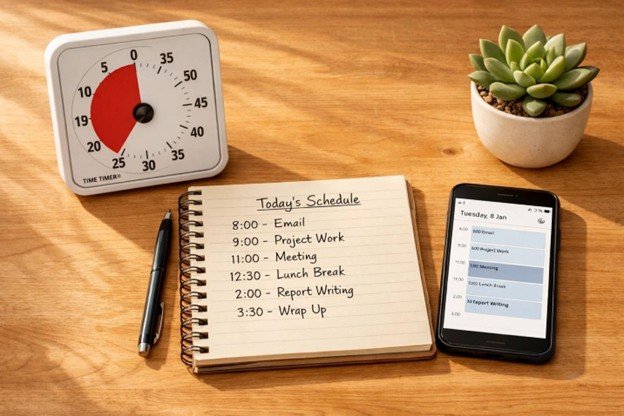
  • Visual timers: Get a Time Timer or use a phone app that shows time as a shrinking colored disk. Seeing time disappear is way more effective than numbers counting down.
  • Alarms and reminders: Set multiple alarms. One for “meeting in 15 minutes,” another for “meeting in 5 minutes,” and a final “GET UP NOW” alarm.
  • Calendar blocking: Don’t just list tasks. Block out specific time chunks. If something’s not on the calendar, it doesn’t exist.

2. The 1.5x Rule (AKA Stop Lying to Yourself)

However long you think something will take? Multiply by 1.5. Minimum.

If you think a task is 30 minutes, block out 45. If you estimate an hour, give yourself 90 minutes. This isn’t padding: this is reality. ADHD brains almost always underestimate.

Start tracking your actual time spent on tasks for a week. You’ll be shocked. Use that data to recalibrate your estimates.

3. Break Big Tasks into Tiny, Time-Stamped Pieces

“Finish presentation” is too vague and too big. Your brain can’t estimate it. Instead:

  • Outline slides: 20 minutes
  • Draft content for slides 1-5: 30 minutes
  • Find images: 15 minutes
  • Format and design: 45 minutes
  • Review and edit: 20 minutes

Suddenly you’ve got a 2-hour, 10-minute project broken into manageable chunks. Each piece is easier to estimate and track.

4. Body Doubling and Accountability

Time management for ADHD adults improves dramatically with external accountability.

  • Work alongside a colleague (even virtually)
  • Join a coworking session online
  • Check in with a manager or accountability buddy at set times
  • Use an ADHD coach to help you build and maintain these systems (more on that in a sec)

5. Build in Transition Time

You’re not a robot. You can’t finish one meeting at 10:00 and start another at 10:00. Your brain needs transition time.

Block 10-15 minutes between tasks and meetings. Use it to pee, grab water, decompress, and mentally shift gears. This alone will reduce ADHD lateness and that constant feeling of being behind.

6. Use the “Leave Now” Alarm

You need to leave at 8:30 to arrive on time? Set an alarm for 8:30 labeled “LEAVE NOW.” Not “get ready to leave.” Not “start thinking about leaving.” LEAVE.

No checking one more email. No feeding the cat. No “I’ll just grab my keys.” When the alarm goes off, you’re walking out the door.

7. Automate and Simplify Everything You Can

Every decision and task drains your executive function. Reduce the load:

  • Lay out work clothes the night before
  • Prep your bag and lunch in advance
  • Use templates for recurring tasks
  • Automate reminders, bill payments, and calendar invites

The fewer micro-decisions you make in the morning, the better your time management will be all day.

8. Hyperfocus Containment Strategy

Set a timer when you start a task you might get sucked into. Every 25-30 minutes, check: Am I still on track? Do I need to shift gears?

Also, schedule hyperfocus-prone tasks for times when you have a hard stop. Got a meeting at 2:00? Start the deep work at 1:00. The meeting acts as a natural boundary.

9. Communicate Proactively (Without Shame)

You don’t have to disclose ADHD if you don’t want to, but you can communicate about your working style:

  • “I work best with clear deadlines and check-ins”
  • “I appreciate calendar invites with specific time blocks”
  • “I’m recalibrating my time estimates: can we set a realistic timeline together?”

Most managers would rather know upfront than deal with missed deadlines later.

10. Weekly Time Audit

Every Friday, review:

  • What took longer than expected?
  • Where did I lose track of time?
  • What strategies worked this week?

This isn’t about beating yourself up. It’s about collecting data to improve your systems. ADHD time management is an evolving practice, not a one-and-done fix.

You’re Not Failing: You’re Just Using the Wrong Map

Here’s what I want you to take away from this: ADHD time blindness is real, it’s neurological, and it’s not a moral failing.

You’re not lazy. You’re not irresponsible. You’re not “bad at adulting.” Your brain processes time differently, and the strategies that work for everyone else aren’t designed for you.

The solution isn’t to “try harder” or “be more disciplined.” It’s to build external systems that compensate for what your brain doesn’t do automatically. It’s to stop expecting yourself to function like a neurotypical person and start working with your ADHD brain instead of against it.

And look: this stuff is hard to figure out alone. That’s where professional support comes in.

Work With Your Brain, Not Against It

At Heal and Thrive Therapy and Coaching, we specialize in helping adults with ADHD build systems that actually stick. Whether you’re struggling with time blindness, decision paralysis, or executive function challenges at work, our ADHD coaching services are designed for real-world professional environments.

We get it. You’re smart, capable, and accomplished: but your brain needs different tools. Let’s build them together.

Time blindness doesn’t have to cost you your job, your relationships, or your sanity. With the right strategies and support, you can show up on time, meet your deadlines, and stop underestimating everything.

You’ve got this. And we’ve got you. 💙

ADHD and Money: How Impulsive Spending Happens (and How to Build a Safer System)

Let me tell you about the time I bought a $200 succulent collection at 11 PM on a Tuesday because my brain decided that right now was the only time that mattered.

I wasn’t trying to be irresponsible. I wasn’t “bad with money.” My ADHD brain was just doing what ADHD brains do, chasing the dopamine wherever it could find it. And friend, at midnight, scrolling through tiny plants felt like the best decision in the world.

If you’re reading this, I’m guessing you’ve been there too. Maybe it’s online shopping at 2 AM. Maybe it’s the Target run that was supposed to be “just milk” but turned into $150 worth of organizational bins you’ll never use. Maybe it’s the subscription services you forgot you signed up for, quietly draining your account every month.

ADHD impulsive spending isn’t about being careless or lazy. It’s about how your brain is wired, and why traditional budgeting advice usually makes things worse, not better.

Let’s talk about what’s really happening in your brain, why you’re not broken, and how to build a system that actually works with your ADHD instead of against it.

Your Brain on Dopamine (and Why Shopping Feels So Good)

Here’s the thing most financial advice gets wrong: ADHD impulsive spending isn’t a character flaw. It’s neurological.

Adults with ADHD are about four times more likely to make frequent impulse purchases than people without ADHD. That’s not because we lack discipline. It’s because our brains process rewards differently.

The ADHD brain has altered dopamine pathways. Dopamine is that feel-good chemical that helps with motivation, pleasure, and reward. Your brain doesn’t produce or use dopamine the same way a neurotypical brain does. So you’re constantly, unconsciously seeking activities that give you that dopamine hit.

And guess what gives you an instant dopamine rush? Buying stuff.

Dopamine spending is real. When you click “buy now,” your brain lights up. It feels good. It feels urgent. It feels necessary. That’s not weakness, that’s your brain trying to regulate itself the only way it knows how in that moment.

The problem is that the dopamine hit fades fast. Then you’re left with buyer’s remorse, a lighter bank account, and packages you don’t remember ordering showing up at your door.

Why Your Executive Function Isn’t Helping

Here’s where it gets extra tricky. ADHD doesn’t just affect dopamine. It also messes with your executive functions, the mental skills you need for planning, organizing, remembering things, and controlling impulses.

This creates a perfect storm for impulsive spending:

Time blindness means you can’t really feel the future consequences of buying something right now. Your ADHD brain genuinely can’t connect “I buy this today” with “I won’t have rent money in two weeks.” The future feels abstract and far away. Right now feels urgent and real.

Working memory issues mean you might forget you already bought something similar. Or you forget to cancel that free trial before it turns into a $40 monthly charge.

Decision fatigue means that after a long day of forcing your brain to focus, making decisions, and regulating yourself, you have zero capacity left to say no to that late-night shopping impulse.

Emotional dysregulation means when you’re stressed, anxious, sad, or bored, your brain reaches for quick relief. And shopping? Shopping feels like relief.

None of this is your fault. But it does explain why the standard “just make a budget and stick to it” advice feels impossible.

The Real Cost (It’s Not Just Money)

Let’s be real about what ADHD impulsive spending actually costs you.

Research shows that adults with ADHD carry over $3,000 more in credit card debt compared to people without ADHD. Up to 21% of adults with ADHD develop compulsive buying behaviors. But the financial hit isn’t even the worst part.

The emotional cost is brutal:

  • Guilt and shame every time you look at your bank account
  • Anxiety about bills, debt, and whether you can afford basic needs
  • Clutter from impulse purchases you didn’t need and won’t use
  • Relationship stress if a partner is frustrated by the spending
  • Self-worth issues because you feel like you “should” be able to control this

You start avoiding looking at your finances altogether. You feel like you’re failing at being an adult. You wonder why everyone else seems to have this figured out.

Here’s what I need you to hear: You’re not failing. The system you’re trying to use was designed for brains that work differently than yours.

Why Traditional Budgeting Fails ADHD Brains

Most budgeting advice assumes you have consistent executive function, stable impulse control, and the ability to track tiny details over time.

If you have ADHD, you probably don’t have any of those things reliably.

Traditional budgeting requires:

  • Tracking every purchase (executive function + working memory)
  • Planning ahead (time perception + future thinking)
  • Saying no to immediate wants (impulse control + delayed gratification)
  • Remembering to check your budget (working memory + consistency)
  • Feeling motivated by long-term goals (dopamine regulation)

No wonder it doesn’t work.

You try tracking expenses in an app for three days, then forget it exists. You make a detailed budget, then break it within 48 hours and feel like a failure. You promise yourself you’ll stop spending, then order something on Amazon at 1 AM because your brain was bored and needed stimulation.

The problem isn’t you. The problem is that the advice doesn’t match your neurology.

Building Your ADHD-Friendly Money System

Okay, here’s the good news: You can reduce impulsive spending without relying on willpower or shame. You just need to build systems that work with your ADHD brain instead of against it.

The key is creating what I call “speed bumps”, small barriers that give your ADHD brain a chance to pause between impulse and action.

Speed Bump #1: Kill the One-Click Everything

The easier it is to spend money, the more you’ll spend. So make it harder.

Remove saved payment info from your favorite shopping sites. Delete your credit card numbers from Amazon, Target, and anywhere else you impulse shop. Yes, it’s annoying to re-enter them. That’s the point.

Turn off one-click purchasing. Every extra click is a chance for your brain to catch up with your impulse.

Delete shopping apps from your phone. If you have to open a browser and type in the website, that’s a speed bump. It creates just enough friction to interrupt the impulsive autopilot.

Unsubscribe from marketing emails. You can’t be tempted by a sale if you don’t know it’s happening. Be ruthless. If a brand is triggering your dopamine spending, cut the connection.

Speed Bump #2: The 24-Hour Rule (Modified for ADHD)

Traditional advice says “wait 24 hours before buying anything.” But with ADHD time blindness, 24 hours feels like forever, and you’ll either forget completely or the urgency will feel even more intense.

Instead, try this: Put it in your cart and walk away for just 2 hours.

Set a timer. Do something else. Often, the dopamine urgency will fade, and you’ll realize you don’t actually want or need the item. If you still want it after 2 hours, at least it was a more conscious choice.

For bigger purchases, use your phone’s reminder system. Take a screenshot of what you want to buy and set a reminder for tomorrow. Your future self gets to make the decision instead of your impulse brain.

Speed Bump #3: The Cash Envelope System (Digital Version)

Here’s a system that actually works with ADHD brains: separate bank accounts for different purposes.

Most banks let you open multiple accounts for free. Create these categories:

  • Bills & Necessities (rent, utilities, groceries: untouchable)
  • Safe Spending Money (your “fun money” that you can blow without guilt)
  • Savings (out of sight, harder to access)

When your paycheck hits, automatically split it between these accounts. The key is that your Safe Spending Money account is truly guilt-free. You can dopamine-spend from this account without financial consequences because it’s already budgeted for.

This removes the shame and gives your ADHD brain a safe outlet.

Speed Bump #4: Automate Everything You Can

ADHD budgeting help often comes down to one word: automation.

You’re not going to remember to transfer money to savings. You’re not going to consistently pay bills on time if you have to manually do it. Remove the need for executive function wherever possible.

Set up automatic bill pay for everything that’s the same amount each month. One less thing to remember.

Automate savings transfers. If $50 automatically moves to savings the day after payday, you never see it, so you don’t miss it.

Use subscription auditing tools. Apps like Truebill or Rocket Money will find subscriptions you forgot about and help you cancel them. Let technology do the executive functioning for you.

Speed Bump #5: Address the Emotional Trigger

This is the part most financial advice skips entirely, but it’s crucial for ADHD brains.

Impulsive spending is often emotional regulation in disguise. You’re not shopping because you need things. You’re shopping because you’re anxious, bored, stressed, understimulated, or overwhelmed.

Start noticing when you’re most likely to spend impulsively. Is it late at night when you’re tired? After stressful work days? When you’re feeling lonely or bored?

Once you identify the pattern, you can create alternative dopamine sources that don’t cost money:

  • Boredom? Keep a list of free dopamine hits on your phone (favorite YouTube channels, video games you already own, calling a friend, going for a walk with music)
  • Stress? Movement, breathing exercises, or even just stepping outside for five minutes
  • Understimulation? Creative activities, puzzles, or reorganizing something you already own
  • Loneliness? Text someone, join an online community, listen to a podcast that feels like conversation

The goal isn’t to never spend money for pleasure. The goal is to have options that aren’t just shopping.

When to Get Professional Support

Sometimes ADHD impulsive spending crosses into compulsive territory, where it’s not just occasional impulse buys: it’s a cycle that feels impossible to break.

If you’re experiencing:

  • Spending despite serious financial consequences
  • Lying to others about your spending
  • Shopping to cope with intense emotions and nothing else helps
  • Feeling out of control with money despite multiple attempts to change

It might be time for additional support. ADHD coaching can help you build personalized systems that work with your specific brain and triggers. At Heal and Thrive Therapy and Coaching, we work with adults navigating the real-world impacts of ADHD, including financial challenges.

ADHD coaching gives you accountability, structure, and strategies tailored to how your brain actually works: not how it “should” work.

You’re Not Broken: Your System Is

Here’s what I want you to take away from this: ADHD impulsive spending isn’t a moral failing. It’s a neurological reality that requires a different approach.

You don’t need more willpower. You need better systems.

You don’t need to “just be more responsible.” You need speed bumps that work with your dopamine-seeking, time-blind, executive-function-challenged brain.

You don’t need shame. You need compassion and practical tools.

Start with one speed bump. Just one. Maybe it’s deleting the Amazon app today. Maybe it’s setting up that separate “fun money” account. Maybe it’s starting to notice what emotional state triggers your spending.

Small changes in your system create space for your brain to make different choices.

And if you’re tired of fighting this alone? We’re here. Heal and Thrive Therapy and Coaching specializes in helping adults with ADHD build sustainable systems that actually work. Reach out: you don’t have to figure this out by yourself.

Your ADHD brain isn’t broken. It just needs the right infrastructure.

And that succulent collection I bought at 11 PM? Half of them died because I forgot to water them. But I learned something important from that expensive mistake: My brain needs guardrails, not guilt.

Build your guardrails. Be kind to yourself. And remember that progress isn’t perfection: it’s just making it a little bit harder for 11 PM You to make decisions that 8 AM You will regret.

You’ve got this. 🌱💰

ADHD and Decision Paralysis: Why Small Choices Drain You (and How to Reduce the Load)

You know that feeling when you open your closet in the morning and suddenly every single item of clothing looks wrong? Or when you’re standing in front of the fridge at 2 PM, staring at perfectly good food options, and your brain just… stops working?

Yeah. Me too.

Here’s the thing nobody tells you about ADHD decision paralysis: it’s not about the big decisions. Most of us can eventually work through whether to take that new job or move across the country. It’s the small stuff, what to eat, what to wear, which task to start first, that absolutely wrecks us.

And I’m not being dramatic. Research shows that 58% of people with ADHD experience decision paralysis at least weekly, with 35% dealing with it daily. That’s more than a third of us frozen by choices every single day.

So let’s talk about why your brain treats “what’s for dinner?” like a philosophy dissertation, and more importantly, how to actually fix it.

Why Your Brain Turns Every Small Choice Into a Production

When I work with clients at Heal and Thrive Therapy and Coaching, this is usually one of the first things that comes up: “Why does deciding what to have for lunch feel harder than writing a work presentation?”

The answer is actually pretty straightforward (even if it feels anything but): ADHD decision paralysis isn’t about being indecisive or lazy. It’s about your brain’s executive function system being overloaded by what neurotypical folks consider “no big deal” choices.

Working Memory Is Already Maxed Out

Think of working memory like RAM in a computer. Neurotypical brains have, let’s say, 16GB to work with. Your ADHD brain? Maybe 4GB on a good day. And half of that is already running background programs like “remember to text mom back” and “did I lock the door?” and “what was that song from the grocery store?”

So when you’re faced with a decision, even a tiny one, your brain needs to:

  • Hold all the options in mind at once
  • Remember the pros and cons of each
  • Predict future outcomes
  • Weigh them against your current mood, energy, and priorities
  • Actually pick one

For someone with ADHD, this process eats up cognitive resources like Chrome tabs on an old laptop. Every. Single. Time.

Decision Fatigue Hits You Earlier and Harder

Here’s where it gets worse: because people with ADHD already burn through more cognitive energy on everything, from regulating emotions to starting tasks to filtering out distractions, we hit decision fatigue ADHD style way faster than neurotypical folks.

By 10 AM, you might have already made dozens of micro-decisions that a neurotypical person barely noticed:

  • Which alarm to use (or snooze)
  • What order to do your morning routine
  • Which coffee mug to grab
  • What route to take to work
  • Where to park
  • Which task to tackle first

Each one chips away at your decision-making capacity. So by lunch, that “simple” choice between a salad or sandwich feels like solving a calculus problem underwater.

The Micro-Decision Trap: A Day in the Life

Let me paint you a picture. You wake up and immediately face:

Morning micro-decisions:

  • Shower now or after coffee?
  • Which clothes match (and are clean)?
  • Breakfast or skip it?
  • Take meds now or with food?
  • Leave at 8:15 or 8:20?

Work micro-decisions:

  • Which email to answer first?
  • Coffee or water?
  • Work on Project A or Project B?
  • Take a break now or power through?
  • Respond to that Slack message now or later?

Afternoon overwhelm choices:

  • What’s for lunch?
  • Eat at desk or go out?
  • When to schedule that meeting?
  • Which tab to close first (out of 47)?
  • Take a walk or push through fatigue?

Evening exhaustion:

  • What’s for dinner?
  • Cook or order in?
  • Gym or rest day?
  • Reply to texts or zone out?
  • Netflix or read?
  • Bedtime routine now or scroll for “just five more minutes”?

Each decision feels small. Inconsequential. But they add up to hundreds of tiny cognitive loads that drain your battery before you even get to the stuff you actually care about.

And this is where ADHD communication patterns come into play too, because when you’re decision-exhausted, you’re more likely to snap at your partner when they ask “what do you want for dinner?” for the third time. (It’s not them. It’s the 247th decision of the day.)

The Paradox of Choice (And Why It’s Worse for ADHD Brains)

There’s this famous study where researchers set up a jam tasting booth. When they offered 24 flavors, people stopped to look but rarely bought anything. When they offered just 6 flavors, sales went up tenfold.

Too many choices paralyze everyone. But for ADHD brains? It’s exponentially worse.

Why? Because our brains struggle with:

  • Filtering irrelevant information: Every option feels equally important
  • Predicting satisfaction: “What if I pick wrong and regret it?”
  • Managing emotional responses: The anxiety of choosing “wrong” can be genuinely distressing
  • Prioritizing effectively: Without clear criteria, how do you even begin?

This is why you can spend 20 minutes scrolling through Netflix, never actually picking something to watch, and then giving up entirely. It’s not that nothing looks good. It’s that everything looks equally good (or bad), and your brain can’t compute a winner.

Choice Architecture: The Game-Changer You Haven’t Tried Yet

Okay, here’s where we flip the script. Instead of trying to get better at making decisions (spoiler: willpower alone won’t fix this), we’re going to redesign your environment to reduce the number of decisions you need to make in the first place.

This is called choice architecture, and it’s genuinely life-changing for ADHD decision paralysis.

Strategy #1: The “Rule of Three” Maximum

Your brain can realistically hold and compare about three options at once without overloading. That’s it. Not ten Netflix shows. Not eight dinner ideas. Three.

How to implement this:

  • Meal planning? Pick three rotating dinners for the week, not seven
  • Morning routine? Lay out three outfit options the night before
  • Work tasks? Choose your top three priorities before you open your laptop
  • Restaurant decisions? Everyone picks their top choice, then vote between three

This isn’t about limiting your life. It’s about reducing cognitive load so you can actually enjoy your choices instead of agonizing over them.

Strategy #2: Default Decisions (Your New Best Friend)

A default decision is a pre-made choice that happens automatically unless you consciously decide otherwise. This is how you reclaim energy for decisions that actually matter.

Examples that work:

  • Monday is always pasta night
  • Coffee order is always the same (no more staring at the menu)
  • Workout days are Tuesday/Thursday/Saturday (non-negotiable)
  • Morning routine follows the exact same order daily
  • Work inbox gets checked at 9 AM, 1 PM, and 4 PM only

I know, I know. “But what if I don’t feel like pasta on Monday?” Then you change it. But having the default means your brain doesn’t waste energy deciding. You only use energy when you actively want something different.

Strategy #3: Remove Decisions Entirely (The Nuclear Option)

Some successful people with ADHD have taken this to the extreme. Steve Jobs wore the same outfit daily. Mark Zuckerberg does too. Obama famously only wore blue or gray suits to eliminate that morning decision.

You don’t have to go full uniform, but you can strategically eliminate decisions in your life:

  • Capsule wardrobe: Every piece matches, so you can’t pick “wrong”
  • Meal subscriptions: Someone else decides dinner
  • Automated bills: No decision needed monthly
  • Standing plans: Friday night is always game night with friends

The goal isn’t to make your life boring. It’s to save your decision-making energy for the stuff that brings you joy and meaning.

Strategy #4: Decision Time Limits

Give yourself a timer. Seriously. When you’re stuck choosing between options, set a timer for 2-3 minutes and pick when it goes off.

Why this works: ADHD decision paralysis often comes from trying to make the “perfect” choice. But perfectionism is the enemy of progress. Most small decisions don’t actually matter that much: you just need to pick something so you can move forward.

Use this for:

  • What to order at a restaurant
  • Which task to start with
  • What to watch on TV
  • What to wear when you’re already running late

The relief of just deciding is often better than the paralysis of trying to optimize.

When Decision Paralysis Is Really About Something Deeper

Sometimes, what looks like ADHD decision paralysis is actually:

  • Burnout in disguise (your brain is protecting you from overload)
  • Anxiety about making the “wrong” choice
  • Depression sapping your ability to imagine positive outcomes
  • Trauma responses where decisions trigger fear of consequences

If you’ve tried these strategies and you’re still frozen by daily choices: or if the paralysis is affecting your work, relationships, or well-being: it might be time to work with someone who gets it.

At Heal and Thrive Therapy and Coaching, we specialize in helping adults with ADHD build systems that actually work with their brains, not against them. Our ADHD coaching focuses on practical, sustainable strategies tailored to how your brain works: not generic advice that works for neurotypical folks.

The Bottom Line on Small Choices

Here’s what I want you to remember: decision fatigue ADHD style is real, it’s exhausting, and it’s not your fault. Your brain isn’t broken: it’s just working overtime on tasks that other people don’t even register as tasks.

The solution isn’t to “just decide faster” or “stop overthinking.” It’s to redesign your life so you’re making fewer decisions in the first place. Use choice architecture to your advantage. Create defaults. Limit your options. Give yourself permission to not optimize every single choice.

Because here’s the truth: the mental energy you spend deciding what to have for breakfast could be better spent on literally anything else you actually care about.

Your brain has limited bandwidth. Use it wisely. And if you need help figuring out which decisions are draining you most? We’re here for that.

Now if you’ll excuse me, I’m going to eat the same lunch I always eat on Wednesdays: because I made that decision once, and now I never have to make it again. And honestly? That’s freedom.

High-Functioning ADHD: Signs You’re Coping Well on the Outside and Overwhelmed Inside

You know that feeling when someone compliments your productivity and you want to laugh and cry at the same time?

Like, yeah, I crushed that presentation. But also? I haven’t answered a text in four days, my laundry is in three different rooms, and I genuinely can’t remember if I ate lunch today.

Welcome to high-functioning ADHD symptoms, where your LinkedIn looks incredible and your brain feels like a browser with 847 tabs open, half of them frozen, and someone keeps adding new ones while you sleep.

If you’re here, chances are you’re the person everyone thinks has it together. You meet deadlines (mostly). You show up to meetings looking professional (usually). You’re crushing it at work, in relationships, at life… right?

Except internally, you’re drowning.

And the worst part? Nobody sees it. Sometimes even you don’t see it. You just know something feels harder than it should.

Let me tell you: you’re not making it up. And you’re definitely not alone.

What Even Is “High-Functioning” ADHD?

First, let’s get something straight: “high-functioning” isn’t an official diagnosis. It’s more like shorthand for “I have ADHD but I’ve gotten really good at hiding it.”

High-functioning ADHD means you’re managing external responsibilities, job, kids, social life, that thing where you pretend to have your life together, while internally wrestling with all the core ADHD stuff. The distractibility, the emotional rollercoasters, the impulsivity, the mental exhaustion that makes you want to melt into the couch and never move again.

You’ve developed coping mechanisms. Lots of them. Some healthy, some… less so. And they work well enough that most people don’t see the struggle. But here’s the thing: just because they don’t see it doesn’t mean it’s not real.

The gap between how you appear and how you feel? That’s not a character flaw. That’s what happens when your brain works differently and you’ve spent years building elaborate systems to compensate.

The Signs You’re Struggling (Even When You Look Fine)

Your Home Life Is a Disaster Zone

You’re organized at work. Your desk is clean(-ish). You send professional emails. You remember important meetings.

But your apartment? It’s like a tornado hit a container store. There are piles. So many piles. Clean laundry lives on the chair for weeks. You have seventeen half-finished projects scattered around. Your kitchen counter is a archaeology dig of good intentions.

This is classic adult ADHD hidden signs territory. You can hold it together in public because there’s external structure and accountability. But at home, where it’s just you and your executive function issues? The mask comes off.

You’re “On” in Public, Exhausted in Private

People think you’re social. Fun. Engaging. And you are! For about three hours. Then you need to hibernate for two days to recover.

You show up to dinner parties, networking events, family gatherings. You’re charming. You ask questions. You remember to laugh at appropriate times.

But inside? You’re tracking seventeen conversations, managing your body language, remembering not to interrupt, fighting the urge to check your phone, and mentally rehearsing what you’ll say next while someone’s still talking.

Social interactions aren’t just tiring for you, they’re Olympic-level mental gymnastics. And nobody sees the scoreboard.

The Weekend Crash Is Real

Friday hits and you’re done. Not “tired” done. More like “my brain is oatmeal and if anyone asks me one more question I might cry” done.

You spend all weekend recovering. Sleeping in. Lying on the couch. Scrolling your phone with zero retention. Maybe staring at the wall for a bit.

Monday rolls around and you do it all over again.

This isn’t laziness. This is what happens when you burn through your mental resources just trying to appear neurotypical all week. Your brain needs recovery time. Lots of it.

You’re a Last-Minute Legend (And You Hate It)

Deadlines? You meet them. But the process is chaos.

You work best under pressure, which sounds great until you realize it means you can’t start anything until the panic sets in. You tell yourself you’ll start earlier next time. You never do.

The work gets done. Sometimes it’s even good. But the internal experience is pure stress, self-loathing, and the crushing sensation that you’re about to mess everything up even though you probably won’t.

Your Emotions Are LOUD

Something small happens, a slightly critical email, a friend canceling plans, someone giving you That Look, and your emotional response is immediate and intense.

You feel things at volume eleven. Frustration hits like a wave. Disappointment feels crushing. Excitement is overwhelming. And you’re constantly trying to modulate yourself so people don’t see how much you’re feeling all the time.

This is emotional dysregulation, one of the most exhausting high-functioning ADHD symptoms. You’re not overreacting. Your brain just processes emotions differently, with less of a built-in buffer between feeling and response.

Mental Restlessness Looks Like “Creativity”

Your mind never stops. People call it creativity, passion, being “idea-driven.” And sure, maybe it is those things. But it’s also relentless.

Even when you’re resting, your brain is generating ideas, making connections, planning, worrying, remembering that weird thing you said in 2019, and adding seventeen items to your mental to-do list.

You can’t turn it off. Sleep is hard. True relaxation feels impossible. And the worst part? People think this is a superpower when sometimes you’d kill for five minutes of mental silence.

The Hidden Cost of Looking “Fine”

Here’s what nobody tells you about high-functioning ADHD: the coping mechanisms that help you succeed are the same ones slowly burning you out.

You’re using meticulous planning to compensate for working memory issues. You’re overworking to make up for time lost to distraction. You’re people-pleasing to manage rejection sensitivity. You’re saying yes to everything because you’re terrified of disappointing anyone.

And it works. Until it doesn’t.

Because all of these strategies require massive amounts of mental energy. Energy you’re spending just to do what other people’s brains do automatically.

Think about it: most people don’t need seventeen alarms, four calendar apps, and a complex system of Post-it notes just to remember to pay their electric bill. But you do. And that’s exhausting.

The internal experience of high-functioning ADHD is like running a marathon while everyone else is taking a leisurely walk. You might finish the race, but you’re going to be a lot more tired.

The Self-Blame Trap

The really insidious part? You probably blame yourself for all of it.

You think: “If I just tried harder…” “If I was more disciplined…” “If I wasn’t so lazy…”

But here’s the truth: this isn’t a willpower issue. It’s a brain wiring issue.

Your prefrontal cortex, the part responsible for executive function, emotional regulation, and impulse control, works differently. It’s not broken. It’s not lazy. It’s just running a different operating system.

And you’ve been trying to force that operating system to work like everyone else’s instead of learning how to work with it.

Why This Pattern Shows Up (Especially in High Achievers)

High-functioning ADHD is particularly common in smart, capable people. Why? Because you figured out early that if you just worked harder, planned better, or tried more, you could compensate for whatever felt “off.”

You got good grades (even if you studied the night before). You built a career (even if every project feels like controlled chaos). You maintain relationships (even if it takes everything you’ve got).

And because you succeeded, nobody looked closer. Including you.

This pattern is especially common in women and people socialized as female, where ADHD often goes undiagnosed because the symptoms are more internalized. You’re not hyperactive in the stereotypical way, you’re mentally restless. You’re not obviously struggling, you’re quietly drowning.

Add in professional success, financial stability, or any kind of achievement, and the disconnect gets even wider. How can you have ADHD when you’re doing so well?

Easy: you’re spending enormous amounts of energy making it look easy.

What You Can Do About It

If you’re reading this and thinking “oh god, this is me,” first: breathe. Seriously. You’re already doing the hardest part, which is recognizing the pattern.

Here’s what I’ve seen work, both for myself and for the incredible clients I work with at Heal and thrive psychotherapy and coaching:

Stop Trying to Fix Yourself

You’re not broken. Full stop.

The goal isn’t to become neurotypical. It’s to build systems that work with your brain instead of against it. That might mean different strategies than what works for other people. That’s okay. Actually, that’s the point.

Get an Actual Assessment

Self-awareness is great. But working with someone who specializes in adult ADHD can be game-changing.

A proper assessment can confirm what’s going on, rule out other stuff (hello, anxiety and depression that often tag along), and give you a roadmap forward. Plus, there’s something incredibly validating about hearing a professional say “yes, your brain works differently, and here’s why.”

Build Sustainable Systems

Those elaborate coping mechanisms you’ve developed? Some of them are brilliant. Others are burning you out.

Working with an ADHD coach can help you figure out which is which. We can help you build systems that actually support your brain instead of fighting it. Systems that don’t require you to be perfect or superhuman to maintain.

Because here’s the thing: you shouldn’t have to white-knuckle your way through life.

Address the Burnout

If you’re in ADHD burnout signs territory: constant exhaustion, emotional numbness, inability to do even simple tasks: you need more than productivity hacks. You need actual support.

Psychotherapy can help you untangle the years of self-blame, develop better emotional regulation skills, and rebuild your relationship with yourself. Because often, the biggest barrier isn’t ADHD itself: it’s the story you’ve been telling yourself about what it means.

Let People See the Real You

This one’s hard. But hiding the struggle doesn’t make it go away. It just makes you feel more alone.

You don’t have to broadcast your internal experience to everyone. But finding even one or two people who get it: whether that’s a therapist, a coach, a support group, or just a friend who also has ADHD: can make a massive difference.

You’re Not Imagining It

Look, I get it. When you’ve spent years holding it together, when people keep telling you how capable you are, when your achievements suggest everything’s fine: it’s easy to think you’re making it up.

You’re not.

The exhaustion is real. The overwhelm is real. The gap between how you look and how you feel is real.

And the fact that you’ve managed to build a successful life while dealing with all of this? That’s not proof that you’re fine. That’s proof that you’re incredibly strong and resourceful.

But here’s the thing: you don’t have to keep white-knuckling it. There are better ways to work with your ADHD brain that don’t require you to constantly perform “normal.”

Ready to Stop Holding It All Together Alone?

If you’re tired of looking fine while feeling like you’re falling apart, we get it. At Heal and thrive psychotherapy and coaching, we specialize in working with high-achieving adults who are navigating ADHD, burnout, and the exhausting gap between external success and internal struggle.

Whether you’re looking for ADHD coaching to build sustainable systems or therapy to process the years of masking and self-blame, we’re here to help you figure out what actually works for your brain.

You don’t have to do this alone anymore. Let’s talk.

Because you deserve more than just “getting by.” You deserve to actually thrive (not just look like you are.)

ADHD Conflict Patterns: The 5 Most Common Loops Couples Get Stuck In

You know that fight you had last Tuesday? The one that felt weirdly familiar, like you’d already lived through it fifty times before?

Yeah. That’s because you probably have.

Here’s what I see in my office every single week: couples who love each other deeply, sitting on opposite ends of my couch, exhausted from having the same argument on repeat. They can’t figure out why they keep ending up here. They blame themselves. They blame each other. And they’re both convinced they’re doing everything wrong.

But here’s the truth nobody tells you about ADHD relationship conflict: you’re not broken. You’re just stuck in a loop.

As an ADHD coach who’s worked with hundreds of couples navigating these patterns, I can promise you this, recognizing the loop is the first step to breaking it. And that’s exactly what we’re going to do today.

Why ADHD Relationships Get Stuck in Conflict Loops

Before we dive into the specific patterns, let’s talk about why ADHD creates these recurring cycles in the first place.

The ADHD brain operates differently when it comes to emotional regulation, working memory, and executive function. That’s not a character flaw, it’s neurobiology. But when two people are trying to communicate, make decisions, and share responsibilities, those neurological differences can create predictable friction points.

Think of it like this: if one partner’s brain is running on iOS and the other is running on Android, you’re both trying to communicate in different operating systems. Neither system is “wrong,” but without the right adapters and translations, messages get lost, misunderstood, or completely scrambled.

The good news? Once you identify which loop you’re stuck in, you can actually do something about it. These ADHD communication patterns aren’t life sentences, they’re just habits that need interrupting.

Let me show you the five most common loops I see, and more importantly, how to start repairing them.

Loop #1: The Parent-Child Dynamic

What it looks like:

One partner becomes the “manager” of the household, tracking appointments, remembering birthdays, organizing schedules, following up on tasks. The other partner (usually the one with ADHD) struggles with follow-through, forgets commitments, and needs frequent reminders.

Before long, one person sounds like a nagging parent, and the other feels like a scolded child. Neither role feels good. Nobody signed up for this dynamic when they fell in love.

I had a client tell me last month: “I don’t want to be his mom. I wanted a partner. But if I don’t remind him, nothing gets done.”

Her husband shot back: “And I don’t want to feel like I’m constantly disappointing you. I’m trying my best here.”

They were both right. And they were both stuck.

Why it happens:

Executive function challenges make it genuinely harder for the ADHD brain to hold onto information, initiate tasks, and follow through without external structure. The non-ADHD partner steps in to fill the gap, not because they want control, but because someone has to remember that the car registration is due.

Over time, this creates resentment on both sides. One person feels burdened by all the responsibility. The other feels infantilized and criticized.

The repair steps:

  1. Name the pattern out loud. Say it plainly: “I think we’re stuck in a parent-child loop, and I don’t want that for us.”
  2. Separate ADHD from character. The ADHD partner isn’t “lazy” or “irresponsible”, they’re working with a brain that needs different support systems.
  3. Build external structure together. Use shared calendars, automatic reminders, visual systems, and accountability check-ins that aren’t nagging. Technology can be your third partner here.
  4. Redistribute responsibility consciously. The ADHD partner might need to own fewer tasks but commit fully to the ones they take on. Quality over quantity.
  5. Celebrate follow-through. When things do get done, acknowledge it. Positive reinforcement works for all human brains, not just ADHD ones.

Loop #2: The Chore Wars

What it looks like:

The dishes pile up. The laundry doesn’t get folded. The bills sit unopened. One partner does three tasks while the other is still getting started on one. Arguments erupt about “who does more” and “why can’t you just…”

It’s not really about the dishes. It’s never about the dishes.

Why it happens:

ADHD brains struggle with tasks that don’t provide immediate rewards or dopamine. Boring, repetitive chores (especially ones without clear endpoints) feel like walking through psychological quicksand.

Meanwhile, the non-ADHD partner sees the same tasks and just… does them. They don’t understand why their partner needs an hour of mental preparation to unload the dishwasher.

This creates a genuine imbalance in task distribution, which feeds resentment, which triggers the parent-child dynamic, which makes everything worse.

The repair steps:

  1. Get honest about capacity. The ADHD partner isn’t “choosing” to do less, their brain genuinely processes task initiation differently. Acknowledge this without using it as a permanent excuse.
  2. Play to strengths. Maybe the ADHD partner is terrible at sustained cleaning but great at high-energy cooking or emergency problem-solving. Redistribute chores based on brain compatibility, not fairness.
  3. Use body doubling. Do tasks together whenever possible. The ADHD brain works better with company and shared momentum.
  4. Set timers and make it a game. Ten-minute sprints, music, competition, anything that adds stimulation to a boring task helps the ADHD brain engage.
  5. Consider outsourcing. If you can afford it, hiring help for the most friction-inducing tasks might save your relationship. A house cleaner is cheaper than a divorce attorney.

Loop #3: The Rapid Escalation Cycle

What it looks like:

A simple question (“Hey, why were you late?”) turns into a full-blown explosion in under sixty seconds. The ADHD partner feels attacked and reacts defensively. The argument spirals fast and hard. Someone says something they don’t mean. Someone else storms out or shuts down completely.

Later, after the dust settles, both people feel terrible. The ADHD partner feels ashamed. The non-ADHD partner feels exhausted. And the original issue? Never got resolved.

Why it happens:

Emotional dysregulation is a core feature of ADHD. The brain struggles to modulate emotional responses, especially under stress. What feels like a “small” question to one partner lands like a personal attack to the other.

Add in rejection sensitivity dysphoria (RSD), that instant, overwhelming fear of being criticized or rejected, and you’ve got a neurological hair trigger for ADHD arguments that blow up fast.

The repair steps:

  1. Recognize the escalation pattern before it peaks. Learn your warning signs, heart racing, voice getting louder, thoughts spiraling. Name it: “I’m escalating.”
  2. Call a timeout before the explosion. Not as punishment, but as protection. “I need 15 minutes to regulate. I’m coming back.”
  3. Practice grounding techniques. The ADHD partner needs tools for nervous system regulation, deep breathing, cold water on the face, movement, anything that interrupts the emotional storm.
  4. Return to the conversation with repair. “I’m sorry I blew up. That wasn’t fair. Can we start again?” This isn’t about being perfect, it’s about being accountable.
  5. Get professional support. If escalation is a regular pattern, couples therapy at Heal and thrive psychotherapy and coaching can help you build safer ways to navigate conflict together. You don’t have to white-knuckle this alone.

Loop #4: The Communication Breakdown

What it looks like:

Conversations feel impossible. The ADHD partner interrupts constantly, talks over their partner, or completely zones out mid-sentence. They dominate conversations with too many details or ask the same questions repeatedly.

The non-ADHD partner feels unheard, dismissed, and frustrated. They shut down or stop trying to communicate altogether.

Why it happens:

ADHD impacts working memory, impulse control, and focus, all essential ingredients for smooth conversation. The ADHD brain has a thought and must share it immediately before it vanishes. Listening feels nearly impossible when your internal monologue is screaming at full volume.

It’s not intentional rudeness. It’s a brain that struggles to hold space for two things at once.

The repair steps:

  1. Use communication scaffolding. Try “talking stick” rules where only one person speaks at a time. It sounds silly, but it works.
  2. Write things down. Important conversations should happen with notes or text backup so the ADHD brain doesn’t have to hold everything in working memory.
  3. Set conversation appointments. Spontaneous heavy talks catch the ADHD brain off-guard. Schedule important discussions so both partners can mentally prepare.
  4. Practice active listening scripts. “What I’m hearing you say is…” forces the ADHD partner to pause and reflect back, creating space for actual dialogue.
  5. Give grace for interruptions. The ADHD partner can work on awareness, but perfection isn’t realistic. Agree on a gentle signal (“Hey, I’m still talking”) that doesn’t feel like criticism.

Loop #5: The Pursuit-Retreat Pattern

What it looks like:

One partner (usually non-ADHD) pushes for connection, resolution, or engagement. The other partner (often ADHD) withdraws, shuts down, or disappears emotionally.

The more one pursues, the more the other retreats. It creates a lonely, disconnected dynamic where both people feel abandoned, one because their partner won’t engage, the other because they feel overwhelmed and smothered.

Why it happens:

The ADHD brain can become easily overwhelmed by emotional intensity. When conflict feels too big or shame kicks in, the instinct is to escape, physically or emotionally.

Meanwhile, the pursuing partner is trying to prevent disconnection by seeking resolution. But their pursuit feels like more pressure, which triggers more withdrawal, and the cycle continues.

The repair steps:

  1. Name the dance. “I think I’m pursuing and you’re retreating. We’re both getting hurt here.”
  2. The pursuer needs to soften their approach. Instead of “We need to talk RIGHT NOW,” try “I’m feeling disconnected. Can we find 20 minutes tonight to check in?”
  3. The retreater needs to communicate their limits. “I’m overwhelmed and need space, but I promise I’m coming back in an hour” gives the pursuer reassurance without forcing immediate engagement.
  4. Schedule reconnection. Don’t leave the withdrawal open-ended. Set a specific time to circle back so neither person is left hanging.
  5. Work on secure attachment together. This pattern often reveals deeper attachment wounds that need professional support to heal. ADHD coaching can help both partners understand their patterns and build healthier ways to connect.

Breaking the Loops: What Actually Works

Here’s what I tell every couple in my office who’s stuck in these ADHD relationship conflict patterns:

You’re not failing at love. You’re just missing the instruction manual for your specific brain wiring.

Breaking these loops isn’t about trying harder or loving better. It’s about understanding how ADHD shows up in relationships and building intentional strategies that work with your brains instead of against them.

That means:

  • Naming patterns without blame. “We’re stuck in Loop #3” is way less inflammatory than “You always blow up at me.”
  • Building external systems. Your brains need support structures, calendars, reminders, check-ins, therapy, coaching. Use them.
  • Practicing repair over perfection. You will fall back into old patterns. The goal isn’t to never mess up, it’s to notice faster and repair quicker.
  • Getting professional help early. Don’t wait until you’re both completely burnt out. Couples therapy at Heal and thrive psychotherapy and coaching gives you tools and strategies before resentment becomes the default setting in your relationship.

When to Get Professional Support

Look, I’m biased, I think every couple could benefit from therapy. But there are some red flags that mean you need help now, not later:

  • You’re having the same argument every week with no resolution
  • One or both partners feel emotionally unsafe during conflicts
  • You can’t remember the last time you felt connected
  • Resentment has replaced affection as your baseline
  • You’re starting to question whether the relationship can survive

If any of those feel familiar, please reach out. ADHD relationship conflict doesn’t have to be your forever reality.

At Heal and thrive psychotherapy and coaching, we specialize in helping couples navigate ADHD communication patterns and break free from these exhausting loops. You don’t have to figure this out alone.

You’re Not Broken: You’re Just Stuck

Here’s the last thing I want you to hear today:

These patterns don’t mean your relationship is doomed. They don’t mean you’re incompatible or that ADHD makes love impossible.

They just mean you’ve been dancing the same dance for too long, and it’s time to learn some new steps.

Every couple I work with who’s stuck in these ADHD arguments feels hopeless at first. They think they’re uniquely broken. But then we start identifying the loops, building repair strategies, and creating structure that actually supports their brains: and things shift.

Not overnight. Not perfectly. But noticeably.

You can interrupt these patterns. You can build a relationship that works for both of your brains. You can stop feeling like you’re failing at something that should come naturally.

But you can’t do it alone, and you can’t do it without changing the dance.

Ready to break the loop? Reach out to Heal and thrive psychotherapy and coaching and let’s build something better together. You’ve been stuck long enough.

ADHD and Rejection Sensitivity in Relationships: Why Small Moments Feel So Big

I’m going to be honest with you: I’ve watched my phone for three hours straight after my partner sent a text that just said “k.” Not “okay,” not “sounds good,” just… “k.”

My brain immediately went to: They’re mad at me. They hate me. This relationship is over. I should probably start packing.

The reality? They were just driving and typing quickly at a red light.

Welcome to rejection sensitivity with ADHD, where a lowercase letter can feel like a relationship-ending event, and “we need to talk” might as well be the opening line of a horror movie.

If you’re reading this because small moments in your relationship feel absolutely massive, or because your partner’s tiny shift in tone sends you into an emotional tailspin, you’re not alone. And more importantly, you’re not broken.

Let me walk you through what’s actually happening in your brain, why rejection sensitivity ADHD relationships look the way they do, and what both of you can do about it.

What Is Rejection Sensitive Dysphoria (And Why Does It Feel Like That)?

Rejection Sensitive Dysphoria, RSD for short, is basically your brain’s emotional smoke alarm going off when someone’s just making toast.

Here’s what’s happening: people with ADHD have neurological differences that make emotion regulation harder. We don’t have the same “buffer” between a stimulus and our emotional response. Lower dopamine levels mean our brains can’t soften the blow of perceived rejection the way neurotypical brains do.

So when your partner says something neutral like “I’m tired tonight,” your brain doesn’t just hear words. It hears: They don’t want to spend time with me. I’m exhausting. They’re pulling away. This is the beginning of the end.

It’s not dramatic thinking. It’s not you being “too sensitive.” It’s your ADHD brain processing emotional information differently, faster, louder, and with way less protective padding.

Dr. William Dodson, who basically wrote the book on RSD, describes it as “an overwhelming emotional experience that people can’t describe” that can completely take over your life for hours or even days. And that’s exactly what it feels like, right? One small comment, and suddenly you’re three hours deep in an emotional hurricane you can’t explain to anyone, including yourself.

The Small Moments That Feel Catastrophically Big

Let me paint you a picture of what RSD triggers actually look like in relationships:

Your partner forgets to text back for two hours. Your brain: They’re avoiding me. They’ve realized I’m too much. They’re probably talking to someone else right now about how annoying I am.

They suggest a different restaurant than the one you picked. Your brain: They think my ideas are stupid. They don’t value my input. I always get everything wrong.

They’re quieter than usual after work. Your brain: I did something wrong. They’re upset with me. They’re building up to breaking up with me.

They give you gentle feedback about leaving dishes in the sink. Your brain: They think I’m a failure. I can’t do anything right. They deserve someone better.

Notice a pattern? Each of these examples is objectively small. But for someone experiencing ADHD emotional pain through RSD, these moments don’t feel small. They feel like proof that you’re fundamentally unlovable, that your fears about being “too much” are true, and that rejection is inevitable.

The worst part? You know logically that you’re probably overreacting. But knowing that doesn’t make the feeling go away. It just adds shame on top of the pain.

Why Your Brain Does This (The Neuroscience Part, But Make It Simple)

Your ADHD brain isn’t trying to ruin your relationship. It’s actually trying to protect you, it’s just really, really bad at calculating actual danger.

Here’s the simplified version: ADHD brains have impaired emotional regulation systems. We process rejection and criticism through different neural pathways, and those pathways don’t have good brakes. When something triggers that rejection response, there’s no gentle slope into feeling bad. It’s zero to one hundred in about two seconds.

Think of it like this: neurotypical brains have shock absorbers that cushion emotional bumps. ADHD brains are riding on the rims. Every little bump in the relationship road feels like you just hit a pothole at full speed.

This isn’t your fault. It’s not a character flaw. It’s how your brain is wired.

But here’s the thing, and this is important, just because it’s not your fault doesn’t mean you can’t do anything about it. Understanding what’s happening is the first step to managing it better.

The Cycle That Makes Everything Worse

RSD creates this awful cycle in relationships that I see over and over again at Heal and thrive psychotherapy and coaching:

Step 1: You feel intense fear of rejection, so you either avoid difficult conversations completely or you react really intensely to small things.

Step 2: Your partner gets confused by your big reaction to something they thought was minor, or they feel shut out when you withdraw.

Step 3: Your partner starts walking on eggshells, afraid to bring up anything that might upset you.

Step 4: The lack of honest communication builds resentment on both sides.

Step 5: You pick up on their tension and distance, which triggers more RSD, and the cycle starts all over again, only worse this time.

The cruel irony? The protective behaviors your RSD triggers, the defensiveness, the withdrawal, the intense reactions, often create the exact rejection you were trying to avoid. Your partner might pull away, not because of the original small thing, but because they don’t know how to navigate the intensity of your responses.

I’ve seen this pattern destroy relationships where both people genuinely love each other. Not because the love isn’t there, but because nobody has the tools to break the cycle.

What It Looks Like From Your Partner’s Side

If you’re the non-ADHD partner reading this, here’s what I want you to understand:

Your partner isn’t trying to be difficult. When you say “I’m too tired for dinner out tonight,” and they spiral into thinking you hate them, they’re not being manipulative or dramatic. Their brain genuinely processed your statement as rejection, and the emotional pain they’re feeling is very, very real.

But I also get that it’s exhausting on your end. You might feel like you’re constantly monitoring your words, afraid to express needs or give feedback because you never know what’s going to trigger a three-hour emotional crisis. You might feel rejected yourself when they withdraw or become defensive over seemingly nothing.

You’re both struggling. You’re both in pain. And you both need tools to make this better.

Practical Tools For Both Partners

Okay, enough explaining the problem. Let’s talk about what actually helps with rejection sensitivity ADHD relationships.

For the person with ADHD and RSD:

Name it in the moment. When you feel that rejection response kicking in, practice saying out loud: “My RSD is getting triggered right now. I need a minute to sort out what’s my brain and what’s actually happening.” This simple act of labeling creates just enough space between the trigger and your reaction.

Use the 20-minute rule. When something triggers you, commit to waiting 20 minutes before responding. Set a timer. Go for a walk. Do jumping jacks. Whatever. Just give your nervous system time to downshift from crisis mode. You’ll be amazed how different things look after 20 minutes.

Reality-check your interpretations. Practice asking yourself: “What else could this mean?” If your partner is quiet, could they just be tired? If they forgot to text back, could they just be in a meeting? Train your brain to generate alternative explanations that don’t involve rejection.

Talk about it when you’re both calm. Don’t try to explain RSD in the middle of a triggered episode. Pick a good moment when you’re both relaxed and say something like: “Hey, I want you to understand something about how my brain works…”

For the non-ADHD partner:

Be direct and reassuring. If you’re tired and need space, say: “I’m exhausted from work and need to recharge alone for an hour. This has nothing to do with you or us. I love you.” Those extra sentences matter more than you think.

Don’t dismiss their feelings. When they’re spiraling, don’t say “you’re overreacting” or “that’s ridiculous.” Their experience is real, even if the interpretation is skewed. Try: “I can see you’re really hurting right now. That wasn’t my intention. Let’s talk about what you heard versus what I meant.”

Create feedback rituals. If you need to give constructive feedback, sandwich it with reassurance. “I love you and I’m not upset, but I need to talk about the dishes situation because it’s affecting me. This doesn’t change how I feel about you.”

Take care of yourself too. You can’t pour from an empty cup. If you’re constantly managing your partner’s emotional responses, you need support too. That might mean therapy for yourself, or couples work where both of you learn new patterns together.

For both of you:

Develop a code word. Create a safe word that either of you can use when RSD is happening. Something like “mayday” or “red alert” that signals: “My brain is lying to me right now and I need help getting grounded.”

Build in regular check-ins. Don’t wait for problems to talk about the relationship. A weekly 20-minute check-in where you both share what’s working and what’s hard creates a container for difficult conversations that feels safer.

Remember you’re on the same team. RSD is the problem, not your partner. You’re both fighting against the same enemy: it just happens to live in one person’s brain.

The Valentine’s Day Reality Check

It’s mid-February, which means relationship content is everywhere right now. And here’s what I want you to know: your relationship doesn’t have to look like a rom-com to be beautiful and real.

If you’re dealing with rejection sensitivity ADHD relationships, you’re not failing at love. You’re working with a more complex emotional operating system, and that requires more patience, more tools, and more intentional communication than relationships without ADHD.

The couples I work with at Heal and thrive psychotherapy and coaching who have ADHD in the mix? When they learn to work with RSD instead of against it, they often develop deeper communication skills and more emotional intimacy than many neurotypical couples. Because they have to. Because they can’t take the easy road.

Your relationship might require more conscious effort than others. That doesn’t make it less valid or less loving. It makes it yours.

When You Need More Support

Look, I’m giving you practical tools here, but sometimes RSD is too big to manage with blog post advice. If you’re constantly in crisis mode, if your relationship feels like it’s hanging by a thread, or if you’ve tried everything and nothing’s working, it’s time to bring in backup.

At Heal and thrive psychotherapy and coaching, we work specifically with ADHD individuals and couples who are navigating this exact dynamic. Our ADHD coaching helps you develop personalized strategies for managing RSD triggers, while our couples therapy gives both partners a safe space to learn new communication patterns together.

You don’t have to figure this out alone. And you definitely don’t have to keep white-knuckling your way through emotional hurricanes every time your partner does something slightly different than expected.

The goal isn’t to eliminate RSD: that’s not realistic with how ADHD brains work. The goal is to develop enough awareness and tools that RSD doesn’t run your relationship. You do.

The Bottom Line

Small moments feel big with ADHD because your brain is wired to process rejection differently. That’s the neuroscience. But here’s the hope: with understanding, tools, and practice, you can learn to distinguish between what your RSD is screaming at you and what’s actually happening in your relationship.

Your partner’s “k” text is probably just a text. Their tiredness is probably just tiredness. Their suggestion for a different restaurant probably just means they want Thai food tonight, not that they think you’re an idiot.

But even when you know that intellectually, your emotional brain might still sound the alarm. And that’s okay. You’re not broken. You’re learning to work with a brain that processes emotional information differently.

Give yourself grace. Give your partner grace. And remember: the fact that you’re here, reading about this, trying to understand it better, means you’re already doing the work.

That matters more than you think.

Why You Can’t Rest With ADHD: The Nervous System Behind “Recovery That Doesn’t Work”

You know that feeling when you finally get a day off, and you’re supposed to feel rested? Maybe you spent the whole weekend on the couch. You binged a show. You didn’t check work emails. You technically “relaxed.”

But Monday morning rolls around, and you feel… exactly the same. Maybe worse.

That’s not laziness. That’s not you doing rest “wrong.” That’s your ADHD nervous system doing exactly what it was wired to do, which is basically never fully power down.

I’m Rooz, an ADHD coach at Heal and thrive psychotherapy and coaching, and I’ve lived this loop more times than I can count. The “I rested but I’m still exhausted” paradox. And here’s what I’ve learned: if you can’t relax with ADHD, it’s not a willpower issue. It’s a nervous system issue. And until we talk about what’s actually happening in your brain when you try to rest, you’re going to keep spinning your wheels.

Let’s dig into why ADHD rest feels impossible, and what actually works instead.

Rest vs. Restoration: They’re Not the Same Thing

Here’s the thing most people don’t get about ADHD recovery: rest and restoration are two completely different processes.

Rest is stopping. It’s what you do when you’re tired. You sit down. You zone out. You scroll TikTok for three hours. You’re not doing anything.

Restoration is rebuilding capacity. It’s what your nervous system needs to actually recover, to reset the stress response, process the day’s inputs, and come back online with energy and focus.

For neurotypical folks, rest often leads to restoration pretty naturally. Their nervous systems downshift when they stop moving. The parasympathetic system kicks in. Recovery happens.

For ADHD brains? Not so much.

You can rest all weekend and still wake up Monday with that same wired-but-tired feeling. Because your nervous system never actually got the memo that it was time to restore.

The Arousal Dysregulation Problem

Let me explain what’s happening under the hood. People with ADHD deal with something called arousal dysregulation. That’s a fancy way of saying our nervous systems don’t know how to chill.

Even when you’re physically still, your brain is running hot. Racing thoughts. Hypervigilance. That constant low-grade buzz of “what am I forgetting?” or “what should I be doing right now?”

This happens because the systems that regulate arousal in your brain, dopamine, norepinephrine, and other neurotransmitters, are out of sync. They’re either firing too much or not enough, and they don’t respond to normal cues like “it’s nighttime” or “we’re on vacation” or “we literally have nothing on the calendar.”

So when you lie down to rest, your nervous system is still in a heightened state. You’re physically stopping, but neurologically, you’re still running.

And here’s the kicker: the ADHD brain is uniquely vulnerable to sleep deprivation and chronic stress. When your nervous system doesn’t get true restoration, your executive functions, attention, working memory, emotional regulation, tank even harder than they do for other people.

It’s a vicious cycle. You can’t rest because your nervous system won’t downshift. Your nervous system won’t downshift because it’s already depleted. And the more depleted you get, the harder it is to access the tools that would help you rest in the first place.

Why “Time Off” Doesn’t Rebuild Capacity

So you take a day off. A weekend. Maybe even a whole week. You clear your schedule. You tell yourself, “I’m going to actually relax this time.”

And then… nothing changes.

That’s because time off without structure doesn’t give your ADHD nervous system what it needs. In fact, sometimes it makes things worse.

Here’s what I see happen all the time:

The Overstimulation Trap: You finally have free time, so you try to “make the most of it.” You pack the weekend with fun stuff, brunches, hikes, social plans, errands you’ve been putting off. By Sunday night, you’re more overstimulated than you were on Friday.

The Guilt Spiral: You have time off, but you “should” be doing something productive. So you half-rest, half-work, never fully committing to either. You end up feeling like you wasted the whole day.

The Circadian Chaos: Without the structure of your weekday routine, your sleep schedule goes haywire. You stay up late because you finally have time to do the things you enjoy. Then you sleep in. Your circadian rhythm gets even more misaligned, and by Monday, you’re jet-lagged in your own time zone.

None of this is restful. None of this is restorative.

And the reason is simple: your nervous system doesn’t just need time. It needs support to actually shift into recovery mode.

What Your ADHD Nervous System Actually Needs

Okay, so if rest alone doesn’t work, what does?

Here’s the framework I use with my clients at Heal and thrive psychotherapy and coaching: restoration requires regulation first.

You can’t force your nervous system to relax. But you can create the conditions that make relaxation possible.

1. Predictable Structure (Even on Rest Days)

I know, I know. Structure on a day off sounds like the opposite of rest. But hear me out.

Your ADHD brain craves predictability. When your schedule is chaos, your nervous system stays in threat-detection mode because it doesn’t know what’s coming next.

Even on rest days, try building in some gentle anchors:

  • Wake up around the same time (within an hour)
  • Eat meals at regular intervals
  • Have one or two non-negotiable routines (morning coffee, evening walk, etc.)

This isn’t about being rigid. It’s about giving your nervous system enough structure that it feels safe to let go.

2. Active Restoration, Not Passive Shutdown

Here’s the counterintuitive part: for ADHD brains, active rest often works better than passive rest.

Passive rest is scrolling, binging TV, or lying on the couch in a brain fog. Your body stops, but your mind keeps spinning.

Active restoration is doing something that genuinely engages you in a low-stakes way:

  • Going for a walk (with no destination or goal)
  • Cooking something simple
  • Doing a puzzle or craft project
  • Playing with a pet
  • Listening to music while stretching

The key is low-pressure engagement. Your brain has something to focus on, which paradoxically helps it settle.

3. Nervous System Regulation Tools

Sometimes you need to manually downshift your system. Here are a few tools I use:

Box breathing: Inhale for 4, hold for 4, exhale for 4, hold for 4. Repeat for 3-5 minutes. This activates your vagus nerve and signals safety to your body.

Body scan: Lie down and mentally check in with each part of your body, from your toes to your head. Notice tension without trying to fix it. Just observe.

Bilateral stimulation: This can be as simple as tapping your knees alternately, doing slow cross-body movements, or using a tapping app. It helps process stuck stress.

Cold exposure: Splash cold water on your face or hold ice cubes. This triggers the dive reflex, which immediately calms your nervous system.

None of these are complicated. But they directly address the arousal dysregulation that keeps you stuck in that wired state.

The Circadian Rhythm Piece

Let’s talk about sleep for a second, because this is huge for ADHD recovery.

A lot of people with ADHD are natural night owls. Not because we’re lazy or undisciplined, but because our circadian rhythms are delayed. Our melatonin secretion happens later. Our bodies want to go to sleep later and wake up later.

But society doesn’t care about that. Work starts at 9 AM. School starts even earlier. So we fight our biology every single day, getting chronic sleep restriction and never fully recovering.

If you can’t relax with ADHD, this might be a big part of why. Your nervous system is constantly playing catch-up with a sleep debt it can never repay.

Here’s what helps:

Honor your chronotype when possible. If you can shift your schedule even a little bit to align with your natural rhythm, do it. Work later, sleep later. It makes a massive difference.

Create a wind-down ritual. An hour before bed, start dimming lights, reducing screen time, and doing something calming. Your brain needs time to transition.

Be consistent. I know this is hard with ADHD. But going to bed and waking up at roughly the same time (even on weekends) stabilizes your circadian rhythm and makes sleep more restorative.

When “Rest” Becomes Another Task

Here’s something I see a lot: rest becomes another thing you’re trying to optimize. Another box to check. Another way to feel like you’re failing.

You tell yourself, “I need to rest this weekend.” Then you feel guilty when you can’t relax. Or you do rest, but you feel anxious the whole time because you “should” be doing something productive.

That’s not restoration. That’s just more pressure.

If that sounds like you, here’s my advice: give yourself permission to rest badly.

Rest doesn’t have to look Instagram-worthy. It doesn’t have to be yoga and green smoothies and journaling. Sometimes rest is eating cereal for dinner and watching trashy TV and letting the laundry pile up.

The goal isn’t perfection. The goal is lowering your nervous system activation, even just a little bit. Even just for an hour.

And honestly? For ADHD brains, that’s a huge win.

Building a Restoration Practice (Not Just Rest)

So here’s what I want you to take away from this: if ADHD rest feels impossible, it’s because you’re trying to rest in a way that doesn’t match how your nervous system works.

You need more than time off. You need restoration: which means:

  • Regulating your arousal levels
  • Creating supportive structures
  • Aligning with your circadian rhythm
  • Using active, engaging rest
  • Letting go of perfectionism around “doing rest right”

This isn’t a quick fix. It’s a practice. And like any practice with ADHD, it’s going to be messy and inconsistent and full of trial and error.

But I promise you: when you start addressing the nervous system piece: when you stop just resting and start actually restoring: you’ll feel the difference.

You Don’t Have to Figure This Out Alone

Look, I get it. Reading about nervous system regulation is one thing. Actually implementing it when your brain is already fried? That’s a whole different challenge.

If you’re tired of “resting” but never feeling restored, if you’re stuck in that wired-but-exhausted loop, you don’t have to white-knuckle your way through it alone.

At Heal and thrive psychotherapy and coaching, we specialize in ADHD coaching and therapy that gets the nervous system piece. We help you build restoration practices that actually work for your brain: not against it.

Whether you’re dealing with ADHD burnout, chronic sleep issues, or just that constant feeling of never being “off,” we can help you create a framework that makes recovery possible.

Reach out to us to schedule a consultation. Let’s figure out what restoration looks like for you: not what it “should” look like, but what actually works.

Because you deserve rest that actually restores you. And with the right support, that’s 100% possible.

ADHD Masking at Work: How to Stop Burning Out While Looking “Fine”

You know that feeling when you close your laptop at 6 PM and realize you’ve been holding your breath for eight hours straight?

When every muscle in your body is screaming, but your boss just told you “great job today!” and you feel like the world’s biggest fraud?

Yeah. That’s ADHD masking at work, and it’s quietly destroying you.

I’m an ADHD coach, and I’ve watched incredibly talented people burn themselves to the ground trying to look “normal” at work. They show up early, stay late, triple-check everything, and maintain this perfect professional mask, all while their actual ADHD brain is doing backflips trying to keep up with neurotypical expectations.

The worst part? Everyone thinks you’re doing fine. Maybe even thriving.

But you’re not fine. You’re exhausted. And today, we’re talking about why ADHD masking at work is so devastating, what it’s really costing you, and how to stop burning out while pretending everything’s under control.

What Is ADHD Masking at Work, Actually?

ADHD masking is when you deliberately hide your ADHD symptoms to appear neurotypical. It’s a survival strategy most of us learned without even realizing we were doing it.

At work, masking looks like this:

You arrive 30 minutes early because you’re terrified of being late (even though you’ve been on time for three years straight). You overprepare for every single meeting, not because you’re thorough, but because you’re scared your brain will blank mid-sentence. You take obsessive notes on everything because your working memory is shot. You mimic how your coworkers organize their desks, structure their emails, and manage their time, even if those systems make zero sense to your brain.

You force yourself to sit perfectly still during presentations. You rehearse casual hallway conversations in your head. You work through lunch to make up for the 20 minutes you lost scrolling Instagram when your brain refused to start that report. You stay late because you know tomorrow morning you’ll struggle to get going again.

The result? From the outside, you look competent. Reliable. “High-functioning.”

From the inside, you’re barely holding it together.

This is high-functioning ADHD burnout in action, and it’s so normalized in workplace culture that most people don’t even realize they’re doing it.

The Hidden Cost of Looking Competent

Here’s what no one tells you about ADHD masking at work: it’s invisible labor that nobody sees or credits you for.

Your neurotypical coworker shows up, does their work, and goes home. They don’t spend mental energy suppressing fidgeting, rehearsing small talk, or building elaborate backup systems for their backup systems.

You, on the other hand, are running a full-time performance while also trying to do your actual job. You’re monitoring your body language, your tone of voice, your email responses, your desk tidiness, your facial expressions. You’re calculating every interaction, every deadline, every potential mistake.

That takes energy. Enormous amounts of energy.

And here’s the kicker: the better you get at masking, the more exhausted you become, and the less support you receive, because everyone assumes you’re fine.

What Masking Actually Costs You

Let’s get specific about what ADHD workplace coping through masking does to you over time:

Persistent, bone-deep fatigue. You’re tired all the time, but it’s not the kind of tired that sleep fixes. You can rest all weekend and still wake up Monday morning feeling like you’ve already run a marathon. That’s because masking drains your nervous system, not just your body.

Anxiety and depression. Constantly hiding who you are creates a low-grade panic that never fully goes away. You’re always waiting for the moment someone figures out you’re “faking it.” That emotional strain adds up, and many people develop clinical anxiety or depression as a direct result of years of masking.

Imposter syndrome that won’t quit. You accomplish real things, projects completed, praise from managers, promotions, but none of it feels real because you know how much effort it took behind the scenes. You feel like you’re one mistake away from everyone realizing you’re a fraud.

Loss of identity. This one’s big, and it sneaks up on you. When you spend years filtering everything you say and do through a “What would a normal person do here?” lens, you start to lose touch with who you actually are. Your authentic self gets buried so deep you forget what it feels like to just… exist without performing.

Relationship strain and isolation. Masking at work is exhausting, so when you get home, you’ve got nothing left for the people you actually care about. You withdraw. You need excessive alone time to recover. Your relationships suffer, not because you don’t care, but because you’ve spent all your social energy pretending to be someone else.

At Heal and thrive psychotherapy and coaching, I’ve worked with clients who’ve spent 10, 15, even 20 years masking at work before they finally hit a wall. And when that wall comes, it comes hard, full burnout, medical leave, complete collapse of the systems they’ve built.

It doesn’t have to get that bad. But first, you need to understand what you’re actually doing.

The “Competence Presentation” Trap

Let’s talk about what I call the “competence presentation” trap.

You’ve learned that showing struggle equals being seen as incompetent. So you hide the struggle. You overprepare, overwork, overcompensate. You present this polished, professional version of yourself that seems to have it all together.

And it works! You get positive feedback. Your boss trusts you. Your coworkers respect you.

So you keep doing it. The mask gets tighter. The performance gets more elaborate. You can’t stop now, you’ve built your entire professional reputation on this version of yourself that isn’t actually you.

But here’s the thing: competence isn’t a performance. Real competence includes struggle, mistakes, learning, and adjustment. Real competence means asking for help when you need it and building systems that actually work for your brain.

The version of competence you’re presenting? It’s a house of cards. And it’s collapsing under its own weight.

How to Actually Stop Masking (Without Losing Your Job)

Okay, so masking is killing you. Cool. But you still need to pay rent, right?

Here’s what I tell my clients: you don’t have to choose between masking and unemployment. You need to figure out which of your “coping strategies” are actually helpful and which ones are just burning you out.

Step 1: Audit Your Masking Behaviors

Make a list. Be brutally honest. What are you doing every day that feels like performance?

Some examples:

  • Arriving excessively early
  • Working through every lunch break
  • Saying yes to every request
  • Pretending you understand instructions when you don’t
  • Hiding fidgeting or movement
  • Never asking for clarification
  • Staying late to compensate for “lost” time

Now ask yourself: which of these behaviors actually help you do better work, and which ones just help you look like you’re doing better work?

This distinction matters. Learning organizational systems that genuinely help you focus? That’s a useful adaptation. Forcing yourself to sit motionless in meetings even though movement helps you think? That’s masking.

Step 2: Start Small With Unmasking

You don’t have to show up tomorrow and announce “I have ADHD and I’m done pretending!”

Start with low-stakes experiments:

  • Use a fidget tool during a video call (camera on, don’t hide it)
  • Ask for written instructions after a verbal meeting
  • Take a walking break during the day
  • Say “Can you repeat that?” when your brain didn’t catch something the first time
  • Use your calendar/reminders/apps openly instead of pretending you “just remember” things

Notice what happens. In most cases? Nothing. Nobody cares that you’re using a stress ball or that you asked for clarification.

The world doesn’t end when you stop performing perfection.

Step 3: Identify What Accommodations Actually Help

You might need actual workplace accommodations, things that change your environment or expectations to better match how your brain works. Common ones include:

  • Flexible start times (if you’re not a morning person, stop torturing yourself)
  • Written communication preferences (follow-up emails after verbal instructions)
  • Quiet workspace or noise-canceling headphones
  • Task breakdowns for large projects
  • Regular check-ins with your manager (instead of “figuring it out” alone)
  • Permission to work from home on high-focus days

Some of these require formal accommodation requests. Some don’t. But you can’t access any of them if you’re still pretending you don’t need support.

If you’re interested in how structured support can help with ADHD workplace coping, we dive deep into that in our ADHD coaching services.

What About Jobs Where You “Have” to Mask?

I hear you. Some industries, some roles, some workplaces are genuinely hostile to neurodivergence.

But here’s what I’ve learned after years of coaching: the jobs where you feel like you “have to” mask completely are usually jobs that are slowly killing you.

That’s not dramatic. That’s just true.

If you’re in a workplace where you literally cannot be yourself in any capacity, where asking for reasonable support would tank your career, you’re not in a sustainable situation. You’re in a pressure cooker, and eventually, something’s going to give.

Sometimes that means starting to look for a different role. Sometimes it means having a honest conversation with HR about accommodations. Sometimes it means working with a therapist or coach to figure out what’s actually non-negotiable versus what’s fear talking.

Because here’s the truth: plenty of successful professionals with ADHD have found ways to work that don’t require 24/7 masking. They’ve found managers who value their actual strengths, companies with flexible cultures, or roles that let them work in ways that match their brains.