
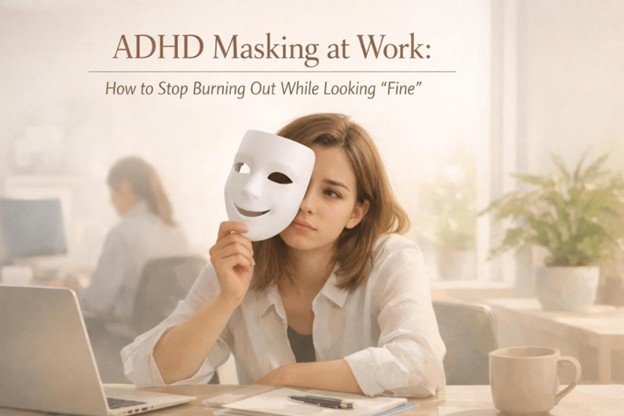
You know that feeling when you close your laptop at 6 PM and realize you’ve been holding your breath for eight hours straight?
When every muscle in your body is screaming, but your boss just told you “great job today!” and you feel like the world’s biggest fraud?
Yeah. That’s ADHD masking at work, and it’s quietly destroying you.
I’m an ADHD coach, and I’ve watched incredibly talented people burn themselves to the ground trying to look “normal” at work. They show up early, stay late, triple-check everything, and maintain this perfect professional mask, all while their actual ADHD brain is doing backflips trying to keep up with neurotypical expectations.
The worst part? Everyone thinks you’re doing fine. Maybe even thriving.
But you’re not fine. You’re exhausted. And today, we’re talking about why ADHD masking at work is so devastating, what it’s really costing you, and how to stop burning out while pretending everything’s under control.
What Is ADHD Masking at Work, Actually?
ADHD masking is when you deliberately hide your ADHD symptoms to appear neurotypical. It’s a survival strategy most of us learned without even realizing we were doing it.
At work, masking looks like this:
You arrive 30 minutes early because you’re terrified of being late (even though you’ve been on time for three years straight). You overprepare for every single meeting, not because you’re thorough, but because you’re scared your brain will blank mid-sentence. You take obsessive notes on everything because your working memory is shot. You mimic how your coworkers organize their desks, structure their emails, and manage their time, even if those systems make zero sense to your brain.

You force yourself to sit perfectly still during presentations. You rehearse casual hallway conversations in your head. You work through lunch to make up for the 20 minutes you lost scrolling Instagram when your brain refused to start that report. You stay late because you know tomorrow morning you’ll struggle to get going again.
The result? From the outside, you look competent. Reliable. “High-functioning.”
From the inside, you’re barely holding it together.
This is high-functioning ADHD burnout in action, and it’s so normalized in workplace culture that most people don’t even realize they’re doing it.
The Hidden Cost of Looking Competent
Here’s what no one tells you about ADHD masking at work: it’s invisible labor that nobody sees or credits you for.
Your neurotypical coworker shows up, does their work, and goes home. They don’t spend mental energy suppressing fidgeting, rehearsing small talk, or building elaborate backup systems for their backup systems.
You, on the other hand, are running a full-time performance while also trying to do your actual job. You’re monitoring your body language, your tone of voice, your email responses, your desk tidiness, your facial expressions. You’re calculating every interaction, every deadline, every potential mistake.
That takes energy. Enormous amounts of energy.
And here’s the kicker: the better you get at masking, the more exhausted you become, and the less support you receive, because everyone assumes you’re fine.
What Masking Actually Costs You
Let’s get specific about what ADHD workplace coping through masking does to you over time:
Persistent, bone-deep fatigue. You’re tired all the time, but it’s not the kind of tired that sleep fixes. You can rest all weekend and still wake up Monday morning feeling like you’ve already run a marathon. That’s because masking drains your nervous system, not just your body.
Anxiety and depression. Constantly hiding who you are creates a low-grade panic that never fully goes away. You’re always waiting for the moment someone figures out you’re “faking it.” That emotional strain adds up, and many people develop clinical anxiety or depression as a direct result of years of masking.
Imposter syndrome that won’t quit. You accomplish real things, projects completed, praise from managers, promotions, but none of it feels real because you know how much effort it took behind the scenes. You feel like you’re one mistake away from everyone realizing you’re a fraud.

Loss of identity. This one’s big, and it sneaks up on you. When you spend years filtering everything you say and do through a “What would a normal person do here?” lens, you start to lose touch with who you actually are. Your authentic self gets buried so deep you forget what it feels like to just… exist without performing.
Relationship strain and isolation. Masking at work is exhausting, so when you get home, you’ve got nothing left for the people you actually care about. You withdraw. You need excessive alone time to recover. Your relationships suffer, not because you don’t care, but because you’ve spent all your social energy pretending to be someone else.
At Heal and thrive psychotherapy and coaching, I’ve worked with clients who’ve spent 10, 15, even 20 years masking at work before they finally hit a wall. And when that wall comes, it comes hard, full burnout, medical leave, complete collapse of the systems they’ve built.
It doesn’t have to get that bad. But first, you need to understand what you’re actually doing.
The “Competence Presentation” Trap
Let’s talk about what I call the “competence presentation” trap.
You’ve learned that showing struggle equals being seen as incompetent. So you hide the struggle. You overprepare, overwork, overcompensate. You present this polished, professional version of yourself that seems to have it all together.
And it works! You get positive feedback. Your boss trusts you. Your coworkers respect you.
So you keep doing it. The mask gets tighter. The performance gets more elaborate. You can’t stop now, you’ve built your entire professional reputation on this version of yourself that isn’t actually you.
But here’s the thing: competence isn’t a performance. Real competence includes struggle, mistakes, learning, and adjustment. Real competence means asking for help when you need it and building systems that actually work for your brain.
The version of competence you’re presenting? It’s a house of cards. And it’s collapsing under its own weight.
How to Actually Stop Masking (Without Losing Your Job)
Okay, so masking is killing you. Cool. But you still need to pay rent, right?
Here’s what I tell my clients: you don’t have to choose between masking and unemployment. You need to figure out which of your “coping strategies” are actually helpful and which ones are just burning you out.
Step 1: Audit Your Masking Behaviors
Make a list. Be brutally honest. What are you doing every day that feels like performance?
Some examples:
- Arriving excessively early
- Working through every lunch break
- Saying yes to every request
- Pretending you understand instructions when you don’t
- Hiding fidgeting or movement
- Never asking for clarification
- Staying late to compensate for “lost” time
Now ask yourself: which of these behaviors actually help you do better work, and which ones just help you look like you’re doing better work?

This distinction matters. Learning organizational systems that genuinely help you focus? That’s a useful adaptation. Forcing yourself to sit motionless in meetings even though movement helps you think? That’s masking.
Step 2: Start Small With Unmasking
You don’t have to show up tomorrow and announce “I have ADHD and I’m done pretending!”
Start with low-stakes experiments:
- Use a fidget tool during a video call (camera on, don’t hide it)
- Ask for written instructions after a verbal meeting
- Take a walking break during the day
- Say “Can you repeat that?” when your brain didn’t catch something the first time
- Use your calendar/reminders/apps openly instead of pretending you “just remember” things
Notice what happens. In most cases? Nothing. Nobody cares that you’re using a stress ball or that you asked for clarification.
The world doesn’t end when you stop performing perfection.
Step 3: Identify What Accommodations Actually Help
You might need actual workplace accommodations, things that change your environment or expectations to better match how your brain works. Common ones include:
- Flexible start times (if you’re not a morning person, stop torturing yourself)
- Written communication preferences (follow-up emails after verbal instructions)
- Quiet workspace or noise-canceling headphones
- Task breakdowns for large projects
- Regular check-ins with your manager (instead of “figuring it out” alone)
- Permission to work from home on high-focus days
Some of these require formal accommodation requests. Some don’t. But you can’t access any of them if you’re still pretending you don’t need support.
If you’re interested in how structured support can help with ADHD workplace coping, we dive deep into that in our ADHD coaching services.
What About Jobs Where You “Have” to Mask?
I hear you. Some industries, some roles, some workplaces are genuinely hostile to neurodivergence.
But here’s what I’ve learned after years of coaching: the jobs where you feel like you “have to” mask completely are usually jobs that are slowly killing you.
That’s not dramatic. That’s just true.
If you’re in a workplace where you literally cannot be yourself in any capacity, where asking for reasonable support would tank your career, you’re not in a sustainable situation. You’re in a pressure cooker, and eventually, something’s going to give.
Sometimes that means starting to look for a different role. Sometimes it means having a honest conversation with HR about accommodations. Sometimes it means working with a therapist or coach to figure out what’s actually non-negotiable versus what’s fear talking.
Because here’s the truth: plenty of successful professionals with ADHD have found ways to work that don’t require 24/7 masking. They’ve found managers who value their actual strengths, companies with flexible cultures, or roles that let them work in ways that match their brains.