

You tell yourself the report will take “maybe an hour, tops.” Three hours later, you’re still elbow-deep in formatting, and you’ve missed your next meeting. Again.
Or maybe you’re that person who genuinely believes you can answer 47 emails, attend two back-to-back Zooms, and grab coffee with a colleague, all before lunch. Spoiler alert: you can’t. And when 1 p.m. rolls around and you’ve only tackled 12 emails, you feel like a total failure.
Welcome to ADHD time blindness, where time is basically a cryptic foreign language, and your brain refuses to hire a translator.
If you’ve got ADHD, you’re probably nodding so hard right now your neck hurts. Time blindness isn’t about being lazy or irresponsible, it’s a legitimate executive function issue that makes estimating, tracking, and managing time feel like trying to juggle invisible bowling balls. While everyone else seems to have this internal stopwatch that keeps them on track, your brain is over here vibing to a different rhythm entirely.
And in the workplace? Time blindness can wreak absolute havoc. ADHD lateness, missed deadlines, and the constant feeling of being behind, it all adds up. Research actually shows that poor timekeeping is the number one reason people with ADHD get fired. Not performance. Not attitude. Timekeeping.
Let’s talk about what ADHD time blindness really looks like at work, why your brain does this to you, and, most importantly, how to build systems that actually work with your ADHD brain instead of against it.
What Is ADHD Time Blindness, Really?
Time blindness is the difficulty sensing the passage of time and estimating how long tasks will take. For neurotypical folks, time is like a steady background hum, they can “feel” 10 minutes passing versus an hour. But for those of us with ADHD? Time is either “now” or “not now.” There’s no in-between.
You know that feeling when you look up from hyperfocusing on a spreadsheet and suddenly three hours have evaporated? Or when you’re scrolling your phone for “just a sec” and boom, 20 minutes gone? That’s time blindness in action.

At work, this translates to chronic underestimation. You think:
- “I can knock out this presentation in 30 minutes” (actual time: 2.5 hours)
- “I’ll just hop on one quick call before the meeting” (you’re now 15 minutes late)
- “Traffic’s not that bad, I’ll leave in 5 minutes” (you arrive flustered and apologizing)
It’s not that you’re bad at time management for adults with ADHD, it’s that your brain literally perceives time differently. And that’s not your fault.
How Time Blindness Shows Up at Your Job
Let me paint you a picture. Maybe a few of these sound familiar:
The Serial Underestimator: You confidently tell your boss you’ll have the project done by Friday. It’s Tuesday. You’re smart, capable, and genuinely believe you can do it. Friday comes. You’re maybe 60% done, frantically finishing at 11 p.m., quality suffering because you’re exhausted.
The Chronic Late Arrival: You’re not trying to be disrespectful. You genuinely thought you could shower, get dressed, make coffee, respond to that “urgent” text, and still make the 9 a.m. standup. You arrive at 9:17, and everyone’s already mid-update.
The Meeting Ghoster: You’re so deep in focus mode that you completely miss the calendar reminder. By the time you remember, the meeting’s half over. Cue the guilt spiral.
The Overpromiser: You say yes to everything because each individual task seems totally doable. Then you look at your calendar and realize you’ve somehow committed to 14 hours of work in an 8-hour day.
The Rusher: Everything’s a last-minute scramble. You’re the person speed-walking through the office with coffee sloshing, files half-open on your laptop, muttering “sorry sorry sorry.”
Here’s the thing, this isn’t about being unprofessional or not caring. People with ADHD often change jobs more frequently than neurotypical folks, and poor timekeeping is cited as a primary reason for termination. That’s heartbreaking, especially because time blindness is a neurological difference, not a character flaw.
Why Your Brain Does This to You (The Science-y Part, But Make It Simple)
Okay, let’s get nerdy for a hot second, but I promise to keep it digestible.
Executive Dysfunction: Your prefrontal cortex, the part of your brain that handles planning, organizing, and time management, doesn’t fire the same way in ADHD brains. It’s like having a project manager who occasionally takes unscheduled naps.
Dopamine Dysregulation: ADHD brains have lower baseline dopamine, which affects motivation, focus, and yes, time perception. When a task isn’t immediately rewarding, your brain struggles to engage with it, making it harder to estimate how long it’ll take.

Disrupted Internal Clock: Neurotypical people have this internal metronome keeping time. Your ADHD brain? That metronome is more like a jazz drummer, creative, unpredictable, doing its own thing. Time feels “fuzzy.” Ten minutes can feel like two, or two can feel like ten.
Hyperfocus: This one’s sneaky. When you’re locked into something interesting, your brain stops tracking time altogether. Hours vanish. You look up and it’s suddenly dark outside.
Working Memory Deficits: Your working memory is like RAM on a computer. ADHD brains have less of it. So when you’re trying to estimate how long something will take while also remembering all the steps involved and tracking your current task and resisting distractions… yeah. System overload.
Emotional Dysregulation: Strong emotions, stress, excitement, frustration, hijack your attention. When you’re anxious about a deadline, time either speeds up or slows down. Either way, your perception gets warped.
Bottom line? Your brain isn’t broken. It’s wired differently. And that means you need different strategies than what works for neurotypical brains.
How to Actually Manage ADHD Time Blindness at Work
Alright, let’s get practical. These aren’t generic “just use a planner!” tips. These are real strategies that account for how ADHD brains actually work.
1. Externalize Time (Because Your Internal Clock Is on Vacation)
You can’t rely on your sense of time, so make time visible and loud.
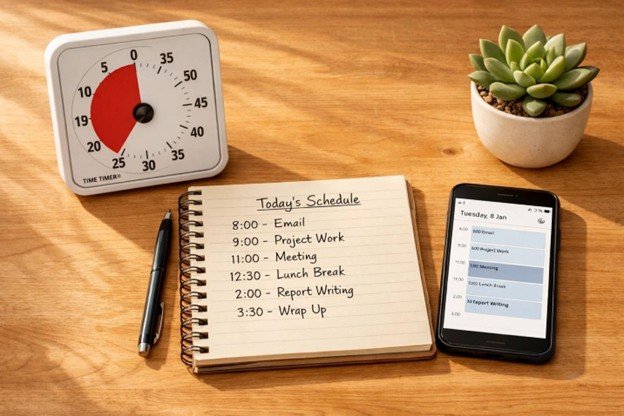
- Visual timers: Get a Time Timer or use a phone app that shows time as a shrinking colored disk. Seeing time disappear is way more effective than numbers counting down.
- Alarms and reminders: Set multiple alarms. One for “meeting in 15 minutes,” another for “meeting in 5 minutes,” and a final “GET UP NOW” alarm.
- Calendar blocking: Don’t just list tasks. Block out specific time chunks. If something’s not on the calendar, it doesn’t exist.
2. The 1.5x Rule (AKA Stop Lying to Yourself)
However long you think something will take? Multiply by 1.5. Minimum.
If you think a task is 30 minutes, block out 45. If you estimate an hour, give yourself 90 minutes. This isn’t padding: this is reality. ADHD brains almost always underestimate.
Start tracking your actual time spent on tasks for a week. You’ll be shocked. Use that data to recalibrate your estimates.
3. Break Big Tasks into Tiny, Time-Stamped Pieces
“Finish presentation” is too vague and too big. Your brain can’t estimate it. Instead:
- Outline slides: 20 minutes
- Draft content for slides 1-5: 30 minutes
- Find images: 15 minutes
- Format and design: 45 minutes
- Review and edit: 20 minutes
Suddenly you’ve got a 2-hour, 10-minute project broken into manageable chunks. Each piece is easier to estimate and track.
4. Body Doubling and Accountability
Time management for ADHD adults improves dramatically with external accountability.
- Work alongside a colleague (even virtually)
- Join a coworking session online
- Check in with a manager or accountability buddy at set times
- Use an ADHD coach to help you build and maintain these systems (more on that in a sec)
5. Build in Transition Time
You’re not a robot. You can’t finish one meeting at 10:00 and start another at 10:00. Your brain needs transition time.
Block 10-15 minutes between tasks and meetings. Use it to pee, grab water, decompress, and mentally shift gears. This alone will reduce ADHD lateness and that constant feeling of being behind.
6. Use the “Leave Now” Alarm
You need to leave at 8:30 to arrive on time? Set an alarm for 8:30 labeled “LEAVE NOW.” Not “get ready to leave.” Not “start thinking about leaving.” LEAVE.
No checking one more email. No feeding the cat. No “I’ll just grab my keys.” When the alarm goes off, you’re walking out the door.
7. Automate and Simplify Everything You Can
Every decision and task drains your executive function. Reduce the load:
- Lay out work clothes the night before
- Prep your bag and lunch in advance
- Use templates for recurring tasks
- Automate reminders, bill payments, and calendar invites
The fewer micro-decisions you make in the morning, the better your time management will be all day.
8. Hyperfocus Containment Strategy
Set a timer when you start a task you might get sucked into. Every 25-30 minutes, check: Am I still on track? Do I need to shift gears?
Also, schedule hyperfocus-prone tasks for times when you have a hard stop. Got a meeting at 2:00? Start the deep work at 1:00. The meeting acts as a natural boundary.

9. Communicate Proactively (Without Shame)
You don’t have to disclose ADHD if you don’t want to, but you can communicate about your working style:
- “I work best with clear deadlines and check-ins”
- “I appreciate calendar invites with specific time blocks”
- “I’m recalibrating my time estimates: can we set a realistic timeline together?”
Most managers would rather know upfront than deal with missed deadlines later.
10. Weekly Time Audit
Every Friday, review:
- What took longer than expected?
- Where did I lose track of time?
- What strategies worked this week?
This isn’t about beating yourself up. It’s about collecting data to improve your systems. ADHD time management is an evolving practice, not a one-and-done fix.
You’re Not Failing: You’re Just Using the Wrong Map
Here’s what I want you to take away from this: ADHD time blindness is real, it’s neurological, and it’s not a moral failing.
You’re not lazy. You’re not irresponsible. You’re not “bad at adulting.” Your brain processes time differently, and the strategies that work for everyone else aren’t designed for you.
The solution isn’t to “try harder” or “be more disciplined.” It’s to build external systems that compensate for what your brain doesn’t do automatically. It’s to stop expecting yourself to function like a neurotypical person and start working with your ADHD brain instead of against it.
And look: this stuff is hard to figure out alone. That’s where professional support comes in.
Work With Your Brain, Not Against It
At Heal and Thrive Therapy and Coaching, we specialize in helping adults with ADHD build systems that actually stick. Whether you’re struggling with time blindness, decision paralysis, or executive function challenges at work, our ADHD coaching services are designed for real-world professional environments.
We get it. You’re smart, capable, and accomplished: but your brain needs different tools. Let’s build them together.
Time blindness doesn’t have to cost you your job, your relationships, or your sanity. With the right strategies and support, you can show up on time, meet your deadlines, and stop underestimating everything.
You’ve got this. And we’ve got you. 💙