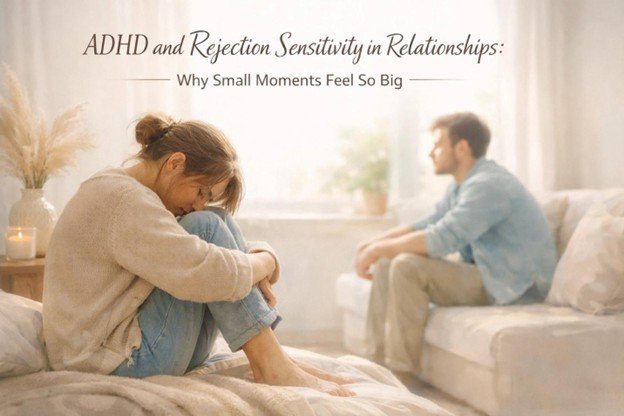
I’m going to be honest with you: I’ve watched my phone for three hours straight after my partner sent a text that just said “k.” Not “okay,” not “sounds good,” just… “k.”
My brain immediately went to: They’re mad at me. They hate me. This relationship is over. I should probably start packing.
The reality? They were just driving and typing quickly at a red light.
Welcome to rejection sensitivity with ADHD, where a lowercase letter can feel like a relationship-ending event, and “we need to talk” might as well be the opening line of a horror movie.
If you’re reading this because small moments in your relationship feel absolutely massive, or because your partner’s tiny shift in tone sends you into an emotional tailspin, you’re not alone. And more importantly, you’re not broken.
Let me walk you through what’s actually happening in your brain, why rejection sensitivity ADHD relationships look the way they do, and what both of you can do about it.
What Is Rejection Sensitive Dysphoria (And Why Does It Feel Like That)?
Rejection Sensitive Dysphoria, RSD for short, is basically your brain’s emotional smoke alarm going off when someone’s just making toast.
Here’s what’s happening: people with ADHD have neurological differences that make emotion regulation harder. We don’t have the same “buffer” between a stimulus and our emotional response. Lower dopamine levels mean our brains can’t soften the blow of perceived rejection the way neurotypical brains do.
So when your partner says something neutral like “I’m tired tonight,” your brain doesn’t just hear words. It hears: They don’t want to spend time with me. I’m exhausting. They’re pulling away. This is the beginning of the end.

It’s not dramatic thinking. It’s not you being “too sensitive.” It’s your ADHD brain processing emotional information differently, faster, louder, and with way less protective padding.
Dr. William Dodson, who basically wrote the book on RSD, describes it as “an overwhelming emotional experience that people can’t describe” that can completely take over your life for hours or even days. And that’s exactly what it feels like, right? One small comment, and suddenly you’re three hours deep in an emotional hurricane you can’t explain to anyone, including yourself.
The Small Moments That Feel Catastrophically Big
Let me paint you a picture of what RSD triggers actually look like in relationships:
Your partner forgets to text back for two hours. Your brain: They’re avoiding me. They’ve realized I’m too much. They’re probably talking to someone else right now about how annoying I am.
They suggest a different restaurant than the one you picked. Your brain: They think my ideas are stupid. They don’t value my input. I always get everything wrong.
They’re quieter than usual after work. Your brain: I did something wrong. They’re upset with me. They’re building up to breaking up with me.
They give you gentle feedback about leaving dishes in the sink. Your brain: They think I’m a failure. I can’t do anything right. They deserve someone better.
Notice a pattern? Each of these examples is objectively small. But for someone experiencing ADHD emotional pain through RSD, these moments don’t feel small. They feel like proof that you’re fundamentally unlovable, that your fears about being “too much” are true, and that rejection is inevitable.
The worst part? You know logically that you’re probably overreacting. But knowing that doesn’t make the feeling go away. It just adds shame on top of the pain.
Why Your Brain Does This (The Neuroscience Part, But Make It Simple)
Your ADHD brain isn’t trying to ruin your relationship. It’s actually trying to protect you, it’s just really, really bad at calculating actual danger.
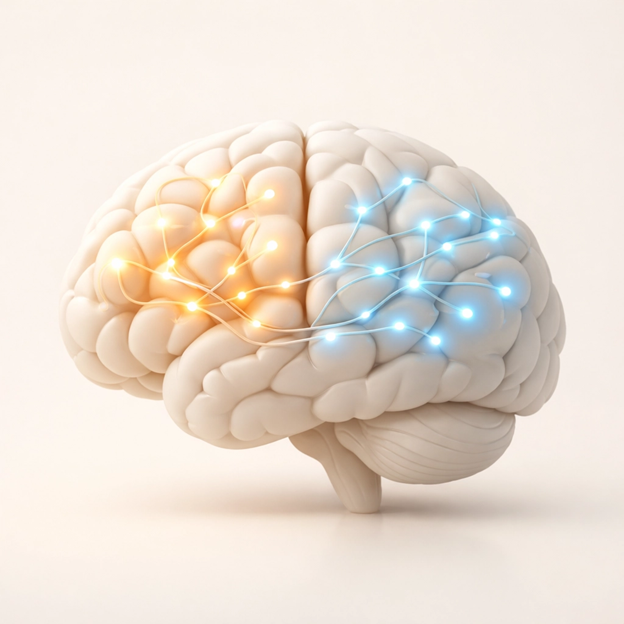
Here’s the simplified version: ADHD brains have impaired emotional regulation systems. We process rejection and criticism through different neural pathways, and those pathways don’t have good brakes. When something triggers that rejection response, there’s no gentle slope into feeling bad. It’s zero to one hundred in about two seconds.
Think of it like this: neurotypical brains have shock absorbers that cushion emotional bumps. ADHD brains are riding on the rims. Every little bump in the relationship road feels like you just hit a pothole at full speed.
This isn’t your fault. It’s not a character flaw. It’s how your brain is wired.
But here’s the thing, and this is important, just because it’s not your fault doesn’t mean you can’t do anything about it. Understanding what’s happening is the first step to managing it better.
The Cycle That Makes Everything Worse
RSD creates this awful cycle in relationships that I see over and over again at Heal and thrive psychotherapy and coaching:
Step 1: You feel intense fear of rejection, so you either avoid difficult conversations completely or you react really intensely to small things.
Step 2: Your partner gets confused by your big reaction to something they thought was minor, or they feel shut out when you withdraw.
Step 3: Your partner starts walking on eggshells, afraid to bring up anything that might upset you.
Step 4: The lack of honest communication builds resentment on both sides.
Step 5: You pick up on their tension and distance, which triggers more RSD, and the cycle starts all over again, only worse this time.
The cruel irony? The protective behaviors your RSD triggers, the defensiveness, the withdrawal, the intense reactions, often create the exact rejection you were trying to avoid. Your partner might pull away, not because of the original small thing, but because they don’t know how to navigate the intensity of your responses.
I’ve seen this pattern destroy relationships where both people genuinely love each other. Not because the love isn’t there, but because nobody has the tools to break the cycle.
What It Looks Like From Your Partner’s Side
If you’re the non-ADHD partner reading this, here’s what I want you to understand:
Your partner isn’t trying to be difficult. When you say “I’m too tired for dinner out tonight,” and they spiral into thinking you hate them, they’re not being manipulative or dramatic. Their brain genuinely processed your statement as rejection, and the emotional pain they’re feeling is very, very real.
But I also get that it’s exhausting on your end. You might feel like you’re constantly monitoring your words, afraid to express needs or give feedback because you never know what’s going to trigger a three-hour emotional crisis. You might feel rejected yourself when they withdraw or become defensive over seemingly nothing.
You’re both struggling. You’re both in pain. And you both need tools to make this better.
Practical Tools For Both Partners
Okay, enough explaining the problem. Let’s talk about what actually helps with rejection sensitivity ADHD relationships.
For the person with ADHD and RSD:
Name it in the moment. When you feel that rejection response kicking in, practice saying out loud: “My RSD is getting triggered right now. I need a minute to sort out what’s my brain and what’s actually happening.” This simple act of labeling creates just enough space between the trigger and your reaction.
Use the 20-minute rule. When something triggers you, commit to waiting 20 minutes before responding. Set a timer. Go for a walk. Do jumping jacks. Whatever. Just give your nervous system time to downshift from crisis mode. You’ll be amazed how different things look after 20 minutes.
Reality-check your interpretations. Practice asking yourself: “What else could this mean?” If your partner is quiet, could they just be tired? If they forgot to text back, could they just be in a meeting? Train your brain to generate alternative explanations that don’t involve rejection.
Talk about it when you’re both calm. Don’t try to explain RSD in the middle of a triggered episode. Pick a good moment when you’re both relaxed and say something like: “Hey, I want you to understand something about how my brain works…”

For the non-ADHD partner:
Be direct and reassuring. If you’re tired and need space, say: “I’m exhausted from work and need to recharge alone for an hour. This has nothing to do with you or us. I love you.” Those extra sentences matter more than you think.
Don’t dismiss their feelings. When they’re spiraling, don’t say “you’re overreacting” or “that’s ridiculous.” Their experience is real, even if the interpretation is skewed. Try: “I can see you’re really hurting right now. That wasn’t my intention. Let’s talk about what you heard versus what I meant.”
Create feedback rituals. If you need to give constructive feedback, sandwich it with reassurance. “I love you and I’m not upset, but I need to talk about the dishes situation because it’s affecting me. This doesn’t change how I feel about you.”
Take care of yourself too. You can’t pour from an empty cup. If you’re constantly managing your partner’s emotional responses, you need support too. That might mean therapy for yourself, or couples work where both of you learn new patterns together.
For both of you:
Develop a code word. Create a safe word that either of you can use when RSD is happening. Something like “mayday” or “red alert” that signals: “My brain is lying to me right now and I need help getting grounded.”
Build in regular check-ins. Don’t wait for problems to talk about the relationship. A weekly 20-minute check-in where you both share what’s working and what’s hard creates a container for difficult conversations that feels safer.
Remember you’re on the same team. RSD is the problem, not your partner. You’re both fighting against the same enemy: it just happens to live in one person’s brain.
The Valentine’s Day Reality Check
It’s mid-February, which means relationship content is everywhere right now. And here’s what I want you to know: your relationship doesn’t have to look like a rom-com to be beautiful and real.
If you’re dealing with rejection sensitivity ADHD relationships, you’re not failing at love. You’re working with a more complex emotional operating system, and that requires more patience, more tools, and more intentional communication than relationships without ADHD.
The couples I work with at Heal and thrive psychotherapy and coaching who have ADHD in the mix? When they learn to work with RSD instead of against it, they often develop deeper communication skills and more emotional intimacy than many neurotypical couples. Because they have to. Because they can’t take the easy road.
Your relationship might require more conscious effort than others. That doesn’t make it less valid or less loving. It makes it yours.

When You Need More Support
Look, I’m giving you practical tools here, but sometimes RSD is too big to manage with blog post advice. If you’re constantly in crisis mode, if your relationship feels like it’s hanging by a thread, or if you’ve tried everything and nothing’s working, it’s time to bring in backup.
At Heal and thrive psychotherapy and coaching, we work specifically with ADHD individuals and couples who are navigating this exact dynamic. Our ADHD coaching helps you develop personalized strategies for managing RSD triggers, while our couples therapy gives both partners a safe space to learn new communication patterns together.
You don’t have to figure this out alone. And you definitely don’t have to keep white-knuckling your way through emotional hurricanes every time your partner does something slightly different than expected.
The goal isn’t to eliminate RSD: that’s not realistic with how ADHD brains work. The goal is to develop enough awareness and tools that RSD doesn’t run your relationship. You do.
The Bottom Line
Small moments feel big with ADHD because your brain is wired to process rejection differently. That’s the neuroscience. But here’s the hope: with understanding, tools, and practice, you can learn to distinguish between what your RSD is screaming at you and what’s actually happening in your relationship.
Your partner’s “k” text is probably just a text. Their tiredness is probably just tiredness. Their suggestion for a different restaurant probably just means they want Thai food tonight, not that they think you’re an idiot.
But even when you know that intellectually, your emotional brain might still sound the alarm. And that’s okay. You’re not broken. You’re learning to work with a brain that processes emotional information differently.
Give yourself grace. Give your partner grace. And remember: the fact that you’re here, reading about this, trying to understand it better, means you’re already doing the work.
That matters more than you think.