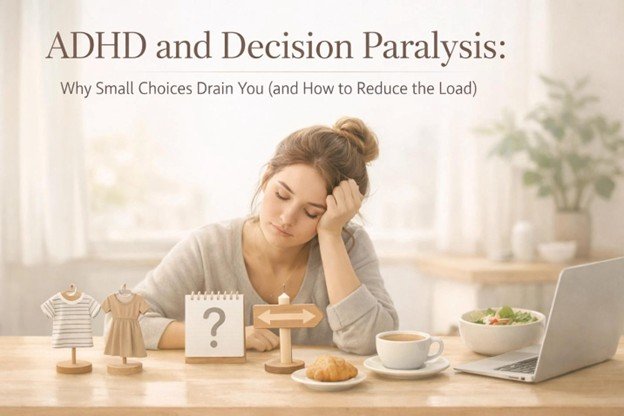
You know that feeling when you open your closet in the morning and suddenly every single item of clothing looks wrong? Or when you’re standing in front of the fridge at 2 PM, staring at perfectly good food options, and your brain just… stops working?
Yeah. Me too.
Here’s the thing nobody tells you about ADHD decision paralysis: it’s not about the big decisions. Most of us can eventually work through whether to take that new job or move across the country. It’s the small stuff, what to eat, what to wear, which task to start first, that absolutely wrecks us.
And I’m not being dramatic. Research shows that 58% of people with ADHD experience decision paralysis at least weekly, with 35% dealing with it daily. That’s more than a third of us frozen by choices every single day.
So let’s talk about why your brain treats “what’s for dinner?” like a philosophy dissertation, and more importantly, how to actually fix it.
Why Your Brain Turns Every Small Choice Into a Production
When I work with clients at Heal and Thrive Therapy and Coaching, this is usually one of the first things that comes up: “Why does deciding what to have for lunch feel harder than writing a work presentation?”
The answer is actually pretty straightforward (even if it feels anything but): ADHD decision paralysis isn’t about being indecisive or lazy. It’s about your brain’s executive function system being overloaded by what neurotypical folks consider “no big deal” choices.
Working Memory Is Already Maxed Out
Think of working memory like RAM in a computer. Neurotypical brains have, let’s say, 16GB to work with. Your ADHD brain? Maybe 4GB on a good day. And half of that is already running background programs like “remember to text mom back” and “did I lock the door?” and “what was that song from the grocery store?”
So when you’re faced with a decision, even a tiny one, your brain needs to:
- Hold all the options in mind at once
- Remember the pros and cons of each
- Predict future outcomes
- Weigh them against your current mood, energy, and priorities
- Actually pick one
For someone with ADHD, this process eats up cognitive resources like Chrome tabs on an old laptop. Every. Single. Time.

Decision Fatigue Hits You Earlier and Harder
Here’s where it gets worse: because people with ADHD already burn through more cognitive energy on everything, from regulating emotions to starting tasks to filtering out distractions, we hit decision fatigue ADHD style way faster than neurotypical folks.
By 10 AM, you might have already made dozens of micro-decisions that a neurotypical person barely noticed:
- Which alarm to use (or snooze)
- What order to do your morning routine
- Which coffee mug to grab
- What route to take to work
- Where to park
- Which task to tackle first
Each one chips away at your decision-making capacity. So by lunch, that “simple” choice between a salad or sandwich feels like solving a calculus problem underwater.
The Micro-Decision Trap: A Day in the Life
Let me paint you a picture. You wake up and immediately face:
Morning micro-decisions:
- Shower now or after coffee?
- Which clothes match (and are clean)?
- Breakfast or skip it?
- Take meds now or with food?
- Leave at 8:15 or 8:20?
Work micro-decisions:
- Which email to answer first?
- Coffee or water?
- Work on Project A or Project B?
- Take a break now or power through?
- Respond to that Slack message now or later?
Afternoon overwhelm choices:
- What’s for lunch?
- Eat at desk or go out?
- When to schedule that meeting?
- Which tab to close first (out of 47)?
- Take a walk or push through fatigue?
Evening exhaustion:
- What’s for dinner?
- Cook or order in?
- Gym or rest day?
- Reply to texts or zone out?
- Netflix or read?
- Bedtime routine now or scroll for “just five more minutes”?
Each decision feels small. Inconsequential. But they add up to hundreds of tiny cognitive loads that drain your battery before you even get to the stuff you actually care about.
And this is where ADHD communication patterns come into play too, because when you’re decision-exhausted, you’re more likely to snap at your partner when they ask “what do you want for dinner?” for the third time. (It’s not them. It’s the 247th decision of the day.)

The Paradox of Choice (And Why It’s Worse for ADHD Brains)
There’s this famous study where researchers set up a jam tasting booth. When they offered 24 flavors, people stopped to look but rarely bought anything. When they offered just 6 flavors, sales went up tenfold.
Too many choices paralyze everyone. But for ADHD brains? It’s exponentially worse.
Why? Because our brains struggle with:
- Filtering irrelevant information: Every option feels equally important
- Predicting satisfaction: “What if I pick wrong and regret it?”
- Managing emotional responses: The anxiety of choosing “wrong” can be genuinely distressing
- Prioritizing effectively: Without clear criteria, how do you even begin?
This is why you can spend 20 minutes scrolling through Netflix, never actually picking something to watch, and then giving up entirely. It’s not that nothing looks good. It’s that everything looks equally good (or bad), and your brain can’t compute a winner.
Choice Architecture: The Game-Changer You Haven’t Tried Yet
Okay, here’s where we flip the script. Instead of trying to get better at making decisions (spoiler: willpower alone won’t fix this), we’re going to redesign your environment to reduce the number of decisions you need to make in the first place.
This is called choice architecture, and it’s genuinely life-changing for ADHD decision paralysis.
Strategy #1: The “Rule of Three” Maximum
Your brain can realistically hold and compare about three options at once without overloading. That’s it. Not ten Netflix shows. Not eight dinner ideas. Three.
How to implement this:
- Meal planning? Pick three rotating dinners for the week, not seven
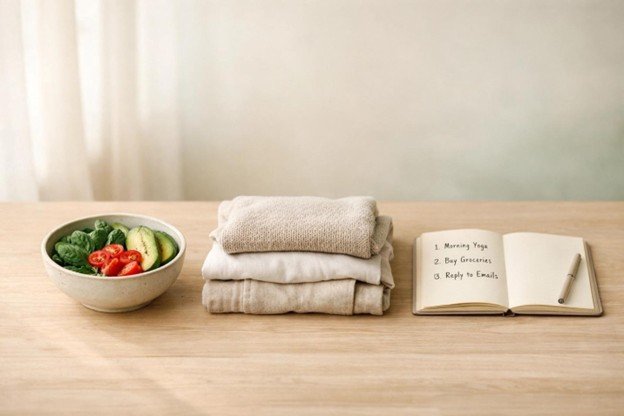
- Morning routine? Lay out three outfit options the night before
- Work tasks? Choose your top three priorities before you open your laptop
- Restaurant decisions? Everyone picks their top choice, then vote between three
This isn’t about limiting your life. It’s about reducing cognitive load so you can actually enjoy your choices instead of agonizing over them.
Strategy #2: Default Decisions (Your New Best Friend)
A default decision is a pre-made choice that happens automatically unless you consciously decide otherwise. This is how you reclaim energy for decisions that actually matter.
Examples that work:
- Monday is always pasta night
- Coffee order is always the same (no more staring at the menu)
- Workout days are Tuesday/Thursday/Saturday (non-negotiable)
- Morning routine follows the exact same order daily
- Work inbox gets checked at 9 AM, 1 PM, and 4 PM only
I know, I know. “But what if I don’t feel like pasta on Monday?” Then you change it. But having the default means your brain doesn’t waste energy deciding. You only use energy when you actively want something different.
Strategy #3: Remove Decisions Entirely (The Nuclear Option)
Some successful people with ADHD have taken this to the extreme. Steve Jobs wore the same outfit daily. Mark Zuckerberg does too. Obama famously only wore blue or gray suits to eliminate that morning decision.
You don’t have to go full uniform, but you can strategically eliminate decisions in your life:
- Capsule wardrobe: Every piece matches, so you can’t pick “wrong”
- Meal subscriptions: Someone else decides dinner
- Automated bills: No decision needed monthly
- Standing plans: Friday night is always game night with friends
The goal isn’t to make your life boring. It’s to save your decision-making energy for the stuff that brings you joy and meaning.
Strategy #4: Decision Time Limits
Give yourself a timer. Seriously. When you’re stuck choosing between options, set a timer for 2-3 minutes and pick when it goes off.
Why this works: ADHD decision paralysis often comes from trying to make the “perfect” choice. But perfectionism is the enemy of progress. Most small decisions don’t actually matter that much: you just need to pick something so you can move forward.
Use this for:
- What to order at a restaurant
- Which task to start with
- What to watch on TV
- What to wear when you’re already running late
The relief of just deciding is often better than the paralysis of trying to optimize.
When Decision Paralysis Is Really About Something Deeper
Sometimes, what looks like ADHD decision paralysis is actually:
- Burnout in disguise (your brain is protecting you from overload)
- Anxiety about making the “wrong” choice
- Depression sapping your ability to imagine positive outcomes
- Trauma responses where decisions trigger fear of consequences
If you’ve tried these strategies and you’re still frozen by daily choices: or if the paralysis is affecting your work, relationships, or well-being: it might be time to work with someone who gets it.
At Heal and Thrive Therapy and Coaching, we specialize in helping adults with ADHD build systems that actually work with their brains, not against them. Our ADHD coaching focuses on practical, sustainable strategies tailored to how your brain works: not generic advice that works for neurotypical folks.
The Bottom Line on Small Choices
Here’s what I want you to remember: decision fatigue ADHD style is real, it’s exhausting, and it’s not your fault. Your brain isn’t broken: it’s just working overtime on tasks that other people don’t even register as tasks.
The solution isn’t to “just decide faster” or “stop overthinking.” It’s to redesign your life so you’re making fewer decisions in the first place. Use choice architecture to your advantage. Create defaults. Limit your options. Give yourself permission to not optimize every single choice.
Because here’s the truth: the mental energy you spend deciding what to have for breakfast could be better spent on literally anything else you actually care about.
Your brain has limited bandwidth. Use it wisely. And if you need help figuring out which decisions are draining you most? We’re here for that.
Now if you’ll excuse me, I’m going to eat the same lunch I always eat on Wednesdays: because I made that decision once, and now I never have to make it again. And honestly? That’s freedom.