pixel

What an ADHD Coach Actually Does (and How It’s Different from a Therapist, Accountability Partner, or App)

You know that feeling. You have a giant list of things to do. You know how to do them. You have the tools. You have the apps. But you are just… sitting there. You are staring at your phone. Or you are cleaning the baseboards with a toothbrush instead of doing your taxes.

People tell you, “Just get a planner!” Or they say, “Try harder.”

But here is the secret: Most people with ADHD don’t have a “knowing” problem. We have a “doing” problem. We know what to do. We just can’t get our brains to start the engine.

That is where an ADHD coach comes in. At Heal and Thrive Therapy and Coaching, we see this every day. But what does an ADHD coach do, really? Is it just a fancy way of saying “someone who nags you”?

Let’s break it down. I’m going to tell you exactly how a coach helps, and why it’s not the same as therapy, your best friend, or that $10 app you downloaded and never opened. The Big Question: What Does an ADHD Coach Do?

Think of an ADHD coach like a personal trainer for your brain.

If you go to the gym and don’t know how to use the machines, a trainer shows you the moves. They watch your form. They help you pick weights that are heavy enough to work but not so heavy you get hurt.

ADHD coaching explained is pretty simple: It’s the “how-to” part of life.

We don’t just talk about your feelings (though feelings are important!). We look at your Tuesday. We look at your messy desk. We look at the 4,000 unread emails in your inbox.

A coach helps you build systems that actually work for your specific brain. We don’t use “neurotypical” advice. We don’t tell you to “just focus.” We find the “hacks” that make focus happen naturally.

ADHD Coach vs. Therapist: Which One Do You Need?

This is the most common question we get at Heal and Thrive Therapy and Coaching. People get confused. They think, “I already have a therapist. Why would I need a coach?” Here is the easiest way to see the difference:

  • Therapy is the “Why”: Therapy looks at your past. It looks at your trauma. It looks at the deep shame you might feel because of your ADHD. It’s about healing your heart and your mind. If you are struggling with emotional numbness, therapy is the place to be.
  • Coaching is the “How”: Coaching looks at your future. It looks at your goals. It asks, “How are we going to get that project done by Friday?” It’s about building skills.

In therapy, you might talk about why you feel like a failure when you miss a deadline. In coaching, we build a system so you stop missing the deadline.

Many of our clients at Heal and Thrive Therapy and Coaching do both! They see a therapist to heal the “ADHD shame,” and they see a coach to handle the impulsivity control and the daily mess. They work together like a dream team.

Why Your “Accountability Buddy” Isn’t a Coach

You might have a friend you call “my accountability partner.” You text each other and say, “Did you do the thing?” You say, “No.” They say, “Me neither. Let’s go get tacos.” That is a great friend. But it is not a coach.

An ADHD coach is a pro. We know the science of the brain. When you tell me, “I couldn’t start the laundry,” I don’t just say “Try again tomorrow.” I ask:

  • Where did you get stuck?
  • Was the basket too full?
  • Did the noise of the machine bother you?
  • Did you forget the clothes were even in there?

We find the “friction.” Then we fix it. A coach gives you strategies that are backed by science, not just “good vibes.”

Apps Are Great, But They Don’t Have a Heart

There are a million ADHD apps. They have timers. They have cute trees that grow when you work. They have loud alarms.

But apps have a big problem: You can swipe them away.

When an app sends a notification that says “Time to work!”, it’s easy to ignore. You don’t feel bad about it. The app doesn’t care.

A human coach cares. A coach knows when you are burning out. A coach can see the look on your face when you are overwhelmed. An app just keeps ticking.

A Peek Inside a Coaching Session

If you were to hire ADHD coach at our office, what would it actually look like? It’s not a lecture. It’s a conversation.

  1. The Check-In: We look at last week. What worked? What was a total disaster? (We love disasters:

they tell us what we need to change!)

  1. The Goal: We pick one or two things to focus on. Maybe it’s time blindness at work.
  2. The Brainstorm: We find a system. We don’t use a standard planner if you hate planners. Maybe we use sticky notes on the mirror. Maybe we use voice memos. We find your way.
  3. The Practice: We might even start the task together. This is called “body doubling.” It makes the scary stuff feel easy.

It’s about moving from feeling stuck to feeling like you have a plan.

Why Coaching Is a “Deep Dive” Into Your Life

At Heal and Thrive Therapy and Coaching, we don’t just give you a “to-do” list. We look at the big picture.

We look at how your sleep habits are affecting your focus. We look at how decision paralysis is making your mornings a nightmare.

We teach you emotional awareness. Because let’s be real: If you are upset or stressed, no “time management tip” in the world is going to help you. You have to handle the feelings to get to the work.

Is Coaching Worth It?

If you are tired of “white-knuckling” it through life, coaching is a game changer.

Imagine waking up and actually knowing what you are going to do first. Imagine not feeling that heavy pit in your stomach because of a “doom pile” in the corner of your room. Imagine having someone in your corner who gets it. Someone who doesn’t judge you when you forget your keys for the third time this week.

That is the power of a coach.

At Heal and Thrive Therapy and Coaching, we believe you don’t need to be “fixed.” You aren’t broken. You just have a brain that works differently. And when you learn the manual for that brain, everything changes.

Stop Guessing. Start Doing.

You don’t have to figure this out alone. You’ve probably tried the “DIY” way for years. You’ve read the books. You’ve watched the TikToks.

If you are ready for a real change, it might be time to hire ADHD coach.

Let’s stop the cycle of “I’ll do it tomorrow.” Let’s make “today” the day things actually happen. Whether you need the deep emotional work of psychotherapy or the practical boots-on-the-ground help of coaching, we are here for you.

You can check out more about our ADHD coaching for adults and see how we can help you finally thrive.

Your brain is amazing. It just needs a little help with the “boring” stuff. Let’s get to work.

The ADHD Productivity Myth: Why “Getting More Done” Isn’t the Goal

Do you know that feeling on a Sunday night? You sit down with a brand-new planner. You have three different colored pens. You write out a list of twenty things you’re going to do this week. You feel like a superhero. This week is the week you finally “get your life together.”

Then Monday happens. You wake up late. You lose your keys. You spend three hours looking at a single email. By Tuesday, that fancy planner is under a pile of mail. By Wednesday, you feel like a failure.

If that sounds like you, I have a secret to tell you. You aren’t lazy. You aren’t broken. You are just stuck in the ADHD productivity trap.

At Heal and Thrive Therapy and Coaching, we talk to people every day who are exhausted from trying to “do more.” They think if they just find the right app or the right “hack,” they will finally be productive. But here is the truth: for an ADHD brain, trying to “get more done” is usually the fastest way to burn out.

The Lie of “Optimize Harder”

We live in a world that loves ADHD hustle culture. You see it on social media all the time. People talk about “maximizing every minute” or “crushing your goals.” They tell you to wake up at 5:00 AM, drink a green smoothie, and work for twelve hours straight.

For a neurotypical brain: a brain that works like a steady factory line: that might work. But for us? Our brains don’t work like factories. They work like thunderstorms. We have moments of huge energy and moments where the sky is just gray and quiet.

When we try to “optimize” ourselves, we treat our brains like machines. We think if we just push the buttons harder, we will get more output. But an ADHD brain isn’t a machine. It’s a living thing. When you push it too hard without the right support, it shuts down. This is why you might feel totally burnt out even when you look fine on the outside.

Alt-text: A person looking at a massive wall of sticky notes, feeling overwhelmed by the “to-do” list.

Why “More” Isn’t Better

In my work as an ADHD coach, I see a pattern. We focus so much on the quantity of what we do.

  • “I answered 50 emails.”
  • “I cleaned the whole kitchen.”
  • “I finished that report.”

But we forget to ask about the quality of our lives. If you finished 50 emails but you are too tired to play with your kids or eat a real dinner, was that a win?

Most ADHD productivity advice tells you how to squeeze more juice out of the orange. But if the orange is already dry, you’re just hurting your hands. Real success isn’t about how many boxes you check. It’s about building a life that feels good to live.

The Danger of Toxic Productivity

The “hustle” mindset tells us that our value as a person depends on how much we produce. If we aren’t “busy,” we feel guilty. This leads to something I call the “Rest Guilt Loop.”

  1. You feel tired.
  2. You try to rest.
  3. You think about all the things you should be doing.
  4. You get anxious and can’t actually relax.
  5. You end up more tired than before.

If you struggle with this, you might want to read about why the ADHD nervous system makes rest feel so hard. It’s not your fault: it’s how your brain is wired.

Reframing Success: From Output to Sustainability

Instead of asking “How much can I do today?” I want you to start asking, “What can I sustain?”

ADHD systems aren’t about doing everything. They are about doing the right things without losing your mind. A sustainable system is one that still works even on your bad days.

If your “system” requires you to be perfectly focused for eight hours, it’s not a system. It’s a fantasy. A real ADHD system includes room for:

  • Bad moods.
  • Distractions.
  • Forgetting where you put your phone.
  • Needing a nap.

Alt-text: A calm forest path with deep green trees and soft blue shadows, representing a slow and steady way forward.

Setting ADHD Realistic Goals

One of the biggest problems we have is “Time Blindness.” We think we can do way more than is actually possible. We look at a project and think, “That will take ten minutes.” Then, two hours later, we are still on Step 1.

To stop the cycle of disappointment, we need ADHD realistic goals. Here is how I help my clients at Heal and Thrive Therapy and Coaching do that:

  1. The Rule of Three: Pick three things. Just three. If you do those three, the day is a win. Anything else is a bonus.
  2. Double the Time: Whatever you think a task will take, double it. If you think a shower takes 10 minutes, give yourself 20. If a report takes an hour, block out two. This removes the “panic” of being behind.
  3. Focus on Energy, Not Time: Some days your brain is on fire (in a good way!). Some days it’s soup. Learn to work with the soup days instead of fighting them.

If you find yourself constantly underestimating how long things take, you might be dealing with time blindness at work.

Building a System That Supports You

So, what does an ADHD-friendly system actually look like? It looks like “low friction.”

If you want to exercise, but your gym clothes are in a pile in the basement, that’s “high friction.” You probably won’t do it. A “low friction” system means putting those clothes right next to your bed the night before.

It also means using tools that help your brain stay on track without making you feel bad. Sometimes that’s a timer. Sometimes it’s a body-doubling partner. Sometimes it’s just admitting that certain tasks like emails and forms feel impossible and asking for help.

Alt-text: A simple battery icon, half-full, glowing with a soft, comforting green light.

The Role of Coaching and Therapy

At Heal and Thrive Therapy and Coaching, we don’t just give you a better to-do list. We help you look at the why behind the struggle.

  • Why do you feel like you have to be perfect?
  • Why does “doing nothing” feel like a crime?
  • How can we quiet that inner critic that says you’re “not doing enough”?

Sometimes, the “productivity” problem is actually an emotional one. We might be stuck in decision paralysis because we are afraid of making a mistake. Or maybe we are so worried about what others think that we spend all our energy people-pleasing.

A New Way to Thrive

I want you to imagine a day where you don’t feel “behind.” Imagine finishing work and actually feeling done. Not “done because I collapsed,” but “done because I did what mattered.”

That is possible. But you have to let go of the “more, more, more” myth. You have to stop trying to be a neurotypical person and start being the amazing ADHD person you actually are.

You deserve a life that doesn’t feel like a constant race you’re losing. You deserve to feel proud of yourself, even on the days you only check off one box.

Alt-text: A person sitting quietly with a cup of tea, looking at a single checked-off box on a piece of paper with a smile.

Ready to stop the hustle?

If you’re tired of the “optimize harder” cycle, we’re here to help. Whether you need ADHD coaching to build those sustainable systems or therapy to heal the shame of “not being enough,” Heal and Thrive Therapy and Coaching has your back.

Let’s stop trying to fix your brain and start building a life that fits it.

Book a free consultation with us today. Let’s talk about how you can thrive, not just survive.

This blog post is for the main Heal and Thrive Therapy and Coaching website

Parenting Through Your Own Unresolved Stuff: How to Break Cycles Without Being Perfect

I’m going to start with a moment I’m not proud of.

My kid spilled something. Not a big spill. Just a normal-kid spill.

And my body reacted like it was an emergency.

My voice got sharp. My face got hot. My brain went straight to: Why can’t we just do ONE thing without a mess?

Then I saw my kid’s eyes.

That look. The one that says, “Uh oh. I’m in trouble.”

And my stomach dropped because… I’ve seen that look before.

I’ve seen it on me.

If you grew up in a home where love felt a little tight, a little earned, or a little scary, you know that look.

Maybe you heard things like:

  • “Stop crying.”
  • “Don’t talk back.”
  • “What will people think?”
  • “You’re embarrassing me.”
  • “Why can’t you be like your cousin?”

If you’re Persian (or you grew up around Persian families), you might also know the vibe of:

  • respect is everything
  • image matters
  • family loyalty is sacred
  • “what will the aunties say?” (aka chi migan mardom?)

And listen—I’m not here to bash our parents or our culture. I love our culture. I love our families.

I’m here to say something simple and kind:

Sometimes we parent with old pain still inside us.

And when that old pain gets poked, we react fast. We don’t mean to. But it happens.

At Heal and Thrive Therapy and Coaching, we call this healing while parenting. It’s real. It’s messy. And it’s possible.

This article is for you if you’re trying to:

  • do generational trauma parenting (even if you hate that phrase)
  • focus on breaking parenting cycles
  • work on not repeating parents’ mistakes • be a good parent without becoming a perfect robot No shame. No blame. Just tools and truth.

What Does “Unresolved Stuff” Even Mean?

“Unresolved stuff” can sound like you need to sit on a couch and talk about your childhood for 10 years.

Sometimes, yes, therapy helps a lot.

But “unresolved stuff” can also be simple:

It’s the old feelings your body still holds.

Things like:

  • feeling not good enough
  • feeling like you had to be the “good kid”
  • feeling like mistakes were not allowed
  • feeling like you had to stay quiet to stay safe
  • feeling like love came with conditions

So now, as a parent, your kid does something normal—like whining, spilling, forgetting, talking back—and your nervous system goes:

“This is dangerous.”

Not because your kid is dangerous.

Because your past got triggered.

The Cycle (How It Usually Goes)

Here’s a common cycle I see (and yep, I’ve lived it too):

1. Your kid does a kid thing. (Spill, whine, argue, move slow.)

2. Your body reacts first. (Heat, tight chest, angry tone.)

  1. Your brain tells a story.
    • “They don’t respect me.”
    • “They’re going to be spoiled.”
    • “If I don’t stop this now, I’m failing.”
  2. You go big. (Yell, lecture, threaten, slam a door, shut down.)
  3. You feel awful after. (“Why did I do that? I sound like my mom/dad.”)
  4. You promise you’ll never do it again.
  5. Then stress hits… and the cycle repeats.

That is what people mean by breaking parenting cycles.

And the key is this:

You don’t break the cycle by being perfect.

You break it by noticing sooner… and repairing faster.

A Persian-Community Thing: Love + Pressure at the Same Time

In a lot of Persian homes, love is huge.

Food love. Care love. Family love.

But there can also be pressure:

  • to behave
  • to succeed
  • to “represent the family”
  • to keep things private
  • to not “make trouble”

Sometimes feelings were treated like a problem.

If you got sad, someone might say:

  • “Boro, boro. It’s fine.” (go, go, you’re fine)
  • “Crying won’t fix anything.”
  • “Don’t be weak.”

So now, when your kid cries, it can hit a deep nerve.

Not because you don’t care.

Because nobody taught your nervous system how to be with big feelings in a safe way.

That is generational trauma parenting in real life.

Not as a buzzword. As a lived experience.

Signs You’re Parenting From a Trigger (Not From the Present)

Here are some signs you’re triggered:

  • Your reaction feels bigger than the problem.
  • You feel a rush like you “must win” the moment.
  • You feel disrespected fast.
  • You start mind-reading your kid (“They’re doing this on purpose.”) • You go to extremes (“You never listen!” “You always do this!”)
  • You feel shame after and want to hide.

If any of this is you, I want you to hear this:

You’re not a bad parent.

You’re a stressed nervous system.

The Big Goal: Healing While Parenting (Without Waiting for Life to Be Calm)

A lot of parents say: “I’ll work on myself when things calm down.”

But parenting doesn’t calm down. Parenting is like Los Angeles traffic. There is no “perfect time.” So we do it in real life.

We do it while making lunches. We do it while breaking up sibling fights. We do it while trying to get out the door.

That’s healing while parenting.

Tools for Breaking Parenting Cycles (Simple, Real, Not Perfect)

1) The “Oh Crap, I’m Triggered” Pause (3 Seconds Counts)

When you feel that heat rising, try this:

  • Put one hand on your chest or stomach.
  • Take one slow breath out.
  • Say in your head: “I’m triggered. This is old.”

You don’t need a 10-minute meditation. You need a tiny pause.

That pause is where you choose a different path.

2) Name the Feeling (So It Doesn’t Drive the Car)

A lot of us didn’t grow up naming feelings.

Try simple words:

  • mad
  • scared
  • overwhelmed
  • embarrassed
  • sad

Example: “I’m overwhelmed right now.”

That doesn’t excuse yelling. It just tells the truth.

And truth calms the brain.

3) Trade the “Respect” Story for the “Skill” Story In many homes, “respect” was the whole thing.

But kids are not tiny adults.

Instead of: “They’re disrespecting me,” try: “They don’t have this skill yet.” Skills like:

  • waiting
  • handling disappointment
  • stopping their body
  • using a calm voice
  • switching tasks

When you see it as a skill, you teach instead of punish.

4) Use the Two-Sentence Limit

When I’m triggered, my mouth goes on a TED Talk.

And it doesn’t help.

Try this:

  • Sentence 1: “I see what’s happening.”
  • Sentence 2: “Here’s what we’re doing next.”

Example: “I see you’re mad you can’t have the iPad. We’re taking a break, and then we’ll talk.” Short. Clear. Kind.

5) Make Repairs a Normal Part of Your Home

This is the biggest one for not repeating parents’ mistakes.

Many of us did not get apologies from adults. We got excuses, silence, or “I’m the parent.” But repair is how you break cycles.

A repair can sound like:

  • “I yelled. That was not okay. I’m sorry.”
  • “You didn’t deserve that tone.”
  • “Next time I’m going to take a breath first.”
  • “We’re okay. I love you.” This teaches your kid:
  • mistakes can be fixed
  • love doesn’t disappear when someone is upset
  • adults can own their behavior

That is powerful.

6) Re-Parent Yourself (In Small Moments)

Sometimes when your kid is melting down, it wakes up the part of you that never got comfort.

So you get angry… but underneath is grief.

Try telling yourself (quietly):

  • “Of course this is hard.”
  • “I’m allowed to learn.”
  • “I’m not a bad person.”
  • “I can be different.”

This is how healing while parenting starts—inside you.

“But My Parents Did Their Best” (And I Still Want to Do Better)

Two things can be true:

  1. Your parents did what they knew.
  2. Some things still hurt you.

You can honor your parents and still change the pattern.

That’s not betrayal.

That’s growth.

That’s love.

When You Need More Support (Because This Is Deep)

Sometimes the cycles are connected to real trauma:

  • growing up with yelling, hitting, or fear
  • emotional neglect
  • addiction in the home
  • being parentified (having to be the adult too soon)
  • immigration stress and survival mode
  • shame-based parenting

If that’s you, you don’t have to DIY this.

At Heal and Thrive Therapy and Coaching, we support parents in two big ways:

  • Psychotherapy to work through old pain, trauma responses, and the shame that keeps the cycle going
  • Coaching to build simple, real-life tools for emotional control, routines, and calmer communication

And if you want to talk it through, we offer a free consultation.

A Soft Reminder (For the Parent Who Feels Guilty)

If you’re reading this and thinking, “I’ve already messed up,” I want to say:

Your kid doesn’t need a perfect parent.

Your kid needs a parent who comes back.

A parent who repairs. A parent who learns. A parent who tries again.

That is how you break cycles.

That is how you do breaking parenting cycles in real life.

That is how you do generational trauma parenting with compassion.

And that is how you do not repeating parents’ mistakes without hating yourself in the process.

Need more support? Check out our blog for parenting, ADHD, and mental health tools, or explore our therapy services to find the right fit.

How Childhood Experiences Shape Your Adult Relationships (Even When You Think You’ve Moved On)

I want to start with a story that still makes my stomach tight.

A client once told me, “I don’t get it. My partner is so kind. But when they don’t text back fast, I feel this hot panic. Like I’m about to get in trouble.”

They looked embarrassed when they said it. Like they were “too much.”

And I said, “That panic makes sense. It’s not random. It’s probably old.”

Because this is the thing nobody tells you: you can move out of your childhood home and still carry it inside you.

Not in a dramatic way. In a quiet way.

In a “my body reacts before my brain can explain it” way.

At Heal and Thrive Therapy and Coaching, we see this all the time—especially with people from immigrant and multicultural families. A lot of us grew up with big love and big pressure. We learned rules like:

  • Don’t talk back.
  • Don’t embarrass the family.
  • Don’t make it harder for your parents.
  • Be grateful. Be strong. Be successful.

So you grow up. You “make it.” You build a life.

And then you’re in a relationship… and suddenly you’re fighting about the dishes like it’s life-ordeath. Or you can’t ask for help without feeling guilty. Or you shut down when your partner looks upset.

That’s not because you’re broken.

That’s often childhood wounds showing up in adult clothes.

This article connects the past to the present. We’ll talk about:

  • how childhood trauma adult relationships can show up (even when you think you’re fine)
  • why your brain repeats attachment patterns relationships
  • how family of origin therapy can help you finally feel safe
  • and what you can do this week to start changing the cycle

First: What Do We Mean by “Childhood Trauma”?

When people hear “trauma,” they think it has to be extreme.

But trauma can be big or small. It’s not only what happened. It’s also what you didn’t get.

Sometimes it’s:

  • yelling
  • harsh punishments
  • living with addiction or mental illness
  • violence
  • being bullied
  • having to grow up too fast And sometimes it’s quieter:
  • parents who loved you but had zero time
  • emotions that got ignored (“Stop crying.”)
  • affection that came only when you performed
  • being the “translator kid” or the “third parent”
  • feeling like you had to be perfect to be safe

In immigrant and multicultural homes, this gets extra layered.

Your parents might have carried war, poverty, racism, loss, or a whole life restart. They might have been doing their best with what they had.

And still… your nervous system learned something like: “I have to earn love.” “I have to stay small.” “I can’t have needs.” “If I mess up, I get rejected.” Those are childhood lessons.

Adult relationships push on those lessons hard.

The Hidden Link: Your Childhood “Rules” Become Your Relationship Habits

Let me say it in simple words:

Your brain loves what’s familiar.

Even if what’s familiar hurts.

So if you grew up walking on eggshells, your body might scan your partner’s face all day long. If they’re quiet, you assume something is wrong. If they’re upset, you assume it’s your fault.

That’s an old survival skill.

And it can look like:

1) You people-please (and then you explode)

You say yes. You act chill. You take on too much.

Then one day you snap, and you don’t even recognize your own voice.

This often comes from a childhood rule like: “Keeping the peace keeps me safe.”

2) You shut down when things get emotional

Your partner wants to talk. Your chest gets tight. Your mind goes blank.

It’s not because you don’t care.

It’s because your body learned: “Big feelings equal danger.”

3) You pick partners who feel like “home” Sometimes “home” was warm.

And sometimes “home” was stressful.

So you might feel bored with safe love… and addicted to love that feels like a chase.

That’s one way attachment patterns relationships show up.

4) You feel guilty for having needs

You want comfort. You want help. You want rest.

And then you feel selfish for even wanting it.

That can come from a family system where you were the “strong one” or the “good kid.”

A Quick Attachment Cheat Sheet (In Real-Life Language)

Attachment is just how we learned to connect.

It’s the “style” we learned in our family of origin.

Here are a few common patterns (not labels to shame you—just clues):

  • Anxious attachment: “Are you mad at me?” “Are you leaving?” You need a lot of reassurance, and silence feels scary.
  • Avoidant attachment: “I’m fine.” You act independent, but closeness can feel like pressure.
  • Disorganized attachment: You want love and fear it at the same time. You pull people close… then push them away.

None of this means you’re doomed.

It means you learned what you had to learn to survive.

And now you can learn new things.

“But My Childhood Was Fine…” (I Hear This a Lot)

Many people tell me: “My parents weren’t abusive. We had food. We had a house. I shouldn’t complain.”

I get it. That guilt is real—especially in immigrant families where your parents sacrificed a lot.

But here’s the key:

You can honor your parents and be honest about what hurt.

You can love them and say: “Some things I learned back then are messing with my life now.” That’s not betrayal. That’s growth.

How Childhood Wounds Show Up in Fights (A Simple Example)

Let’s make it super real.

Imagine your partner says: “Hey, you forgot to call my mom back.” In the present, it’s a small request.

But your body might hear an old message like: “You’re failing.” “You’re lazy.” “You’re going to get rejected.”

So you don’t respond to the real moment.

You respond to the old moment.

You might:

  • defend yourself fast
  • attack back
  • shut down
  • apologize 20 times
  • promise something you can’t keep Then both people feel alone.

This is one reason childhood trauma adult relationships can feel confusing. The fight isn’t only about the fight.

What Helps (Without Turning Your Life Upside Down)

You don’t have to “fix your whole past” to feel better.

You need small, steady moves that teach your brain a new message: “I am safe now.” Here are a few that I use with clients at Heal and Thrive Therapy and Coaching.

1) Catch the old story in your head

When you feel a big reaction, ask: “What does this remind me of?”

Not in a deep, fancy way. Just: “This feels like… being in trouble.” That one sentence helps you separate:

  • the present moment from
  • the old wound

2) Name the feeling (one word only)

Try: mad, scared, embarrassed, lonely, ashamed.

One word. Not a paragraph.

Because when your nervous system is flooded, long talking can make it worse.

3) Use a “pause phrase” with your partner

Here are a few you can borrow:

  • “I’m getting flooded. I need 20 minutes.”
  • “I’m not mad. I’m overwhelmed.”
  • “I care. My body is in panic mode.”

This is huge for immigrant and multicultural couples, because many of us were never taught how to talk about feelings safely. We learned to push through.

4) Track your top 3 triggers Common ones:

  • being criticized
  • being ignored
  • someone raising their voice
  • feeling controlled
  • money stress
  • “tone” (this is a big one)

Your triggers aren’t random. They’re a map.

5) Get support that includes your family story This is where family of origin therapy can be powerful.

Not to blame your parents.

But to understand the pattern you grew up in, so you stop repeating it.

In therapy, you can learn things like:

  • how to set boundaries without feeling like a “bad kid”
  • how to stop choosing partners who recreate old pain
  • how to calm your body when it thinks love = danger
  • how to build safer attachment, step by step

A Note for ADHD Brains (Because Yes, It’s Connected)

If you have ADHD, childhood stuff can hit even harder.

A lot of ADHD kids grow up hearing:

  • “Why can’t you just…?”
  • “You’re so smart, but you don’t try.”
  • “You’re too sensitive.”
  • “You forgot again?”

That can create deep shame.

So as an adult, a simple “Can you do this differently?” can land like: “You’re failing as a person.” That’s not you being dramatic.

That’s your nervous system protecting you the only way it knows how.

What Healing Can Actually Look Like

Healing isn’t “never getting triggered again.” Healing is:

  • you notice the trigger faster
  • you recover quicker
  • you stop saying things you don’t mean
  • you ask for what you need
  • you feel close without feeling trapped
  • you choose partners and friends who feel safe, not just familiar And you start to feel something many people have never felt in love:

Ease.

We’re Here to Help

If you’re reading this and thinking, “Wow… this is me,” I want you to know you’re not alone.

At Heal and Thrive Therapy and Coaching, we help people connect the past to the present in a clear, kind way—so your relationships stop feeling like a fight you have to win, and start feeling like a

place you can rest.

If you want support with childhood wounds, attachment patterns relationships, or family of origin therapy, we’re here.

You don’t have to keep paying for a childhood you didn’t choose.

How ADHD Affects Friendships in Adulthood (and Why You Feel Like You’re Always the One Falling Behind)

I want you to picture something. It is Tuesday night. You are sitting on your couch. You pick up your phone to check the time. There it is. A text message from your best friend. It was sent four days ago.

Your heart sinks. You remember seeing it. You even remember thinking of a really funny reply. But then? The dog barked. Or you smelled toast. Or you just thought, “I’ll answer that in a minute when I have more energy.”

Now, it has been ninety-six hours. The “funny reply” feels weird now. You feel like a jerk. You feel like a “bad friend.” So, instead of texting back, you put the phone face down. You hide.

This is the “quiet rot” of ADHD friendships adults deal with every day. It is not that we don’t care. We care so much it actually hurts. But our brains make keeping friends feel like a full-time job we never applied for.

At Heal and Thrive Therapy and Coaching, we see this pattern all the time. You aren’t a bad person.

You just have a brain that plays hide-and-seek with your social life.

Why We “Drop the Ball” (It’s Not What You Think)

Most people think being a good friend is about effort. If you love someone, you remember their birthday. If you value them, you call them back.

But for an ADHD brain, memory and love are not the same thing.

We have something called “out of sight, out of mind.” In the ADHD world, we call it object permanence. If I am not looking at my keys, I might forget they exist. Sadly, our brains sometimes do this with people, too.

It is not that we forget the person. We forget the tether. We lose track of how much time has passed since we last spoke. To us, it feels like we just talked yesterday. In reality, it has been three months.

The “Texting Trap” and the Shame Spiral

The biggest killer of ADHD friendships adults face is the unread message.

Here is how it happens:

  1. You get a text.
  2. You are “in the middle of something” (even if that “something” is just staring at a wall).
  3. You tell yourself you will reply later.
  4. You forget.
  5. You remember three days later.
  6. The Shame Hits.

Once the shame hits, everything changes. You start thinking, “They must be so mad at me.” Or, “If I reply now, I have to explain why I’m late, and that feels like too much work.”

This is a shame spiral. You start avoiding the friend because you feel guilty. Then they stop reaching out because they think you don’t like them.

This is how good friendships just… fade away. It’s not a big fight. It’s just a long silence. Rejection Sensitivity: The “Do They Hate Me?” Factor

Have you ever had a friend cancel plans? For most people, it’s a bummer. For us? It feels like a punch to the chest.

Our brains are hyper-tuned to rejection. We call this Rejection Sensitive Dysphoria (RSD). If a friend sounds a little “short” on the phone, we spend three days wondering what we did wrong.

We are always looking for signs that people are tired of us. Because we know we can be “too much.” We know we interrupt. We know we forget things. So, we stay on high alert.

This makes ADHD social struggles very lonely. We want to connect, but we are terrified of being “found out” as a mess. Sometimes, it feels easier to just stay home and not try at all.

The Energy Cost of “Acting Normal”

Let’s talk about the “Social Hangover.”

When you go out with friends, your brain is working ten times harder than everyone else’s. You are trying to:

  • Listen to what they are saying.
  • Not get distracted by the music in the restaurant.
  • Not interrupt them when a thought pops into your head.
  • Keep your “mask” on so you look like a functional adult.

By the time you get home, you are fried. This is why many of us struggle with maintaining friendships. We love our friends, but the act of socializing drains our battery to zero.

Then, we go into “hermit mode” to recover. While we are in the cave, we stop answering texts. And the cycle starts all over again.

How to Stop Falling Behind (The Coach’s Advice)

I’m an ADHD coach. I’ve been where you are. I’ve lost friends because I forgot they existed for six months. I’ve felt the ADHD loneliness that comes from being the “flaky one.”

But you can change the game. You don’t need a new brain. You just need a new system. At Heal and Thrive Therapy and Coaching, we help people build these systems.

1. Be “The Honest Friend”

The best thing you can do is tell your friends how your brain works. Say, “I love you, but I am terrible at texting. If I don’t reply, please double-text me! I won’t think you’re annoying: I’ll think you’re a lifesaver.”

2. The “Low-Stakes” Check-in

Don’t feel like you have to write a novel. If you haven’t talked to someone in a month, just send a meme. Or say, “Thinking of you! Brain is mush lately, but hi!” It keeps the door open without the pressure of a long catch-up.

3. Use Your Phone for Good

If you think of a friend, text them right then. Don’t wait. If you can’t text then, set a reminder on your phone. I have “Call Mom” and “Text Sarah” as actual tasks in my calendar. It’s not “un-romantic”: it’s how I show I care.

4. Forgive Yourself

This is the big one. If you missed a birthday, apologize once, send a gift, and move on. Don’t punish yourself for three weeks. Your friends want you, not your guilt.

You Don’t Have to Do This Alone

If you feel like your social life is a pile of unfinished tasks, it might be time for some support.

At Heal and Thrive Therapy and Coaching, we don’t just talk about feelings. We talk about life. We help you figure out how to stop the decision paralysis that stops you from making plans. We help you deal with the RSD that makes you want to hide.

Whether you need ADHD coaching for adults who feel stuck or therapy to work through years of social shame, we are here.

Your ADHD is a reason, but it doesn’t have to be the end of your friendships. You can be a great friend and have a messy brain. You just have to learn how to bridge the gap.

The Bottom Line

Friendship is supposed to be the “good part” of life. It shouldn’t feel like a chore on your to-do list.

If you are tired of feeling like you’re always “falling behind” everyone else, take a breath. You are not a failure. You are navigating a neurotypical world with a neurodivergent heart.

Ready to build a social life that actually fits your brain? Let’s talk. Check out our ADHD coaching strategies to see how we can help you thrive in your relationships.

You’ve got this. And if you haven’t texted your best friend back yet… go do it now. Just a heart emoji is enough. I promise.

Anxiety That Doesn’t Look Like Anxiety: The Hidden Signs Most Adults Miss

I want to start with a scene from my real life.

It’s 10:47 PM. I’m in bed. The house is finally quiet.

And my brain says, “Cool. Now we can worry.”

Not big, dramatic worry. Not a panic attack. More like a low, buzzing hum.

My jaw is tight. My stomach feels weird. My leg won’t stop bouncing.

And I’m also telling myself, “I’m fine. I’m just tired.” That’s the sneaky thing about anxiety.

A lot of adults don’t feel “anxious.” They feel:

  • annoyed
  • controlling
  • wired-but-tired
  • tense
  • stomachy
  • headachey
  • restless
  • like they can’t fully relax

So if you’ve ever googled hidden anxiety symptoms adults and then closed the tab because you didn’t want to “be dramatic,” this is for you.

I’m writing this as an ADHD coach voice because I see this mix all the time: ADHD + anxiety that hides in plain sight. At Heal and Thrive Therapy and Coaching, we talk about it a lot because it shows up in real life… not in perfect textbook ways.

This article is about anxiety signs that don’t look like anxiety.

The subtle stuff. The “I’m just stressed” stuff. The “this is just my personality” stuff.

And we’re going to name it in plain language: subtle anxiety and high-functioning anxiety can look like irritability, control issues, sleep problems, and physical symptoms.

Anxiety Doesn’t Always Look Like Worry

Most people think anxiety means you feel scared all the time.

But lots of adults with anxiety don’t feel scared.

They feel on edge.

They feel like something is always a little off. Like they need to stay one step ahead.

And here’s the twist: if you’re “high functioning,” people might praise you for it.

They might say:

  • “You’re so responsible.”
  • “You’re so on top of things.”
  • “I wish I had your drive.”

But inside, it can feel like you’re holding your breath all day.

That’s why the phrase high-functioning anxiety hits for so many people. You’re doing life… but it costs you a lot.

Hidden Anxiety Symptom #1: Irritability (The ‘Why Is Everyone So Loud?’ Feeling)

Let me describe it.

You wake up and you’re already annoyed.

The lights feel too bright. Your kid chewing cereal sounds like a drum. Your partner asking one simple question feels like an interruption you can’t handle.

So you snap.

Then you feel guilty. Then you get even more tense.

That cycle is common.

Irritability can be an anxiety sign because your body is already in “danger mode.” Your nervous system is on guard. So small things feel like big things.

If you’ve been calling yourself “moody” or “short-tempered,” it might be subtle anxiety living in your body.

Small reset you can try:

  • Drink water.
  • Eat something with protein.
  • Take 10 slow breaths.
  • Step outside for 2 minutes.

Not because it fixes everything. But because it tells your body, “We are safe right now.”

Hidden Anxiety Symptom #2: Control Issues (AKA ‘If I Don’t Do It, It Won’t Get Done’)

This one is hard to admit, so I’ll go first.

When my anxiety is up, I get controlling.

I want things a certain way. I want to know the plan. I want to check the list again. I want to “just handle it.”

Sometimes it looks like being “organized.” Sometimes it looks like not trusting anyone. Sometimes it looks like re-reading the same email 12 times.

Control is often anxiety in a costume.

Because control gives your brain a tiny hit of relief: “If I control it, I can prevent the bad thing.” But life isn’t fully controllable. So the control gets bigger. The tension gets bigger too.

If you relate to this, you’re not broken. You’re trying to feel safe.

A gentle question: What are you afraid will happen if you don’t control this?

Hidden Anxiety Symptom #3: Sleep Disruption (The ‘Tired But Can’t Turn Off’ Problem)

This is one of the most common hidden anxiety symptoms adults miss.

You’re exhausted… but bedtime makes your brain louder.

You lay down and suddenly you remember:

  • that thing you forgot to reply to
  • the awkward conversation from 2017
  • the bill you might have missed
  • the “what if” future stuff

Sometimes you fall asleep, but you wake up at 3 AM like your body got an alert.

Sleep disruption can be a big anxiety sign because nighttime is when there are fewer distractions. So your brain finally has room to spin.

Two tiny things that can help:

  • Write down your worries before bed (even messy).
  • Give your brain a “parking lot” note: “Tomorrow at 9:30 I’ll handle this.”

You’re not trying to solve it at night. You’re trying to stop carrying it all in your head.

Hidden Anxiety Symptom #4: Physical Symptoms (The Body Keeps Score, Even When You ‘Feel Fine’)

Some adults don’t feel anxious in their thoughts.

They feel it in their body.

Common physical anxiety signs:

  • tight chest
  • upset stomach
  • nausea
  • IBS flares
  • headaches
  • jaw clenching
  • shoulder tension
  • racing heart
  • feeling shaky
  • getting sick a lot

And then people tell themselves, “It’s nothing.” Or they bounce from doctor to doctor feeling confused.

I’m not saying every symptom is anxiety. Always talk to a medical provider about new or scary symptoms.

But if your doctor says, “Everything looks normal,” and you still feel terrible, it might be anxiety living in your nervous system.

“But I’m Not An Anxious Person…”

I hear this all the time.

People say: “I’m not anxious. I just… think a lot.” “I’m not anxious. I just need things done.” “I’m not anxious. I’m just stressed.” “I’m not anxious. I’m just tired.” Friend, anxiety doesn’t always announce itself.

Sometimes it whispers.

Sometimes it looks like:

  • productivity
  • over-planning
  • perfectionism
  • over-explaining
  • checking
  • people-pleasing
  • being “the strong one”

That’s why we call it anxiety that doesn’t look like anxiety.

What To Do If This Sounds Like You (Simple, Not Perfect)

Here’s what I want you to do first:

1) Name it (gently)

Try: “This might be anxiety.” Not: “I’m a mess.” Naming it gives you options. 2) Look for your pattern

Ask:

  • When does my irritability spike?
  • When do I get controlling?
  • When does my sleep fall apart?
  • What does my body do when I’m stressed?

Patterns are power.

3) Add one support (not ten)

Pick one:

  • a short daily walk
  • a 5-minute breathing practice
  • less caffeine after noon
  • a simple nighttime brain-dump
  • therapy
  • coaching

Small steps build safety faster than giant overhauls.

How We Help at Heal and Thrive Therapy and Coaching

At Heal and Thrive Therapy and Coaching, we help adults who look “fine” but feel fried on the inside.

Sometimes that’s anxiety. Sometimes it’s ADHD. Often it’s both. And sometimes it’s old trauma that trained your body to stay on alert.

In therapy, we help you understand what your nervous system has been doing—and why. In coaching, we help you build simple supports so your life feels less like a constant fire drill.

If you’ve been carrying subtle anxiety for years, you deserve help that feels human and practical.

If you want support sorting out anxiety signs, high-functioning anxiety, and the real-life patterns behind hidden anxiety symptoms adults experience, reach out to Heal and Thrive Therapy and

Coaching. We’ll help you build a plan that fits your brain and your life. This is for our main website.

ADHD and Shame Spirals: How One Bad Day Becomes a Week of Avoidance

Hey. I see you.

You missed that one email on Monday. It was a simple question from your boss or a friend. It would have taken thirty seconds to answer. But you were busy. Or you were tired. Or you just… didn’t.

Now it is Thursday. You haven’t opened your laptop in three days. Every time you think about that email, your stomach feels like it’s being squeezed by a giant, cold hand. You feel like a failure. You feel like everyone is mad at you. So, instead of answering the email, you sit on the couch and scroll on your phone for six hours.

Welcome to the ADHD shame spiral.

At Heal and Thrive Therapy and Coaching, we see this every single day. It’s not because you’re lazy. It’s not because you don’t care. It’s actually because you care too much, and your ADHD brain doesn’t know how to handle the “big feelings” that come with making a mistake.

Let’s talk about why this happens and, more importantly, how we can break the cycle.

What Is a Shame Spiral, Anyway?

Think of a shame spiral like a whirlpool. It starts small. Maybe you forgot to fold the laundry. Maybe you were late to a meeting.

For a neurotypical person (someone without ADHD), they might think, “Oops, I messed up. I’ll do better next time.”

But for us? Our brains take that mistake and turn it into a trial. We aren’t just people who made a mistake. We become the mistake.

The internal voice starts screaming:

  • “Why can’t you just be normal?”
  • “Everyone is going to find out you’re a fraud.”
  • “You always do this. You’re never going to change.”

This is the ADHD guilt talking. It’s heavy. It’s loud. And it’s exhausting. To stop the pain of those thoughts, your brain looks for an exit. That exit is usually avoidance.

The Loop: Why One Bad Day Turns Into a Week

The ADHD avoidance cycle is a three-step dance that ruins your week. It looks like this:

1. The Trigger (The “Ouch” Moment)

You forget a deadline. You say something weird in a meeting. You realize you haven’t texted your mom back in a month. This causes a spike of physical stress. Your heart races. You feel “bad.”

2. The Narrative (The Story You Tell Yourself)

Instead of fixing the problem, your brain starts writing a horror movie where you are the villain. You decide that your boss hates you or your friends are done with you. This is often tied to something called Rejection Sensitive Dysphoria (RSD). It feels like actual physical pain.

3. The Shutdown (Self-Sabotage)

Because the “story” is so scary, you can’t face the task anymore. Looking at your to-do list feels like looking at a monster. So, you hide. You nap. You play video games. You “doom scroll.”

This is ADHD self-sabotage. By avoiding the thing, the thing grows bigger. The email that was 1 day late is now 5 days late. Now you’re really in trouble (or so you think), which makes the shame even worse.

The whirlpool gets faster. You are officially stuck in the spiral.

Why Does ADHD Make This So Much Worse?

You might wonder why your partner or your coworker can just “get over it” while you’re stuck under the covers.

It’s science, not a character flaw.

First, our brains have a hard time regulating emotions. When we feel bad, we feel all the way bad. There is no “medium” setting.

Second, most adults with ADHD grew up hearing a lot of “nos.” Research shows that by age 12, a kid with ADHD has heard about 20,000 more negative messages than a kid without ADHD. “Sit still.” “Pay attention.” “Why can’t you just do it?”

After years of that, we start to believe we are broken. So when we make a tiny mistake today, it triggers all those years of “you’re not good enough.” It’s like someone stepped on a bruise that has been there for twenty years.

Sometimes, this leads to high-functioning ADHD, where you look fine on the outside but you are screaming on the inside. You’re working ten times harder just to stay in the same place.

How to Interrupt the Spiral Early

If you’re in the middle of a spiral right now, take a deep breath. You aren’t a bad person. You’re just having a hard time.

Here is how we work with our clients at Heal and Thrive Therapy and Coaching to stop the spin:

1. Name the Monster

When you feel that pit in your stomach, say it out loud: “I am in a shame spiral right now.” Naming it takes away some of its power. It reminds you that this is a thing happening to you, not who you are.

2. Lower the Bar (Then Lower It Again)

When we are ashamed, we try to “make up for it” by being perfect. We think, “I missed one email, so tomorrow I will answer fifty emails and clean the whole house.” Stop. That’s a trap. If you’re stuck, your only job is to do the tiniest thing possible. Can’t answer the email? Just open the laptop. Can’t open the laptop? Just sit in the chair. Small wins break the freeze.

3. The 5-Minute “Shame Break”

Give yourself permission to be a mess for five minutes. Set a timer. Cry, scream into a pillow, or complain about how much this sucks. When the timer goes off, wash your face with cold water. This helps reset your nervous system.

4. Separate Your Worth from Your Output

You are not your to-do list. Even if you never finish that project, you are still a person who deserves love and a good meal. This is hard for ADHD brains because we often use “doing things” to prove we aren’t “lazy.”

If you struggle with this, you might be dealing with ADHD masking at work. You’re trying so hard to look “normal” that any crack in the mask feels like a total failure.

Why You Can’t “Logic” Your Way Out of Shame

One of the biggest mistakes people make is trying to think their way out of a spiral. “I shouldn’t feel this way. It’s just a phone call. I’m being ridiculous.”

Does that ever work? No. It just adds a layer of “shame about having shame.”

Shame is a body feeling. You have to move it out of your body. Go for a walk. Shake your arms. Do some jumping jacks. Once your body feels safe, your brain will start to come back online. This is often why decision paralysis happens, your brain is literally “offline” because it’s too busy being afraid.

Building a “Shame-Proof” System

At Heal and Thrive Therapy and Coaching, we don’t just tell you to “try harder.” We know that doesn’t work. Instead, we help you build systems that expect you to have bad days.

  • The “Oops” Template: Have a pre-written email that says, “Hey, I’m running behind. I’ll get this to you by Wednesday.” Send it the moment you feel the panic.
  • The “Body Double”: Sometimes just having someone else in the room (or on a video call) makes the shame go away. It’s hard to spiral when someone is there just hanging out with you.
  • Forgiveness as a Tool: Self-compassion isn’t “weak.” It’s actually the most productive thing you can do. Shame keeps you frozen. Forgiveness lets you move.

You Don’t Have to Do This Alone

If you feel like you’ve spent your whole life in a cycle of “doing great” and then “falling apart,” we want you to know something: You aren’t broken.

Your brain is just wired differently. It’s sensitive. It’s intense. And it needs a specific kind of support.

Whether you need an ADHD coach to help you build better routines or a therapist to help you heal those old wounds of “not being good enough,” we are here.

We specialize in helping ADHD adults stop surviving and start thriving. We get the mess. We get the missed emails. We get the laundry piles. And we know how to help you find your way back to yourself.

Ready to break the cycle?

Don’t let the shame of “needing help” stop you from getting help. That’s just the spiral trying to keep you stuck.

Reach out to Heal and Thrive Therapy and Coaching today. Let’s talk about how to turn those “bad weeks” back into just “bad mornings.” You’ve got this, and we’ve got you.

This is for the main website.

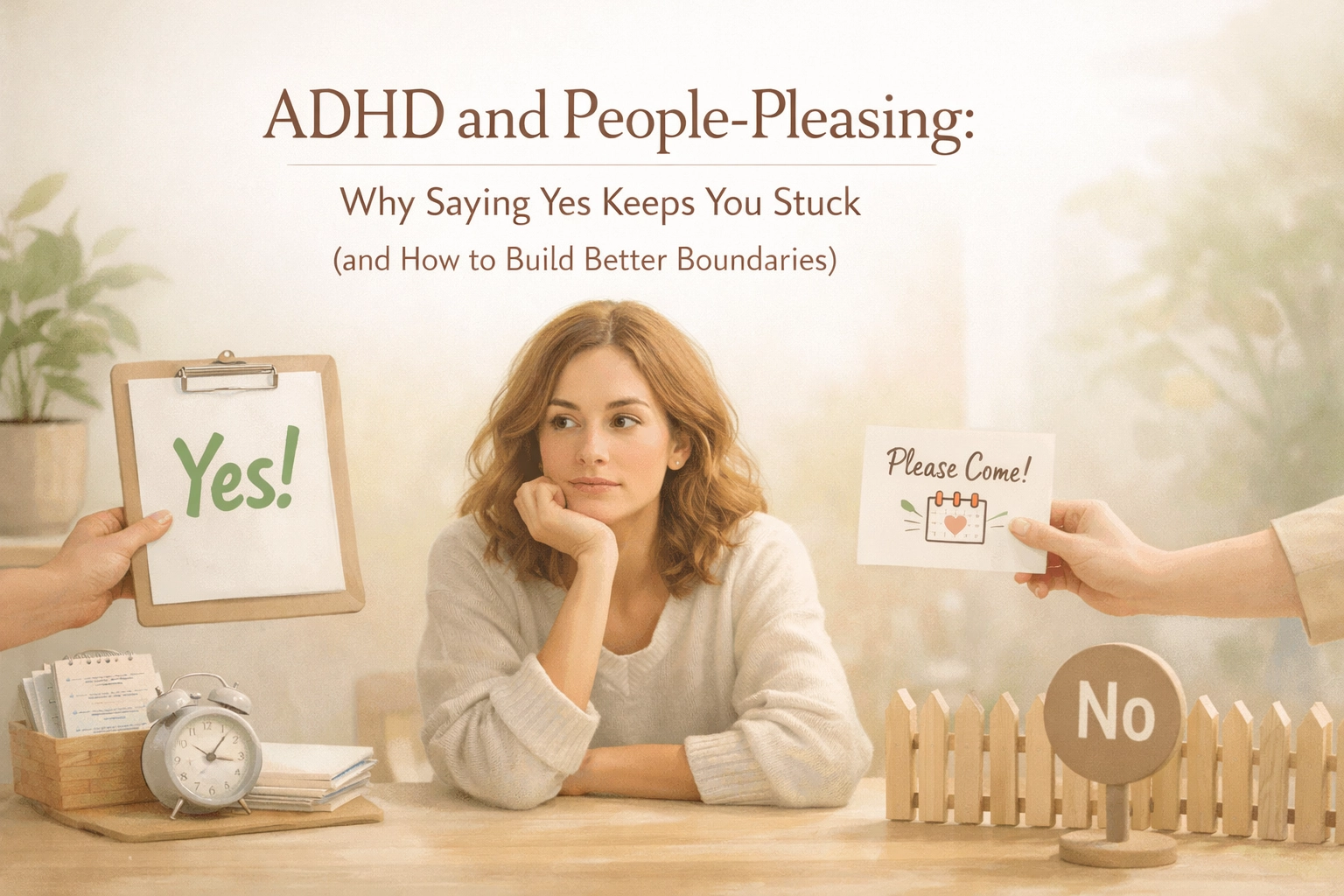
ADHD and People-Pleasing: Why Saying Yes Keeps You Stuck (and How to Build Better Boundaries)

Have you ever said “yes” to something before your brain even had a chance to check your schedule?

Maybe a coworker asked you to help with a project. Or a friend asked you to watch their dog. Before you could even think about the five loads of laundry sitting in your dryer or the bills you forgot to pay, your mouth just opened and said, “Sure! I’d love to!”

Then, two minutes later, you felt that heavy sinking feeling in your stomach. You realized you don’t have the time. You don’t have the energy. And honestly? You don’t even want to do it.

This is the cycle of ADHD people-pleasing. It’s not just you being “nice.” It’s a part of how your ADHD brain works. At Heal and Thrive Therapy and Coaching, we see this every single day. We call it the “Auto-Yes” reflex, and it’s keeping you stuck, tired, and overwhelmed.

The “Auto-Yes” and the ADHD Brain

Why is it so hard for us to just say, “Let me check my calendar and get back to you”?

For an ADHD brain, there are three big reasons why we get stuck in the ADHD approval-seeking trap.

1. The Speed of Impulsivity

ADHD makes our brains move fast. Sometimes, our mouths move even faster. When someone asks us for a favor, our brain sees it as a “now” problem. We want to solve the problem immediately. Saying “yes” is the fastest way to make the interaction feel “done.” By the time our logical brain catches up to realize we are already burnt out, the promise is already made.

2. The Dopamine Hit

Helping people feels good. For a brain that is always hunting for a “gold star” or a hit of dopamine, making someone else happy is a quick fix. We get a little rush when someone says, “Oh, thank you so much! You’re a lifesaver!” That tiny moment of feeling like a hero masks the fact that we are drowning in our own to-do lists.

3. Rejection Sensitivity (The Big Hurt)

This is the big one. Most people with ADHD deal with something called Rejection Sensitive Dysphoria (RSD). This means that the idea of someone being mad at us, or even just disappointed, feels like a physical punch to the gut.

We say yes because we are terrified of the “No.” We worry that if we set ADHD boundaries, people will think we are lazy, selfish, or mean. We’ve spent so much of our lives feeling like we’re “too much” or “failing” at basic tasks, so we try to make up for it by being the person who always says yes.

Why Saying Yes Keeps You Stuck

You might think that saying yes makes your life easier because it avoids conflict. But for the ADHD brain, chronic people-pleasing is like pouring gasoline on a fire.

When you over-commit, you run out of “brain fuel.” This leads to ADHD masking at work, where you act like everything is fine while you are actually screaming on the inside.

Eventually, the “yeses” pile up so high that you start dropping balls. You miss deadlines. You forget the very thing you promised to do. This leads to a massive amount of shame. You feel like a failure, so what do you do? You try to please people more to fix it. It’s a loop that never ends.

It also makes ADHD and decision paralysis much worse. When your plate is full of other people’s problems, choosing what to do for yourself feels impossible.

How to Build ADHD Boundaries (Without Feeling Like a Jerk)

The good news? You can train your brain to stop the Auto-Yes. It takes practice, and it feels a little scary at first, but it is the only way to actually thrive.

Here is how we start building ADHD boundaries at Heal and Thrive Therapy and Coaching.

The “24-Hour Buffer” Rule

Since impulsivity is our biggest enemy, we need to build a wall between the request and the answer.

Next time someone asks you for something, use a script. You don’t have to say “no” yet. You just have to say, “I need to check my schedule. I’ll let you know by tomorrow.”

This gives your ADHD brain time to cool down. It lets the “dopamine high” of being helpful wear off so you can look at your actual capacity. If you struggle with this, you might realize you’re also struggling with ADHD and time blindness, making it hard to know how long things actually take.

Practice the “Low-Stakes No”

Setting boundaries is a muscle. You don’t start by lifting 500 pounds. You start with the 5-pound weights.

Practice ADHD saying no to small things. No, you don’t want the extra receipt. No, you can’t hop on a “quick” call right this second. No, you don’t want to go to that movie you aren’t interested in.

The more you say “no” to small things, the less scary it feels when the big things come up. You’ll start to realize that the world doesn’t end when you say no. People usually just say, “Okay!” and move on.

The “Big Hurt” of rejection you’re expecting usually doesn’t happen.

Understanding the “Why” Behind the Fear

A lot of our people-pleasing comes from how we handled relationships growing up. If you always felt like you had to be “good” to be loved, saying no feels dangerous.

This is especially true if you deal with ADHD and rejection sensitivity in relationships. You might feel like your friendships are fragile. You think, “If I stop doing favors, will they still like me?”

Real talk: A friendship that only exists because you say “yes” isn’t a friendship. It’s a job. And you’re working it for free.

Reframing Your “No”

When you say “no” to someone else, what are you saying “yes” to for yourself?

  • Saying “no” to an extra work task is saying “yes” to sleep.
  • Saying “no” to a social event is saying “yes” to a house that isn’t a mess.
  • Saying “no” to a favor is saying “yes” to your own mental health.

At Heal and Thrive Therapy and Coaching, we help you realize that your time and energy are limited resources. You are not a superhero with infinite batteries. You are a person with a brain that needs rest, focus, and space to breathe.

Scripts for the ADHD Brain

Sometimes, the hardest part of ADHD people-pleasing is just finding the words. When we are put on the spot, our brain goes blank.

Here are a few ADHD-friendly scripts you can keep in your notes app:

  • For Work: “I’d love to help with that, but my plate is currently full with [Project X]. If I take this on, [Project X] will be delayed. Which one should I prioritize?”
  • For Friends: “That sounds so fun! I’m actually at my limit for social stuff this week, so I’m going to pass this time. Let’s catch up later!”
  • For Family: “I can’t commit to that right now. I’m working on not over-scheduling myself so I don’t burn out. Thanks for understanding!”

Notice that you don’t have to lie. You don’t have to make up a fake excuse. Being honest about your capacity is a sign of respect, for yourself and for them. Stop the Spiral Before It Starts

If you’ve already said “yes” and you’re currently panicking, it’s okay to change your mind.

Yes, it feels awkward. Yes, you might feel that RSD sting. But it is better to cancel now than to disappear, ghost them, or show up feeling resentful and exhausted.

You can say: “Hey, I realized I over-committed myself and I won’t be able to do [Task] after all. I’m so sorry for the late notice, but I wanted to let you know as soon as possible.” The more you do this, the more you take your power back.

You Don’t Have to Do This Alone

Breaking the habit of ADHD people-pleasing is hard. It’s not just about “learning to say no.” It’s about healing the part of you that thinks your only value is what you do for others.

At Heal and Thrive Therapy and Coaching, we work with ADHD adults to dismantle these patterns. We help you look at the shame, the fear of rejection, and the impulsivity that keeps you stuck in the “yes” trap.

You deserve to have a life that belongs to you: not a life that is just a collection of favors for everyone else.

If you’re tired of being the “reliable” one who is secretly falling apart, we’re here to help. You can learn more about our approach on our blog or reach out to start building a life that actually feels like yours.

ADHD and Sleep Revenge: Why Nighttime Feels Like Your Only Quiet (and What to Do Instead)

It’s 11 PM. You’re exhausted. Your body is basically screaming at you to go to bed. But instead, you’re scrolling through your phone, reorganizing your bookshelf, or suddenly deciding tonight is the night you’re finally going to learn how to make sourdough bread from scratch.

Sound familiar?

Welcome to revenge bedtime procrastination ADHD style, where the only time your brain feels like it actually belongs to you is when you should be sleeping.

What Is Revenge Bedtime Procrastination (And Why Does It Have Such a Dramatic Name)?

Let’s start with the term itself. “Revenge bedtime procrastination” sounds like something out of a dramatic thriller, right? But it’s actually pretty spot-on.

The concept originated in China, where people with demanding work schedules started staying up late just to reclaim some personal time. It’s not really about being a night owl or being more productive at night (though those can play a role). It’s about taking back control of your time when you feel like the whole day has been stolen from you.

For those of us with ADHD, this hits different. We’re not just dealing with long work hours. We’re dealing with:

  • A brain that never quite feels “caught up”
  • Days where everyone wants something from us
  • Constant task-switching and interruptions
  • Decision fatigue from hundreds of micro-choices
  • That feeling that we spent all day being productive for everyone else but never got to the stuff we actually wanted to do

So when nighttime rolls around? That’s when we finally get our time back. That’s when nobody is asking us questions, sending us emails, or expecting us to remember things. The phone stops buzzing. The demands stop coming. And suddenly, staying awake until 2 AM feels less like self-sabotage and more like self-care.

Except… it’s not. And we know it’s not. But we do it anyway.

The Real Reason Nighttime Feels Like Your Only Quiet

Here’s what most sleep advice gets wrong: it treats revenge bedtime procrastation like it’s just bad habits or poor time management. Like if you just tried harder or set better boundaries during the day, you’d magically go to bed on time.

But that’s not what’s happening.

For people with ADHD, nighttime serves three critical psychological needs that aren’t being met during the day:

1. Autonomy: Finally, Nobody Wants Anything From You

During the day, your ADHD brain is constantly being interrupted. Even if you work from home alone, you’re still dealing with notifications, emails, the dog needing to go out, that package delivery, the dentist calling to confirm your appointment, and your brain randomly remembering you never responded to that text from three days ago.

Every interruption costs you. Not just the two minutes it takes to deal with it, but the 15-20 minutes it takes your ADHD brain to get back into whatever you were doing before.

By the time the day is over, you haven’t had a single uninterrupted moment that belonged completely to you. Nighttime becomes the only space where you get to decide what happens next. Nobody is making demands. You’re not “on call” for anyone. And that feeling of autonomy? It’s intoxicating.

This isn’t about being selfish. It’s about finally getting to exist without having to perform, respond, or produce for someone else.

2. Nervous System Regulation: You’re Finally Coming Down

Let’s talk about what your nervous system has been doing all day.

If you have ADHD, your nervous system is likely running hot most of the time. You’re constantly in a state of mild (or not-so-mild) activation because your brain is working overtime to:

  • Focus on things that don’t naturally interest you
  • Remember tasks and appointments
  • Regulate emotions that come in waves
  • Filter out distractions and stay on track
  • Make decisions about everything from what to eat to which email to respond to first

That’s exhausting. And most of us don’t realize how revved up we are until everything finally stops.

Nighttime is when your nervous system finally gets permission to downregulate. The demands stop. The stimulation decreases. And even though you’re tired, your body is still trying to process and release all that built-up activation from the day.

ADHD sleep delay isn’t just about procrastination, it’s often your nervous system trying to find equilibrium after spending 12+ hours in overdrive.

3. Lack of Boundaries During the Day: You Never Actually Stopped

Here’s the hard truth: many of us with ADHD struggle with boundaries. Not because we don’t want them, but because our brains make it really hard to enforce them.

We say yes when we mean no. We respond to texts immediately even when we don’t have the bandwidth. We keep working past when we said we’d stop because we hyperfocused and lost track of time. We let other people’s urgency become our emergency because rejection sensitivity makes it hard to disappoint people.

By the time nighttime rolls around, we haven’t actually had boundaries all day. We’ve just been available. Responsive. “On.”

So staying up late becomes our way of creating a boundary after the fact. It’s not healthy or sustainable, but it’s the only boundary we feel like we can actually control. Nobody can ask us for anything if they’re all asleep.

Why ADHD Night Productivity Is a Double-Edged Sword

Now, I know what you’re thinking. “But I actually am more productive at night! That’s when I get my best work done!”

And you might be right. A lot of people with ADHD genuinely do experience ADHD night productivity. There are real reasons for this:

  • Fewer distractions: The world is quieter, notifications have slowed down, and there’s less sensory input competing for your attention
  • Delayed circadian rhythm: Many people with ADHD have a naturally delayed sleep-wake cycle, meaning they’re biologically more alert later in the evening
  • Hyperfocus opportunities: With fewer interruptions, it’s easier to drop into that deep focus state that feels impossible during the day

But here’s the catch: even if you can be productive at night, it doesn’t mean this pattern is sustainable or healthy. Sleep deprivation compounds ADHD symptoms in ways that make everything harder:

  • Worse executive function
  • More emotional dysregulation
  • Increased impulsivity
  • Poorer working memory
  • More difficulty with focus and attention

So you might get stuff done at midnight, but you’re paying for it with interest the next day. And the next. And the cycle continues.

What to Do Instead (That’s Not Just “Go to Bed Earlier”)

Okay, so if the answer isn’t just forcing yourself to go to bed earlier or trying harder to have better sleep hygiene, what actually works?

The key is addressing the root causes: autonomy, nervous system regulation, and boundaries. Here’s how:

Create Protected Time During the Day

If nighttime is appealing because it’s the only time that feels like “yours,” then you need to carve out protected time during the day that serves the same purpose.

This isn’t about productivity. It’s about autonomy.

Set aside 30-60 minutes where:

  • You don’t check email or messages
  • You’re not “on call” for anyone
  • You get to do something purely because you want to
  • Nobody can interrupt you

It might be early morning before anyone else is awake, a lunch break where you actually leave your desk, or a specific hour in the afternoon where you’re unavailable. The timing matters less than the consistency and the boundary.

Help Your Nervous System Downregulate Earlier

Instead of waiting until midnight for your nervous system to finally calm down, build in intentional transition time between your “on” hours and your evening.

This isn’t about bubble baths and meditation apps (though if those work for you, great). This is about giving your nervous system what it actually needs:

  • Movement: A walk around the block, stretching, dancing to one song
  • Sensory regulation: Dim lighting, weighted blankets, calming music, or even just sitting in silence for five minutes
  • Brain dumps: Get everything out of your head and onto paper so you’re not trying to remember it all night
  • Screen-free time: Even 20 minutes without screens before bed can help signal to your brain that the day is ending

Practice Saying No Earlier in the Day

If part of the revenge is because you spent all day being available to everyone else, start building your “no” muscle during daylight hours.

This is hard. Especially with ADHD and rejection sensitivity. But boundaries during the day mean you won’t feel the need to revenge-reclaim your time at night.

Start small:

  • “I’ll get back to you tomorrow on that”
  • “I’m not available after 7 PM”
  • “I need to think about that before I commit”
  • “That doesn’t work for my schedule”

The more you protect your time during the day, the less you’ll feel like you need to steal it back at night.

Reframe Your Relationship With Sleep

Instead of thinking about sleep as the thing that’s stopping you from having your time, try reframing it as the thing that gives you more capacity to have your time well.

Sleep isn’t a waste of your precious hours. It’s the thing that makes those hours actually feel like yours. When you’re well-rested, you have better focus, more energy, and stronger executive function, which means you can actually enjoy and use your time during the day.

When Revenge Becomes a Pattern, Not a Choice

If you’ve read this far and you’re thinking “yeah, but I’ve tried this stuff and I still can’t make myself go to bed,” that’s a sign you might need more support.

Sometimes ADHD sleep delay is about more than just lifestyle changes. It might be:

  • Medication timing (if you take stimulants late in the day)
  • A co-occurring sleep disorder like delayed sleep phase disorder
  • Unaddressed anxiety or depression
  • Deep-rooted boundary and autonomy issues that need processing with a therapist

And that’s okay. You’re not broken. You’re just dealing with a brain that works differently, and sometimes that requires professional support.

You Deserve Rest And Autonomy

Here’s what I want you to hear: The need for personal time, autonomy, and a regulated nervous system isn’t selfish or indulgent. It’s human. And the fact that you’re trying to meet those needs: even in ways that aren’t serving you: shows that you’re paying attention to what you need.

The goal isn’t to shame yourself into better sleep habits. It’s to build a life where you don’t feel like you have to wait until everyone is asleep to finally be yourself.

You deserve both rest and freedom. And with the right support and strategies, you can have both.

Ready to Build a Life Where You Don’t Need Revenge?

If revenge bedtime procrastination ADHD patterns are running your life, you don’t have to figure this out alone. At Heal and Thrive Therapy and Coaching, we specialize in helping people with ADHD build sustainable routines, set boundaries, and regulate their nervous systems: without shame or judgment.

Whether you’re looking for ADHD coaching to build practical strategies or therapy to process the deeper patterns keeping you up at night, we’re here to help.

Learn more about our ADHD coaching services or reach out to see how we can support you.

You deserve sleep. And you deserve to feel like your time is your own( long before midnight.)

Why ADHD Makes Emails, Forms, and Phone Calls Feel Impossible

You know that form sitting on your kitchen counter? The one that’s been there for three weeks? Yeah, that one. Or maybe it’s the email you’ve been “meaning to send” for so long that responding now would basically require an apology essay. Or that phone call, oof, that phone call you need to make to schedule the thing, but first you need to check your calendar, but where did you put your calendar, and also what if they ask you a question you don’t know the answer to?

If you’re nodding along right now, welcome. You’re in good company.

I’m an ADHD coach, and I’ve sat across from countless brilliant, capable adults who feel like absolute failures because they can’t seem to do things that everyone else finds “simple.” They run entire departments at work. They remember their kid’s best friend’s mom’s birthday. They can hyperfocus for six hours on a passion project. But ask them to fill out a basic insurance form or reply to their dentist’s email? Suddenly it’s like someone asked them to solve quantum physics while juggling flaming swords.

Here’s the thing nobody tells you: This isn’t laziness. This isn’t a character flaw. And you’re definitely not alone.

Let’s talk about why your ADHD brain treats administrative tasks like they’re made of lava.

The Invisible Mountain: Why “Just Do It” Doesn’t Work

When someone without ADHD looks at an email, they see one task: read it, type a response, hit send. Done.

When your ADHD brain looks at that same email? It sees approximately 47 micro-decisions, several potential social landmines, and a task with no clear endpoint. It’s like the difference between someone handing you a sandwich versus handing you a bag of ingredients and saying “make lunch.”

The research backs this up. People with ADHD struggle with executive function, which is basically your brain’s project manager. Executive function handles things like:

  • Breaking big tasks into smaller steps
  • Deciding what’s most important
  • Starting tasks that aren’t immediately rewarding
  • Switching between different types of thinking
  • Holding multiple pieces of information in your mind at once

So when someone says “just reply to the email,” your brain hears “just simultaneously organize your thoughts, craft socially appropriate language, anticipate potential follow-up questions, manage your anxiety about saying the wrong thing, overcome your shame about taking so long to respond, and do all of this while your brain is also reminding you about that thing you forgot yesterday and that song lyric from 2004.”

No wonder we ghost people.

The Email Black Hole: Why Your Inbox Feels Like a Battlefield

Let’s start with emails, because honestly, they’re probably the worst offender for most of us with ADHD.

You open your inbox and, boom, instant overwhelm. It’s not just about reading and responding. Every single email carries invisible weight.

Decision paralysis hits hard. Each email asks you: Is this urgent? Can I reply quickly or do I need to think about this? Do I have all the information I need to respond? Should I respond now or wait until I have more time? What if I say the wrong thing? What’s the “right” amount of professional but also friendly?

The research shows that people with ADHD get stuck on these decision points and then, here’s the kicker, they avoid the whole inbox entirely. It’s called ADHD avoidance, and it’s a real psychological defense mechanism, not a personal failing.

Then there’s the prioritization nightmare. Your brain genuinely cannot tell the difference between “your insurance claim needs attention” and “someone sent you a funny meme.” They all feel equally urgent or equally ignorable, depending on the day. Important messages get buried. You miss deadlines you didn’t even realize existed.

And don’t even get me started on “mental replying.” You read an email. You think about how you’ll respond. You craft the perfect reply in your head, maybe even while you’re in the shower or driving. And then your brain files it away as “done” even though you never actually typed a single word. Days later, that person follows up, and you’re genuinely confused because you remember responding. But you didn’t. You just thought about it really hard.

Here’s the psychological weight that neurotypical folks don’t always get: Every unopened email represents a potential obligation, a possible failure, someone you might be disappointing. For ADHD brains that already struggle with rejection sensitivity and time blindness, that inbox becomes a stress factory.

Forms: The Special Kind of Hell

Oh, forms. The bane of my existence and probably yours too.

Forms are uniquely terrible for ADHD brains because they combine every single thing we struggle with into one evil document.

They require information from multiple sources. You need your insurance card (where is it?), your social security number (is it safe to have that written down?), dates from past appointments (wait, when was that again?), and probably three different addresses that you can’t quite remember.

Each blank box is a stopping point. A place where you have to switch tasks, hunt for information, make decisions about what counts as an “accurate” answer. And if you don’t have all the information right now? The form sits there. Unfinished. Judging you.

They have arbitrary deadlines that your time-blind brain can’t process. “Complete within 30 days” means nothing when your brain experiences time as “now” and “not now.” That form could sit on your counter for three weeks and your brain will still think you just got it yesterday.

And they’re boring. Let’s be honest. Forms are mind-numbingly boring, and ADHD brains are essentially allergic to boring. We need novelty, interest, challenge. A form asking you to confirm information you already know? That’s like kryptonite for our dopamine-starved brains.

The shame spiral kicks in hard with forms. You know it would take 10 minutes if you just sat down and did it. Everyone else seems to manage. Why can’t you? (Spoiler: because your brain literally works differently, and that’s okay.)

Phone Calls: The Final Boss of ADHD Administrative Tasks

If emails and forms are hard, phone calls are like the final boss level of ADHD avoidance phone calls.

Phone calls are spontaneous, real-time, and completely unscripted, which is basically everything ADHD brains find terrifying about communication.

There’s no edit button. In an email, you can rewrite that sentence 17 times until it sounds right. On a phone call? Whatever comes out of your mouth is out there. No takebacks. For those of us who already struggle with impulsivity and saying the wrong thing, this is nightmare fuel.

You can’t control the pacing. The other person might ask you a question, and your brain needs 30 seconds to process and formulate an answer, but socially you have maybe 3 seconds before the silence gets weird. Or they might talk really fast and your processing speed can’t keep up, but you don’t want to seem rude by asking them to repeat everything.

You might forget what you called about mid-conversation. True story: I once called my doctor’s office, got distracted by the hold music, and when someone finally answered, I completely blanked on why I called. Had to hang up and start over.

And there’s the preparation paralysis. Before you can make the call, you need to have all the information ready. But what information? What if they ask something you don’t know? Better to wait until you’ve gathered everything. But when is everything? How do you know when you’re ready? And now three months have passed and you still haven’t called.

The research calls this ADHD paralysis, when the anxiety about starting a task becomes so overwhelming that you literally freeze. You’re not avoiding the task because you don’t care. You’re avoiding it because thinking about it makes your nervous system light up like a Christmas tree.

The Invisibility Problem: Why Nobody Takes This Seriously

Here’s what makes this whole situation extra frustrating: administrative tasks ADHD struggles are invisible.

You can’t see someone’s brain freezing when they try to open their email. You can’t watch the internal panic attack that happens when they need to call customer service. From the outside, it just looks like procrastination. Laziness. Not caring enough.

People will say things like:

  • “It only takes five minutes, just do it”
  • “You’re overthinking this”
  • “I don’t understand why this is so hard for you”
  • “You managed to [complicated task], why can’t you [simple task]?”

And that last one? That one cuts deep. Because they’re right, the inconsistency doesn’t make sense. You can manage complex projects but not a two-line email. You can remember detailed information about your interests but forget to fill out the form that’s been on your desk for a month.

But that’s exactly how ADHD works. Interest and urgency drive our brains, not importance. Something can be objectively important and your brain will still treat it like optional background noise until there’s a crisis.

The shame that comes with this is real. I’ve had clients cry in sessions because they missed important appointments, lost job opportunities, or damaged relationships, all because they couldn’t respond to emails or make phone calls. They feel broken. Like adults who can’t do adult things.

But you’re not broken. Your brain just needs different strategies.

What Actually Helps: Building Your Own Support System

I’m not going to give you the usual “just set reminders!” advice because if that worked, you wouldn’t be here reading this. Instead, let’s talk about what actually helps with ADHD can’t respond to emails and the rest of these administrative nightmares.

For emails:

  • Set up filters and folders so your inbox automatically sorts itself
  • Use templates for common responses (you can save these in drafts)
  • Try the “two-minute rule”, if it takes less than two minutes, do it now before you even finish reading the rest of your emails
  • Have specific “email times” rather than keeping your inbox open all day
  • Accept that “inbox zero” is not a realistic goal for most ADHD brains

For forms:

  • Take a photo of the form immediately and set it as your phone’s lock screen (sounds weird, but the constant visual reminder helps)
  • Create a “form filling kit”, a folder with copies of all the documents and information you commonly need
  • Body double with someone, even virtually, while you fill it out
  • Break it into sections and do one per day if that feels more manageable

For phone calls:

  • Write a literal script of what you need to say
  • Make calls while you’re walking or doing something with your hands (movement helps ADHD brains focus)
  • Start with calling places where the stakes are low, practice on customer service lines before calling your boss
  • Use text or email options when they’re available, there’s no rule that says phone calls are superior

But here’s the real talk: Sometimes you need more than strategies. Sometimes you need support.

You Don’t Have to Figure This Out Alone

Working with an ADHD coach or therapist who actually understands these struggles can be life-changing. Not because they’ll give you a magical fix, but because they’ll help you:

  • Understand your specific ADHD patterns
  • Build systems that work with your brain, not against it
  • Process the shame and anxiety that keep you stuck
  • Create accountability without judgment
  • Develop self-compassion for these challenges

At Heal and Thrive Therapy and Coaching, we specialize in working with adults who are tired of feeling like failures over “simple” tasks. We get it because we’ve been there. We understand that ADHD coaching isn’t about fixing you, it’s about finding what works for your unique brain.

If you’re reading this and thinking “wow, someone finally gets it,” that’s your sign. You don’t have to keep struggling with this alone. You don’t have to keep beating yourself up for being “bad at adulting.”

Your brain isn’t broken. It just needs the right support.

The Bottom Line

ADHD makes emails, forms, and phone calls feel impossible because they genuinely are harder for your brain to process. The executive function challenges, decision paralysis, time blindness, and anxiety around these tasks are real neurological differences: not character flaws.

The fact that these struggles are invisible doesn’t make them less valid. The fact that they seem “small” to other people doesn’t mean they don’t massively impact your life.

You deserve support that acknowledges this reality. You deserve strategies that actually work for ADHD brains. And you definitely deserve to stop feeling ashamed about needing help with things that other people find easy.

Because here’s the truth: Everyone needs help with something. Your something just happens to be administrative tasks. And that’s totally okay.

If you’re ready to stop the shame spiral and start building systems that actually work for your ADHD brain, reach out to us. Let’s figure this out together.