

Online Therapy in California: 7 Things to Check Before Your First Session
Finding a therapist who understands your concerns can take time. Finding one who fits your schedule, location, and budget may feel even harder. Video appointments can remove a commute and make it easier to meet from home, but choosing a provider involves more than clicking a booking link.
Online therapy in California is a way to receive professional mental health care remotely, usually through a live video session. Before your first appointment, it helps to check the clinician's license, your physical location, privacy arrangements, treatment approach, emergency plan, fees, and technology. These questions protect your ability to make an informed choice—not just your internet connection.
Quick Answer: What Should You Check Before Starting Online Therapy in California?
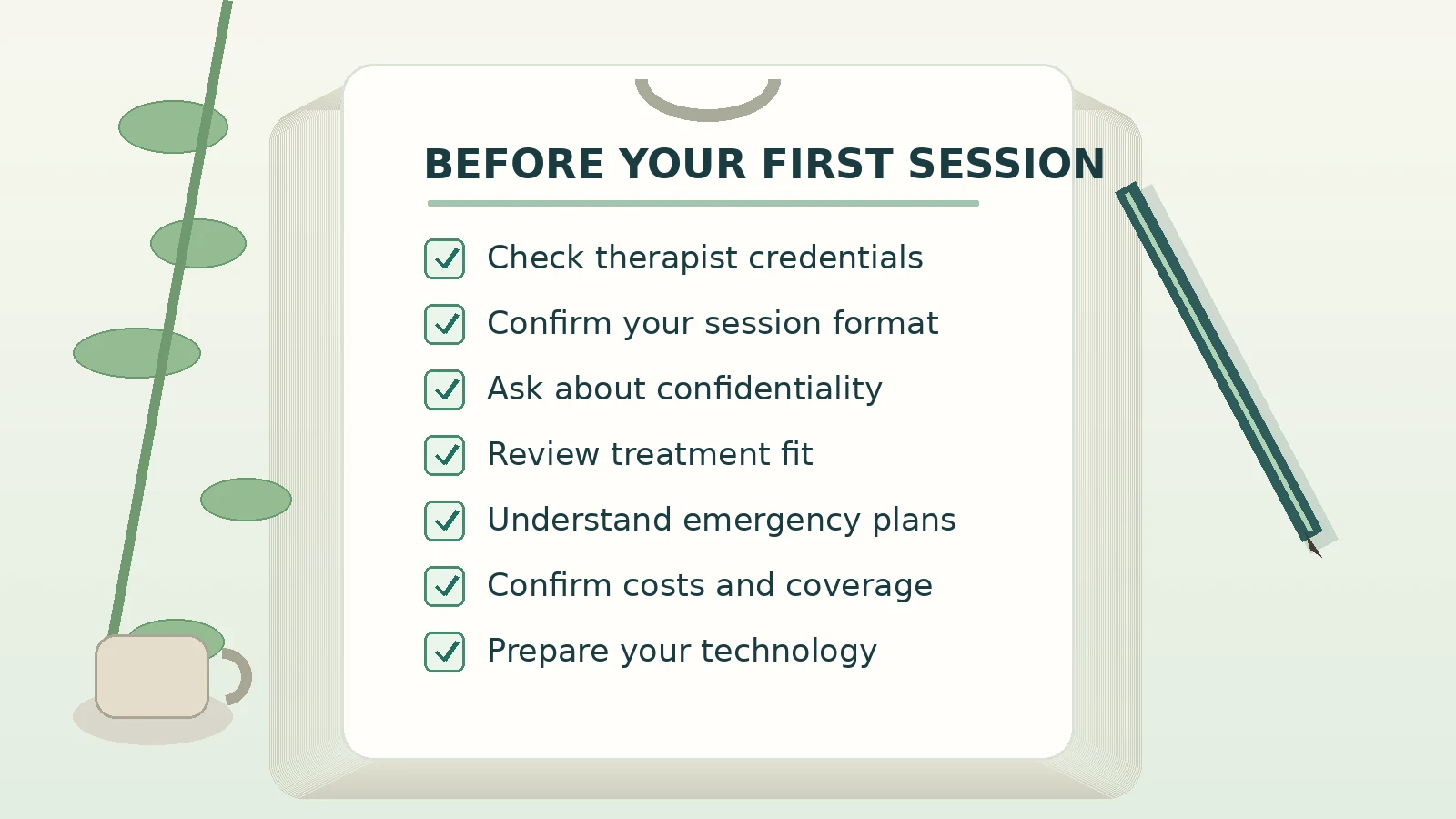
Before booking online therapy in California, confirm (1) the clinician’s authorization to treat you where you will physically be, (2) whether sessions are live video, phone, or another format, (3) privacy and informed-consent procedures, (4) whether telehealth suits your clinical needs, (5) emergency and location procedures, (6) insurance and out-of-pocket costs, and (7) technology and accessibility. A California professional license does not automatically authorize therapy in every other state. Ask the provider directly about current availability and services.
Is Online Therapy a Good Option for Mental Health Care?
Online therapy—also called teletherapy or telehealth psychotherapy—typically involves talking with a qualified mental health professional without attending an office in person. It may be helpful when commuting is difficult, a work schedule is unpredictable, or you prefer to speak from a familiar location.
A 2026 systematic review comparing live video psychotherapy with in-person care did not find a statistically significant average difference in symptom reduction across the included trials. However, the researchers emphasized the limited number of studies, variation between studies, and low certainty of the evidence. This supports video sessions as a reasonable option for many people—not a guarantee that remote treatment will suit every concern or person.
For online therapy in California, the quality and fit of the actual clinical service matter more than whether a website describes it as convenient. Here are seven checks to make before choosing a provider.
1. Verify the Therapist's California License and Your Session Location
Start with the professional's full name, license type, license number, and current status. Depending on the provider, California licenses may include LMFT, LCSW, LPCC, psychologist, or another authorization appropriate to the service. Some registered associates provide supervised services within their legal scope. A title such as “therapist” alone does not tell you which credential the person holds.
You can check many California mental health licenses through the official Department of Consumer Affairs License Search. The California Board of Behavioral Sciences directs the public to this verification system.
Where you physically are during a session matters. A provider who can lawfully see a client located in California may not automatically be authorized to provide the same service when that client is temporarily in Nevada, Arizona, or another jurisdiction. The rules can also depend on the provider's license category and any applicable temporary authorization. The California Board of Psychology's telehealth FAQ explains why interstate cases require checking the other jurisdiction's rules.
When considering online therapy in California, ask: “Are you authorized to treat me if I will be physically located in California for each session? What should I do if I travel?” Do not assume a nationwide website or a multistate brand name answers this question.
2. Confirm What Kind of Online Sessions You Are Booking
The phrase online therapy can describe different services. A live video meeting with a licensed clinician, a telephone appointment, a messaging subscription, and a self-guided mental health app are not identical. The way you communicate affects what the clinician can observe, how quickly they can respond, and whether the service matches your needs.
Ask whether you will see the same clinician consistently, how long appointments last, which platform is used, and whether telephone-only visits are possible if video fails. If a service relies on messages rather than scheduled conversations, clarify response expectations and whether the offering is clinical psychotherapy at all.
For online therapy in California, the treatment should be explained in ordinary language. You should know what you are buying before entering payment details. A scheduling portal, educational app, and live psychotherapy can all be useful, but they have different functions and should not be presented as interchangeable.
3. Ask About Privacy, Confidentiality, and Telehealth Consent
Licensed mental health professionals have confidentiality responsibilities, with legal and safety exceptions. Remote care introduces additional practical questions: Who can hear you at home? What happens if another person enters the room? How is your appointment link shared? Is the session recorded, and under what circumstances?
California requires informed consent to the use of telehealth; consent may be verbal or written and must be documented. For Board of Behavioral Sciences licensees and registrants, telehealth rules also address potential risks and limitations and the professional's license information. You can review the Board's patient-facing telehealth guidance for details.
The U.S. Department of Health and Human Services recommends choosing a private location, using headphones if necessary, and being mindful of nearby smart devices that might overhear a conversation. Ask how the provider protects appointment information and what privacy policy applies. Do not assume that a familiar video app is automatically appropriate for handling sensitive health information.

4. Check the Treatment Approach and Whether Telehealth Fits Your Needs
Remote care is a delivery format, not a therapy method. A clinician might use cognitive behavioral therapy, interpersonal therapy, psychodynamic approaches, or another evidence-informed treatment over video. Ask what approach they recommend, why it fits your concerns, and how you will review progress.
Online sessions may work well for many types of outpatient care. But severe symptoms, certain safety concerns, limited privacy, or a need for specialized assessment may make another setting or level of care more appropriate. A qualified clinician should discuss those needs rather than promising that video sessions work for everyone.
When evaluating online therapy in California, consider therapeutic fit as well as convenience. You should feel able to ask questions, clarify expectations, and discuss a technique that is not helping. Our guide to what psychotherapy is and how it works explains the treatment process in greater detail.
5. Understand the Emergency Plan and Why Your Location Is Requested
At the beginning of a remote appointment, a therapist may ask where you are and how to reach you if a safety concern arises. That can feel unexpected when the therapist already has your home address. But you may be speaking from a different location that day.
California's Board of Behavioral Sciences telehealth standards require its licensees and registrants to obtain and document the client's present-location address at the start of each session and to make reasonable efforts to identify relevant emergency resources near the client. Requirements can vary by license type, so ask your specific provider how their process works.
Before starting online therapy in California, ask what happens if the call drops during an urgent conversation, who should be contacted if you need immediate help, and what the practice expects you to do in a crisis. Online outpatient therapy is not an emergency-response service. For immediate danger, call 911; for suicide or emotional crisis support in the United States, call or text 988.
6. Confirm Insurance, Fees, and Cancellation Policies
A remote appointment is not automatically cheaper than a visit to an office. Ask for the session fee, appointment length, cancellation policy, and whether there are separate intake charges. If you have insurance, verify the clinician's network status, coverage for the specific telehealth service, copay, deductible, and any authorization requirements directly with the provider and plan.
Some Californians use Medi-Cal, employer-sponsored coverage, or another payer. Rules differ by plan, service, provider, and modality, and coverage can change. The California Department of Health Care Services telehealth FAQ outlines relevant Medi-Cal considerations, but it is not a substitute for checking your current benefits.
For online therapy in California, transparent pricing is part of informed choice. If the practice is out of network, ask whether it supplies a superbill and whether your insurer will reimburse anything; a superbill alone does not guarantee repayment.
7. Test the Technology, Accessibility, and Your Private Space
A calm appointment is easier when you are not searching for a charger or troubleshooting audio after the session begins. Before your first visit, open the portal instructions, check your internet connection, test your microphone and camera, and choose a space where other people cannot easily hear.
If you share your home, consider headphones or a private room. If you have hearing, visual, language, or other accessibility needs, ask about available accommodations and whether the format is workable. A reliable fallback plan matters too: will the clinician call you if the connection fails, or will the session need to be rescheduled?
The goal of online therapy in California is to make treatment accessible without overlooking the conditions that allow you to participate comfortably. If you repeatedly cannot secure privacy where you live, an in-person appointment or another appropriate arrangement may be better.
Seven Checks at a Glance
| What to check | Ask the provider | Why it matters |
|---|---|---|
| License and location | “What is your California credential, and where may I join from?” | Confirms professional authorization |
| Session format | “Is this live video with a consistent clinician?” | Clarifies what service you receive |
| Privacy and consent | “How do you protect information and explain telehealth risks?” | Supports informed choice |
| Treatment fit | “Why is this approach appropriate for my needs?” | Connects care to clinical goals |
| Safety plan | “What happens in an emergency or dropped call?” | Establishes a response procedure |
| Cost | “What will I pay, and what will my insurance cover?” | Reduces billing surprises |
| Technology | “What equipment or accommodations will I need?” | Makes sessions more accessible |
Use this checklist as a starting point. The right questions may differ for couples therapy, group treatment, care for a minor, or people who need specialized clinical services.
How to Prepare for Your First Online Therapy Session
A simple preparation plan can reduce uncertainty without turning therapy into a project. A day or two before the appointment, complete any forms you understand and ask about anything unclear. Write down the two or three concerns that led you to seek care, plus any practical questions about scheduling, cost, or confidentiality.
On the day, allow a few minutes to connect, keep your phone nearby as a backup, and find a private place to sit. Your therapist may discuss informed consent, relevant history, symptoms, goals, and what to expect from future meetings. You are not required to tell your entire life story in the first hour. Ask for clarification whenever you need it.
The first appointment is also a chance to notice fit. Does the clinician explain things clearly? Can you raise a concern? Is the proposed plan understandable? If you are unsure how to evaluate credentials or experience, see our guide to choosing a therapist in California.
What If You Travel Outside California During Treatment?
Let the therapist know before traveling. Being an established client does not, by itself, remove interstate practice requirements. A clinician may be permitted to provide services across state lines in a particular situation, may need a different authorization, or may not be able to see you until you return.
California psychologist rules include specific provisions and temporary-practice pathways that differ from those governing LMFTs, LCSWs, and LPCCs. The safe approach is to confirm the relevant location and licensing requirements for your clinician and destination in advance. You can also ask what referral or continuity-of-care options exist if a session cannot legally proceed.
Exploring Online Therapy With Heal & Thrive
If you are considering online therapy in California, Heal & Thrive serves people seeking therapy and coaching through its Lake Forest, Orange County practice. Explore Heal & Thrive's therapy services to learn about the practice and ask whether appropriate telehealth appointments are currently available for your needs and location.
Before booking, confirm the individual clinician's license, current format options, fees, and whether the service fits your concerns. View therapy services at Heal & Thrive to prepare for that conversation. An informed first step matters more than finding a promise of instant results.
Sources and Further Reading
- California Board of Behavioral Sciences — Telehealth Information and FAQs
- California Board of Psychology — Telehealth FAQ
- California Department of Consumer Affairs — License Search
- HHS — Telehealth Privacy and Security Tips for Patients
- California DHCS — Telehealth Frequently Asked Questions
- 2026 Systematic Review — Video-Based vs Face-to-Face Psychotherapy
This article provides general education, not legal advice, a diagnosis, or an individualized treatment recommendation. Telehealth rules, licenses, payer requirements, and practice availability should be verified before publication and booking. Clinical and regulatory statements should receive qualified professional review.
Frequently Asked Questions
No. Professional authorization depends on the provider's license category and the laws that apply where you are physically located. Verify California authorization or another applicable lawful pathway before booking.
Some research finds similar average outcomes for live video psychotherapy and in-person treatment across studied conditions. Evidence has limitations, and the right format depends on your needs, preferences, privacy, and clinical situation.
For professionals regulated by the California Board of Behavioral Sciences, telehealth standards require obtaining and documenting the client's present-location address at the start of each session. Other license categories may have different requirements.
Not automatically. Your therapist must determine whether treatment is legally permitted in the jurisdiction where you will be during the session. Tell the practice about travel before the appointment.
It may, depending on your plan, provider network, service, and eligibility. Ask the practice and your insurer about the exact telehealth visit, copays, deductibles, and any authorization requirements.
Discuss alternatives with the clinician, such as headphones, a safer private location, or an in-person option when available. Privacy and clinical suitability matter; a therapist can help consider whether a different format would be more appropriate.