

How to Choose a Therapist in California: 7 Things to Check
Finding the right therapist in California involves more than searching profiles. Learn seven practical checks for credentials, fees, telehealth, and personal fit.
Educational guide · Publication date and author to be set in WordPress
Quick Answer
To choose a therapist in California, confirm their license or registration through the state’s official lookup, ask about experience with your concerns, understand their treatment approach, review fees and insurance, and check whether in-person or telehealth sessions suit you. Consider your comfort during an initial conversation and ask about availability, privacy, and what therapy will involve. The best choice is a qualified professional whose services match your needs and circumstances.
Table of Contents
Finding a therapist can feel surprisingly complicated. You might see profiles listing different licenses, treatment approaches, insurance arrangements, and virtual appointments, yet still wonder who would be the right person to talk to. If you’re searching in Los Angeles, Orange County, the Bay Area, or anywhere else in California, a clear process can make the decision easier.
Learning how to choose a therapist in California starts with verifying professional credentials. It also means considering practical questions: Does this person work with your concerns? Can you afford sessions? Do you feel comfortable talking with them? Here are seven checks to make before you book.
1. Verify Their California License or Registration
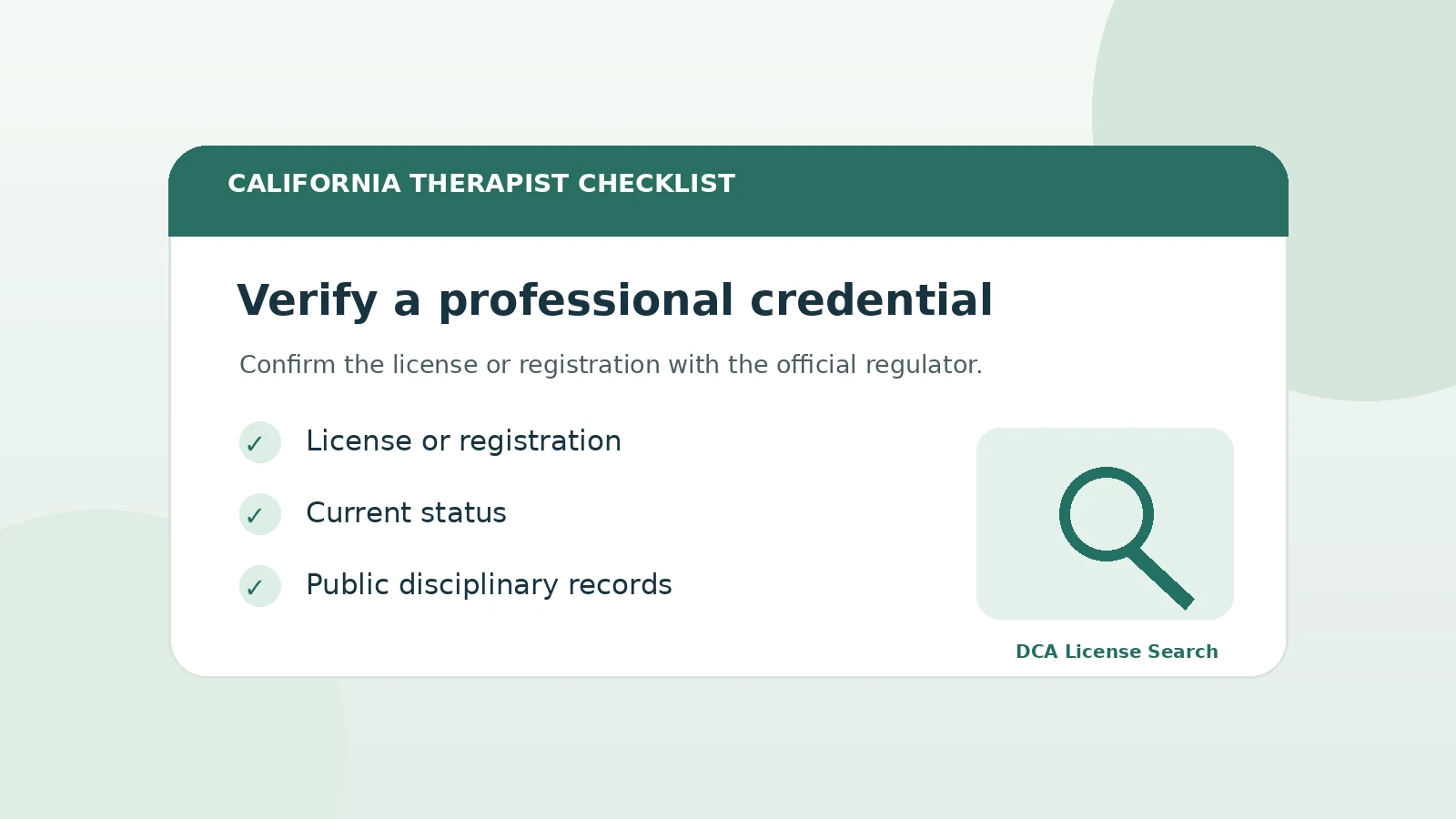
Before comparing websites or reviews, check the provider’s professional credentials. California regulates several types of mental health professionals. The Board of Behavioral Sciences (BBS) oversees Licensed Marriage and Family Therapists (LMFTs), Licensed Clinical Social Workers (LCSWs), Licensed Professional Clinical Counselors (LPCCs), and certain other professionals. The California Board of Psychology regulates licensed psychologists.
Ask for the therapist’s full name, license or registration type, and number. Then use the official Department of Consumer Affairs license search to confirm that the credential is current and review publicly available disciplinary information. The BBS verification guide explains how its records are displayed.
Not everyone providing therapy is independently licensed. Registered associates may provide clinical services under required supervision. If you are considering an associate, ask who supervises their work and confirm their registration. A professional credential alone does not tell you whether someone is a good fit, but verification is an essential first step.
Question to ask: “What is your California license or registration number, and can I verify it online?”
2. Look for Experience With Your Specific Concerns
A therapist may be qualified yet have limited experience with the reason you’re seeking help. Think about what you want to address: anxiety, depression, relationship conflict, grief, trauma, parenting stress, life transitions, or a combination of issues.
Read the provider’s description of their clinical interests. Then go beyond broad phrases such as “I work with adults.” Ask how they typically support people with concerns similar to yours and whether they have relevant training. Someone seeking couples therapy, for example, may have different needs from someone looking for individual help with panic symptoms.
Your age, language preferences, family situation, and cultural background may also matter. You can ask whether the therapist has experience working with your community or is comfortable adapting care to your circumstances. No therapist has to share your identity to offer effective care, but respectful curiosity and relevant experience are useful signs.
If your needs fall outside their expertise, a responsible professional should be willing to discuss a referral.
3. Understand Their Approach to Therapy
Therapy is not one single technique. A provider may use cognitive behavioral therapy (CBT), acceptance and commitment therapy (ACT), psychodynamic therapy, family-systems approaches, or a combination suited to the client.
You do not need to become an expert in these methods. Ask what sessions typically look like. Will you work on practical skills between appointments? Explore patterns and relationships? Set measurable goals? How will the therapist know whether the approach is helping?
An evidence-informed plan should reflect your concerns and preferences rather than promising a guaranteed outcome. You can also ask what the therapist would do if the initial approach was not helping after a reasonable period.
If professional titles are confusing, our guide to the difference between a psychotherapist and a therapist explains the terminology. For this decision, prioritize the clinician’s verified qualifications, competence, and proposed care over a marketing label.
Question to ask: “What approach would you consider for my situation, and how would we review progress?”
4. Check Insurance, Fees, and Payment Options
Financial clarity is part of choosing sustainable care. Before scheduling, ask for the full session fee, appointment length, payment timing, cancellation policy, and any charges for missed sessions or paperwork.
If you have insurance, confirm network participation directly with both your plan and the therapist’s office. Ask about deductibles, copays, referrals, telehealth coverage, and whether out-of-network claims are possible. A provider appearing in an online directory does not necessarily guarantee coverage for your particular plan.
If you are uninsured or choose not to use insurance, ask whether a sliding-scale rate or other payment arrangement is offered. Under the federal No Surprises Act, uninsured and self-pay patients are generally entitled to a Good Faith Estimate of expected charges when scheduling care sufficiently in advance or requesting one. The Centers for Medicare & Medicaid Services explains these protections.
Do not assume every provider offers reduced fees. Ask directly, and compare the costs you can realistically sustain over several visits.
5. Consider Online vs. In-Person Therapy
California residents may have access to in-person appointments, virtual therapy, or both. Neither format is automatically best for everyone. Consider privacy at home, travel time, internet reliability, mobility, scheduling, and whether you prefer meeting face-to-face.
If you choose telehealth, verify that the clinician is legally authorized to serve a client located in California. The BBS explains that practitioners serving California clients generally need appropriate California authorization, although limited exceptions may apply in specific circumstances. Requirements can also depend on the professional license involved.
Ask how video sessions are conducted, how privacy is protected, and what happens if your connection fails. Your therapist should explain informed consent, relevant limitations of telehealth, and emergency arrangements. If you travel or move to another state, tell your provider before your next online session; your physical location can affect whether they may continue treating you.
For clients in Lake Forest or elsewhere in Orange County, travel and scheduling needs may influence the format that works best.
6. Evaluate Communication, Boundaries, and Personal Fit
Qualifications are essential, but so is the working relationship. The American Psychological Association emphasizes that comfort and rapport are important considerations when choosing a therapist.
During a consultation or first appointment, notice whether the provider listens carefully, explains unfamiliar terms, and welcomes reasonable questions. Do they discuss confidentiality and its legal limits? Are fees, scheduling, and expectations clear? Do they respect your goals and boundaries?
You do not have to feel completely comfortable discussing painful topics on day one. Therapy can bring up difficult emotions. However, you should be able to ask questions and receive respectful, understandable answers without feeling pressured.
Be cautious about anyone who guarantees a cure, refuses to clarify credentials, dismisses safety concerns, or pushes you toward services without explaining why. If the fit feels wrong after an initial period, discuss it with the therapist or explore another qualified provider. Changing clinicians does not mean therapy cannot help.
7. Ask the Right Questions Before Starting
A brief introductory call, when offered, can help you narrow your options. Not every practice provides a free consultation, so confirm whether there is a fee before booking.
Consider these questions:
- Are you accepting new clients, and what is your usual appointment availability?
- Are you currently licensed or registered to provide therapy to someone in California?
- What experience do you have with my main concerns?
- Which treatment approaches do you use, and why?
- What are your session fees, insurance policies, and cancellation rules?
- Do you offer in-person sessions, telehealth, or both?
- How do you protect confidentiality and explain its exceptions?
- How will we agree on goals and evaluate progress?
You do not have to ask everything at once. Start with the questions that affect whether the provider is a safe, realistic option for you. Take brief notes so you can compare providers without relying only on first impressions.
A Simple Checklist for Comparing Therapists
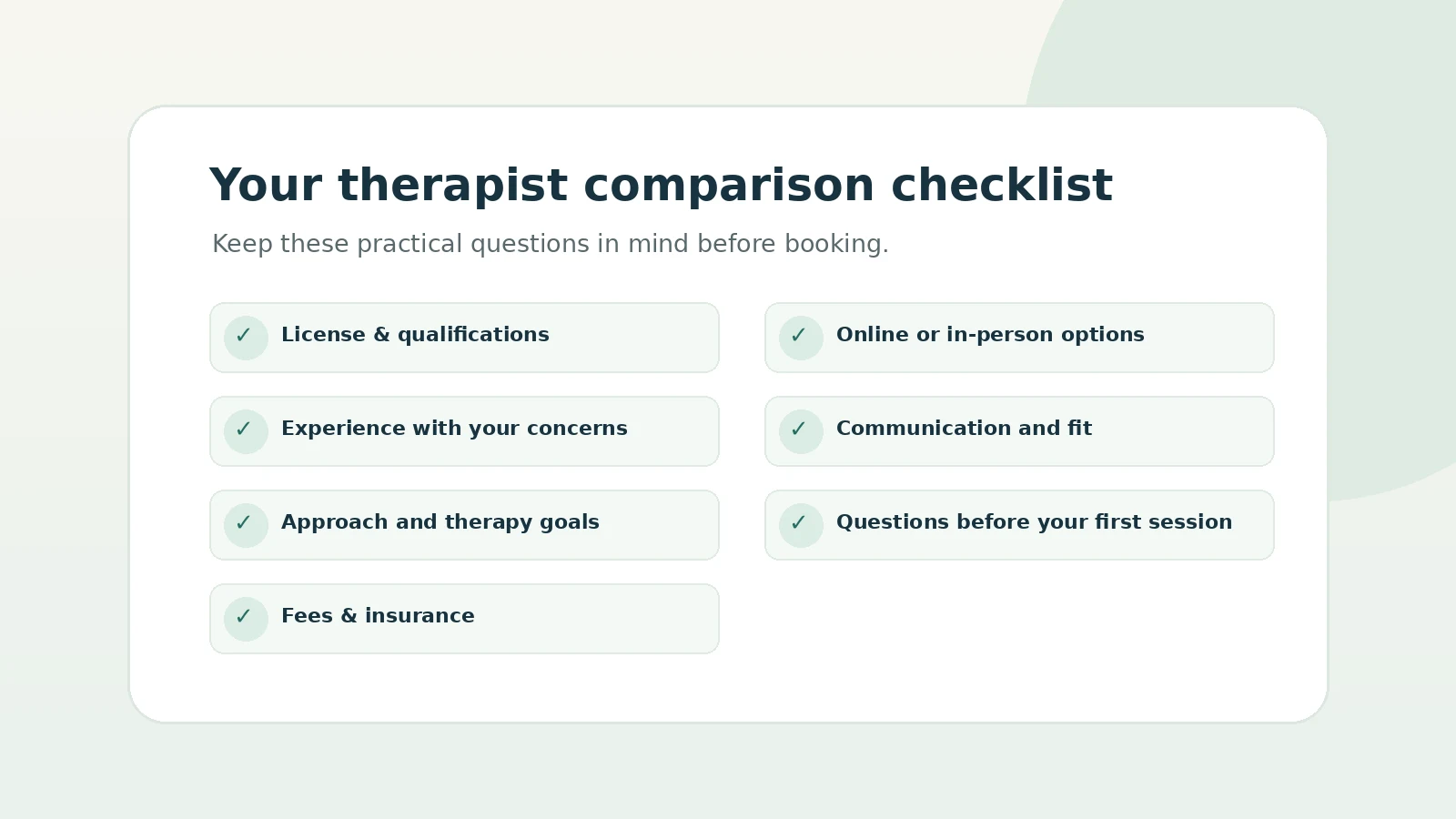
When learning how to choose a therapist in California, comparing two or three qualified candidates side by side can help. Use this short table to guide your decision.
| What to check | What you’re looking for |
|---|---|
| License or registration | Verifiable California credential and appropriate supervision, if applicable |
| Relevant experience | Familiarity with your concerns, age group, or therapy format |
| Treatment approach | Clear explanation of methods, goals, and progress reviews |
| Affordability | Transparent fees, insurance details, and cancellation policy |
| Accessibility | Practical location, scheduling, and telehealth arrangements |
| Personal fit | Respectful communication, clear boundaries, and room for questions |
Try not to choose solely because one profile has more testimonials, social media followers, or an appealing photograph. Verified qualifications, clinical fit, and practical access are more useful decision factors.
Exploring Therapy in Lake Forest and Orange County
If you are searching for therapy near Lake Forest, California, Heal & Thrive’s therapy services describe support options for individuals, couples, and families. You can also visit the Heal & Thrive homepage to learn about the practice and contact the team to ask about current availability, fees, professional credentials, and whether its services fit your goals.
Choosing a therapist is a personal healthcare decision. If a practice is not suited to your needs, asking for an appropriate referral is reasonable. The goal is to find qualified support—not to rush into the first available appointment.
If you are experiencing an immediate mental health crisis, call or text 988 in the United States. For a medical emergency or immediate danger, call 911.
Looking for Therapy in Orange County?
Explore Heal & Thrive therapy services in Lake Forest, California. Ask our team about current availability and whether the practice is a fit for your goals.
Sources and Further Reading
- California Board of Behavioral Sciences — License Verification
- California Board of Psychology — Consumer Guide to Psychological Services
- California BBS — Telehealth FAQs
- CMS — Your Rights When Not Using Insurance
- American Psychological Association — How to Choose a Psychologist
This article is educational and does not replace individualized mental health, legal, or insurance advice. Regulations and coverage can change; confirm current details with the relevant regulator, insurer, and provider.
Frequently Asked Questions
Ask for their full name and license or registration number, then search the official California Department of Consumer Affairs database at search.dca.ca.gov. Confirm the credential’s current status and review any available public disciplinary information. If the person is a registered associate, ask about required clinical supervision.
A clinician treating someone located in California generally needs appropriate authorization to practice there, even if the therapist lives elsewhere. Limited exceptions may apply, so check the rules governing the provider’s profession and ask them directly about their California authorization.
No credential is universally best for everyone. Each represents a different professional training pathway. Compare verified licensure, relevant experience, the provider’s treatment approach, and your comfort. Ask about specialized assessment needs, since not every clinician offers the same services.
Fees vary by clinician, location, session length, format, and insurance arrangements. Ask each practice for its current rates and policies. If you are uninsured or paying without insurance, you may be entitled to a Good Faith Estimate of expected charges.
It is reasonable to discuss the concern, ask whether the approach can be adjusted, or seek another qualified clinician. Developing trust can take time, but respectful communication, clear boundaries, and attention to your goals matter throughout treatment.
Start with the therapist’s license, experience with your concerns, approach, availability, fees, insurance, telehealth options, and confidentiality practices. Ask how you will set goals and review progress. Choose questions that help you make an informed decision rather than trying to conduct a formal interview.