

ADHD COACHING · UPDATED GUIDE
ADHD Coaching for Building Sustainable Habits That Stick
You download a habit tracker, choose five goals, and enjoy checking off the first few days. Then work runs late, an appointment changes, or you miss one reminder. The tracker is still on your phone, but opening it starts to feel like another task. If you have ADHD, that experience may sound familiar.
ADHD coaching and habit trackers can both support daily routines, but they do different jobs. A tracker records actions and offers reminders. A coach may help you choose a realistic goal, identify why a system is hard to use, and adjust it when circumstances change. You might benefit from either one, both, or neither. The useful question is not which option sounds more impressive; it is which support solves the problem you are actually having.
Quick Answer: Is ADHD Coaching Better Than a Habit Tracker?
ADHD coaching is not automatically better than a habit tracker. A simple tracker may be enough when you already know which behavior to practice and only need a visible reminder or record. Coaching may be useful when starting, prioritizing, adapting routines, or following through remains difficult despite trying tools. Many people use a small habit tracker alongside coaching. Neither an app nor coaching diagnoses or treats ADHD, and both should complement clinically indicated care rather than replace it.
On This Page
Why Building Habits With ADHD Can Be Difficult
A habit becomes easier to perform when repeated in a familiar context, but establishing that repetition can require remembering cues, initiating action, estimating time, and switching between activities. ADHD may affect several of these executive-function skills. The National Institute of Mental Health (NIMH) identifies planning, organization, forgetfulness, and task completion as common areas of difficulty.
Consider a goal such as walking after work. Remembering the walk is one task; finding your shoes, finishing your previous activity, leaving on time, and dealing with a changed schedule are others. A tracking app may tell you whether the walk happened, but it may not explain which step became difficult.
For ADHD habit building, the most useful first question is often, “Where did the process break down?” The answer might involve an invisible reminder, an overly ambitious goal, missing supplies, a schedule conflict, or an unrelated health concern. There is no single neurological explanation for every missed day. ADHD coaching can focus on practical barriers, while a qualified healthcare professional should assess symptoms that may require clinical care.
What Habit Trackers Can—and Cannot—Do
Habit trackers may be phone apps, paper calendars, checklists, whiteboards, or simple reminders. Their main advantage is visibility. They can show whether an action happened, prompt you at a chosen time, and help you notice repeated patterns. Some offer widgets, notifications, flexible schedules, or shared accountability.
A tracker is often a sensible starting point for ADHD habit building because it may be inexpensive, easy to test, and available without scheduling an appointment. The Attention Deficit Disorder Association (ADDA) describes several tools that can support planning, reminders, and organization, while emphasizing that the best tool depends on the user's needs.
But a tracker cannot automatically decide whether a goal is realistic, distinguish forgetfulness from an overloaded schedule, or address a sensitive personal concern. More notifications may be unhelpful if you already ignore alerts. A feature-rich app may also create extra setup and maintenance work.
Importantly, not every digital tool is equivalent. A basic checkbox app is different from a structured, studied digital cognitive behavioral therapy program. NIMH's guidance on mental health technology urges caution about app effectiveness, privacy, and unsupported claims. A visually appealing streak counter is not evidence that an app treats ADHD.
Signs a Habit Tracker May Be Enough
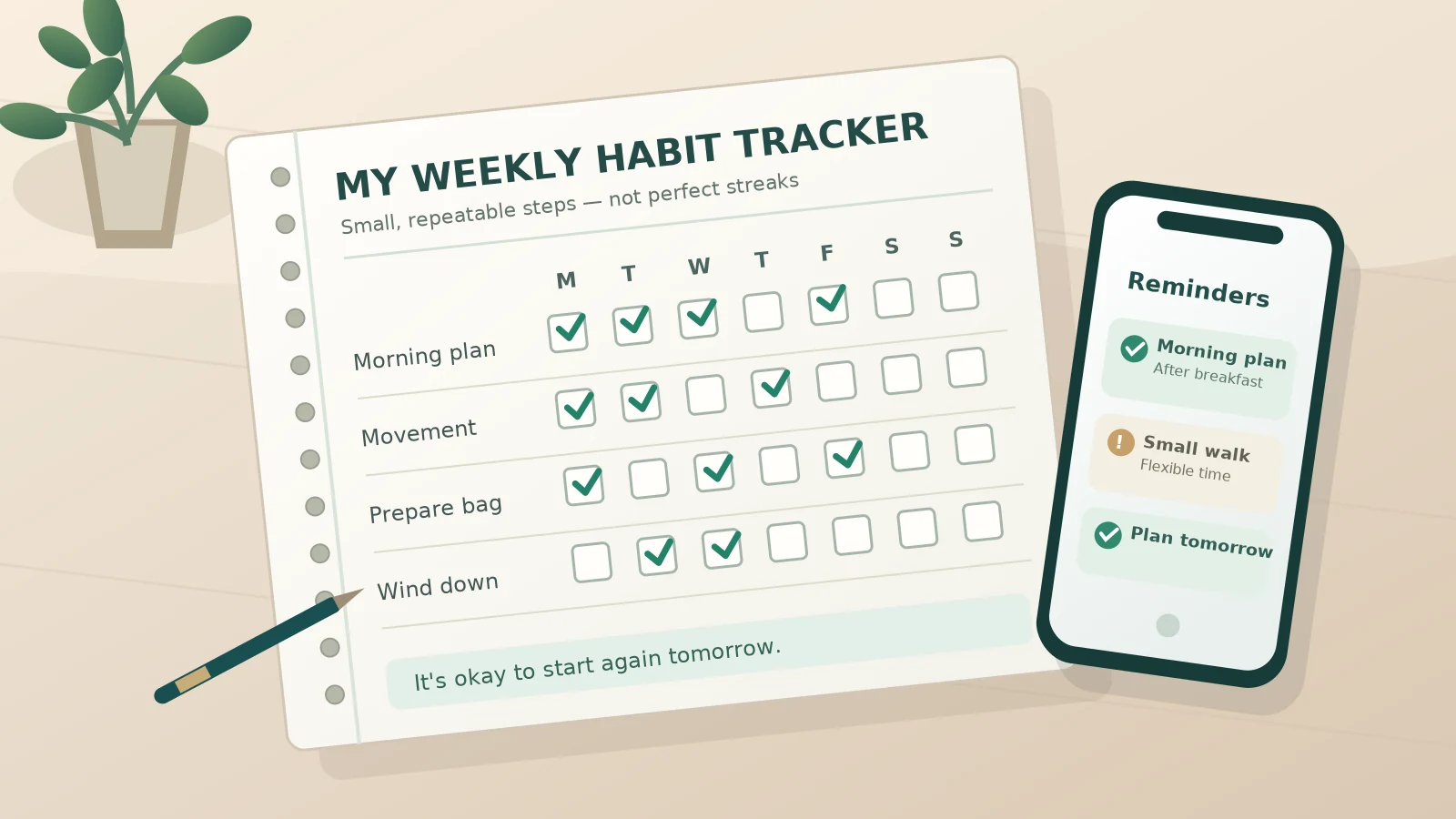
A tracker may suit you when you have one clearly defined goal, can usually start the action, find reminders useful, and do not need another person to review your plan. For example, you might want to record whether you prepared tomorrow's work bag or took a short walk at lunch.
Choose the simplest format that you will notice. If a paper card on the refrigerator works, you do not need a subscription. For ADHD habit building, ease of use matters more than the number of features.
Signs a Tracker Needs to Be Redesigned
If you spend more time customizing the tracker than practicing the behavior, reduce the setup. If missing one day makes you abandon the whole system, remove the streak requirement. If notifications arrive at inconvenient times, switch to a cue tied to something you already do.
You can also stop tracking a goal that is no longer relevant. A habit system should serve your daily life rather than become another obligation to maintain.
ADHD Coaching vs Habit Trackers: A Practical Comparison
The choice between ADHD coaching and habit trackers is not an either-or decision. Both can provide structure; their strengths and limitations are different.
| Question | Habit tracker or reminder | ADHD coaching |
|---|---|---|
| Main purpose | Records, prompts, or visualizes a behavior | Helps define goals, test strategies, and review barriers |
| Personalization | Depends on the tool and how you configure it | Can involve discussion tailored to your circumstances |
| Feedback | Usually automated or self-reviewed | Collaborative feedback from a coach |
| When plans fail | You must interpret the pattern and make changes | You can discuss what happened and revise the plan together |
| Cost and access | Often free or relatively low-cost | Usually requires scheduled sessions and a service fee |
| Clinical treatment | A general habit tracker is not ADHD treatment | Coaching is not diagnosis or clinical treatment either |
A human service is not automatically effective, and a digital tool is not automatically inadequate. Research on ADHD coaching is developing but remains more limited than the evidence base for established ADHD treatments. NIMH notes that some people find coaching helpful with everyday functioning; it does not identify coaching as a substitute for evidence-based medical or psychological care.
What ADHD Coaching Can Add to a Habit System
1. Choosing One Goal Instead of Rebuilding Your Life
An overwhelming tracker may have separate sections for exercise, hydration, reading, cleaning, meditation, and sleep. A coach can help you select the single change that would make the greatest practical difference. For example, preparing medication questions for your prescriber or checking the next day's calendar may be a more useful starting point than six new wellness habits.
ADHD coaching typically works through collaborative goals and small experiments, not a universal schedule. The CHADD overview of coaching describes practical support for time management, organization, planning, and problem-solving.
2. Finding the Step That Actually Gets Stuck
“I can't keep a morning routine” is broad. Are you waking too late, losing needed items, forgetting a task, or becoming distracted while getting ready? Each barrier suggests a different change. An external reminder might help with forgetting; preparing supplies the night before might help with friction.
In ADHD coaching, the conversation can focus on what happens before the missed action, not just whether the box was checked. This is one distinction between personalized guidance and a simple tracker.
3. Adapting Habits When Real Life Changes
A plan that works during a quiet week may not work during exams, a new job, caregiving, or travel. A coach may help develop a full version, a short version, and a minimum version of a routine. The goal is to have a reasonable restart point when circumstances change.
That flexibility is also useful without a coach. For ADHD habit building, a system with a recovery plan may be more sustainable than one that assumes every day will look alike.
4. Reviewing Progress Without Counting Only Streaks
A streak tells you how often something was recorded. It may not tell you whether the habit helped. A weekly conversation can consider different questions: Did the plan reduce missed appointments? Was it easy to restart? Did it create too much work? Was the goal still meaningful?
ADHD coaching may offer collaborative accountability, but progress should be reviewed realistically. No coach can guarantee that a habit will become automatic in a set number of days.
A Seven-Day Experiment: Use a Tracker Without Making It a Second Job
You do not need to commit to paid ADHD coaching before testing a smaller habit system. Try this seven-day exercise and use what you learn to decide whether additional help would be worthwhile.
- Pick one behavior. Choose something concrete, such as checking your calendar after breakfast three weekdays, rather than “be organized.”
- Name the cue. Connect the action to an event that already happens, such as finishing your morning drink.
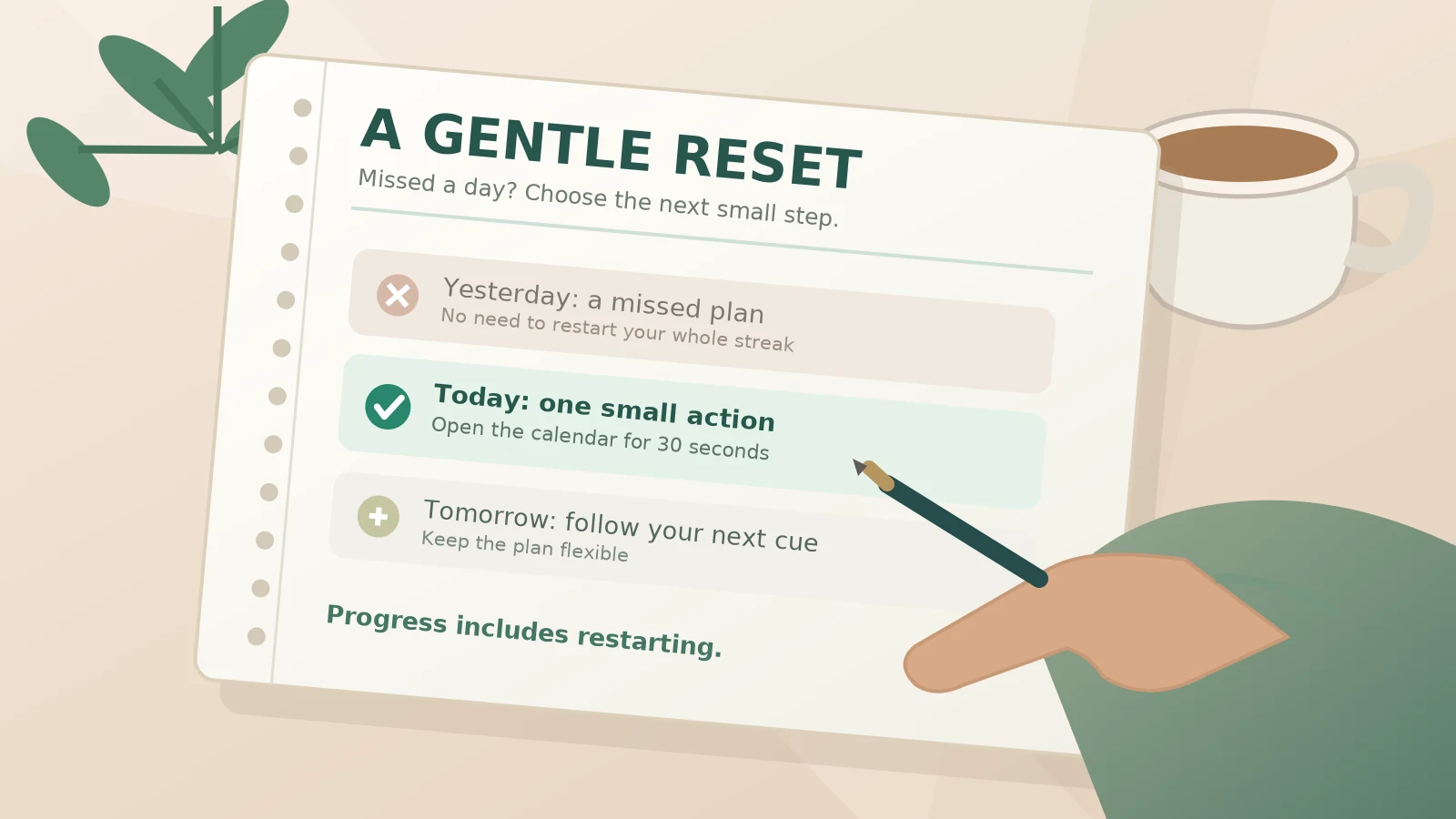
- Shrink the starting step. Your minimum version could be opening the calendar for 30 seconds.
- Choose one recording method. A paper checkbox, phone reminder, or simple app is enough.
- Build in a restart rule. If you miss a day, resume at the next available cue instead of restarting the entire challenge.
- Notice the barrier. When the step does not happen, record one short reason: forgot, no time, unclear next step, or competing demand.
- Review after seven days. Keep what helped and change just one thing that created friction.
For ADHD habit building, the objective of this exercise is to discover a usable setup, not earn a perfect score. One missed action can provide useful information. If you need further examples of practical anchors, our ADHD-friendly daily routine guide explains how to design reminders, transitions, and a flexible reset plan.
A Simple Habit-Tracking Template for ADHD
Track a small amount of information. The table below is an example you can copy into a notebook or simplify into a few checkboxes.
| Day | Cue noticed? | Action attempted? | What helped or got in the way? |
|---|---|---|---|
| Monday | Yes | Yes | Materials were already visible |
| Tuesday | No | No | Reminder was hidden by other alerts |
| Wednesday | Yes | Short version | Had only two minutes |
| Thursday | Yes | Yes | Started immediately after breakfast |
| Friday | No | No | Schedule changed; moved the cue |
A detailed journal is not required. The useful information is the pattern. If a tracker creates frustration or distracts from the habit, simplify it. ADHD coaching may help you interpret patterns if you are unsure how to adjust them, but you can also ask a trusted person for a practical check-in.
When Does Combining a Coach and Habit Tracker Make Sense?
Consider using both when you want a visible reminder during the week and a separate conversation to review why an action is or is not happening. For example, you might choose one habit at a coaching appointment, record attempts on a simple paper card, and discuss what made the habit easier at the next check-in.
You do not need to share detailed personal data from an app with a coach. If you decide to share information, review the service's privacy practices and agree on what will be useful. NIMH recommends checking who develops apps, how data is handled, and whether claims are supported by research.
For someone who already knows what to do and simply forgets occasionally, this extra layer may be unnecessary. For someone who cannot settle on a goal, repeatedly abandons complicated setups, or struggles to restart, ADHD coaching might be worth exploring after considering costs and alternatives.
A good system should become lighter over time. If you need five apps, a complicated dashboard, and several weekly meetings just to remember one routine, the system itself deserves simplification.
Coaching, Therapy, and Medical ADHD Care Have Different Roles
A coach may support practical planning, organization, goal-setting, and everyday follow-through. Coaching titles alone do not establish a mental health license, and ADHD coaching is not a way to diagnose ADHD or treat depression, anxiety, trauma, or another mental health disorder.
A licensed clinician can assess symptoms and recommend evidence-based treatment when indicated. The NIMH guide describes medication and psychotherapy among established options for ADHD. Some adults use practical coaching alongside clinical care, but the appropriate combination is individual.
If your difficulty with habits is accompanied by persistent low mood, severe anxiety, significant sleep problems, substance-use concerns, or unexplained fatigue, seek a qualified healthcare professional rather than assuming a productivity tool will address the cause. Review medication questions with your prescriber rather than changing treatment based on a tracker.
For more detail about professional roles, see What an ADHD Coach Actually Does—and How It Differs From a Therapist, Accountability Partner, or App.
How to Choose ADHD Coaching Support Without Overspending
Before purchasing sessions, ask the coach about their training, experience with adults who have ADHD, methods, fees, cancellation policy, and how progress is reviewed. Ask whether the service includes between-session contact and what boundaries apply. It is reasonable to request a clear explanation of what will happen if the approach is not a good fit.
Be cautious about guaranteed transformations, claims that coaching replaces ADHD medication or psychotherapy, or pressure to buy a large package before you understand the service. You might start with lower-cost reminders, a short support group, or an accountability arrangement and reassess later.
A good ADHD coaching conversation should leave you with a clear, realistic experiment to try rather than another long list of things you are supposed to do perfectly. If a coach suggests medical changes outside their qualifications, consult the relevant licensed clinician.
Exploring ADHD Coaching in Lake Forest and Orange County
For adults in Lake Forest and the wider Orange County area, Heal & Thrive's ADHD coaching services provide information about practical support for organizing daily responsibilities and building routines. You can visit Heal & Thrive to review contact details and ask about service availability, qualifications, fees, and suitability for your goals.
If you already use a habit tracker, bring an example of one goal that keeps getting interrupted. If you have never used an app, that is fine too. ADHD coaching does not require a sophisticated digital setup; the discussion can begin with a single real-life difficulty and a practical next step.
Explore ADHD coaching services at Heal & Thrive to learn about available support. The aim is not a perfect streak. It is a habit system that is useful enough to return to after an ordinary difficult day.
Build a Habit System That Fits Your Life
Explore practical ADHD coaching support for daily routines, planning, and realistic follow-through. Coaching does not diagnose or clinically treat ADHD and does not replace appropriate mental health care.
Sources and Further Reading
- NIMH — Attention-Deficit/Hyperactivity Disorder: What You Need to Know
- NIMH — Technology and the Future of Mental Health Treatment
- CHADD — Coaching
- ADDA — Best ADHD Apps and Tools for Adults
- ADDA — Creating Habits With ADHD
This article is for general education, not diagnosis or personalized treatment. Coaching and habit trackers should not replace indicated medical or mental health care. A qualified clinician should review clinical statements before publication.
Frequently Asked Questions
They can be. A simple tracker can make reminders and repeated actions more visible, but it may not solve difficulties with starting tasks or adapting routines. Choose a low-friction format and change it if the recording process becomes another burden.
Not universally. ADHD coaching may add tailored discussion, planning, and accountability, while a tracker offers convenient prompts and records at lower cost. Some people prefer one; others combine them. Evidence does not support a blanket claim that coaching always outperforms apps.
Reduce the number of tracked goals, simplify the setup, and remove streak-based pressure. Identify whether the problem is remembering, starting, unclear instructions, or an unrealistic schedule. If the pattern continues to affect daily life, consider appropriate professional support.
There is no medically prescribed number. Starting with one meaningful behavior can make it easier to notice which cues and supports help. Add another only when the first system feels manageable.
Coaching alone does not authorize diagnosis or clinical treatment. A qualified healthcare professional evaluates ADHD and discusses evidence-based treatment. Coaching may focus on practical strategies alongside appropriate clinical care.
Yes. A paper calendar, whiteboard, or visible checklist may work just as well for your organizational goal. Choose a method that is easy to notice and maintain; more features do not automatically make a tool more effective.
Look beyond the length of a streak. Ask whether the behavior helps your daily life, whether it is easier to begin, and whether you can restart after interruptions. Adjust a strategy that repeatedly creates more work than it saves.
ADHD Coaching for Building Sustainable Habits That Stick
I want to start with something I say so often in ADHD coaching sessions that some clients can finish the sentence for me:
You are not bad at building habits.
You are trying to build them in a way your ADHD brain was never designed to sustain.
And honestly, this matters more than most people realize.
Many of the adults, parents, and professionals I work with have already tried everything: habit trackers, morning routines, productivity apps, accountability challenges, even willpower-based “30-day resets.” It usually starts strong. There’s motivation. There’s excitement. Sometimes there’s even hyperfocus.
Then… something shifts.
A busy week.
A missed day.
A drop in energy.
And suddenly the habit feels heavy, pointless, or impossible to restart.
This is where shame often creeps in.
“Why can’t I just stick to it?”
“Other people do this every day, what’s wrong with me?”
Here’s the truth ADHD coaching is built on (and I want to be very clear about this):
Habits don’t fail people with ADHD.
Systems fail ADHD brains.
Most traditional habit advice assumes:
- Motivation is consistent
- Time feels predictable
- Repetition is naturally rewarding
- Missing a day is “no big deal”
But ADHD doesn’t work that way.
Dopamine is inconsistent. Motivation comes in waves. Time blindness distorts planning. And missing one day can trigger all-or-nothing thinking that wipes out weeks of effort.
That’s why ADHD coaching for building sustainable habits that stick looks very different from generic habit-building advice.
In ADHD coaching, we don’t ask:
“How do I force myself to be disciplined?”
We ask:
“How do I build ADHD-friendly habits that work with my brain, even on low-energy days?”
This article is about answering that question, practically, realistically, and without shame.
What “Sustainable Habits” Actually Mean in ADHD Coaching
Let’s pause and redefine something.
In the world of ADHD habit building, a habit does not have to be:
- Perfect
- Daily
- Rigid
- Identical every time
A sustainable habit is one that:
- Survives inconsistency
- Can be restarted without self-criticism
- Adjusts when life gets messy
- Still exists after motivation fades
In other words, habits that stick with ADHD are not the habits you never miss.
They’re the habits you don’t abandon when you miss.
This principle sits at the core of ADHD coaching, and it’s especially important for people navigating fast-paced, high-demand environments like California and other parts of the U.S., where pressure and expectations are constant.
Why This Article Exists
If you’ve ever felt like:
- You’re great at starting habits but terrible at maintaining them
- Routines work… until they suddenly don’t
- Your energy, focus, and motivation change daily
- Traditional productivity advice leaves you feeling broken
This article is for you.
We’ll explore how ADHD coaching approaches:
- Building habits with ADHD
- Designing ADHD routines that adapt to real life
- Creating ADHD-friendly habits that reduce friction instead of relying on willpower
No unrealistic promises.
No “just try harder” messaging.
Just systems that respect how ADHD brains actually function.
Problem Identification – Why Habit Building Is So Hard With ADHD

Before we talk about strategies, we need to talk about why building habits with ADHD feels so exhausting in the first place.
This isn’t about laziness.
It isn’t about lack of intelligence.
And it definitely isn’t about not wanting change badly enough.
In ADHD coaching, we look at habit struggles through four core lenses: dopamine, executive function, time & energy, and emotion.
Let’s break this down.
Dopamine and Motivation: The Invisible Barrier
ADHD brains don’t respond well to delayed rewards.
Brushing your teeth, exercising, journaling, or meal prepping all have future benefits, but very little immediate dopamine. That makes them neurologically “expensive” tasks.
Many clients experience:
- A strong burst of motivation at the beginning
- Hyperfocus during the setup phase
- A sudden drop-off once novelty fades
This is why habits often feel exciting for a few days… and unbearable by week two.
ADHD coaching doesn’t rely on motivation staying high.
It designs habits that generate dopamine early and often.
Executive Function: When Starting Is the Hardest Part
Executive function challenges make it difficult to:
- Plan realistically
- Break habits into small steps
- Initiate tasks, even simple ones
This leads to task paralysis: knowing what you want to do, but feeling unable to start.
Another issue is working memory. Many people with ADHD don’t forget habits because they “don’t care”, they forget because the cue never registers.
That’s why external supports are essential in ADHD habit building.
Time Blindness and Energy Fluctuations
One day you have energy.
The next day you don’t.
And time never feels the same twice.
This makes rigid routines collapse quickly.
ADHD coaching works with:
- Variable energy
- Flexible timing
- Scalable habits
Not “do this every day at 6am no matter what.”
Emotional Regulation and the Shame Loop
This might be the most overlooked part.
Missing a habit often triggers:
- Guilt
- Frustration
- Self-criticism
- Perfectionism
And once shame enters the picture, consistency disappears.
ADHD coaching focuses on repair, not perfection.
Because the ability to restart is more important than the ability to never stop.
Practical ADHD Coaching Strategies for Building Habits That Stick
Now we get to the part most people are actually looking for.
Not motivation quotes.
Not “just be consistent.”
Not another habit tracker you’ll forget exists.
In ADHD coaching, habit building starts with one core assumption:
Your brain needs support, not pressure.
Below are the exact principles we use in ADHD coaching to help clients build sustainable habits with ADHD, habits that don’t collapse the moment life gets busy.
Build Habits Around Dopamine, Not Discipline
Let’s say this clearly:
If a habit doesn’t create dopamine, it will not survive long-term.
This is where traditional habit advice fails ADHD brains.
In ADHD coaching, we intentionally design habits to include:
- Immediate reward
- Novelty
- Emotional satisfaction
ADHD-Friendly Habit Shift:
Instead of asking:
“How do I force myself to do this every day?”
We ask:
“How can this habit feel rewarding right now?”
Examples from coaching sessions:
- Listening to a favorite podcast only while walking
- Using visual progress trackers instead of invisible streaks
- Pairing habits with sensory pleasure (music, texture, light)
This is not cheating.
This is neuro-aligned habit design.
Shrink the Habit Until Resistance Disappears
One of the biggest mistakes in ADHD habit building is starting too big.
ADHD brains struggle with high activation energy. If a habit feels “too much,” it simply won’t start.
So we do something counterintuitive in coaching:
We make the habit almost laughably small.
Not because clients are incapable, but because starting is the hardest part.
Example:
Instead of:
- “Exercise for 30 minutes”
We start with:
- “Put on workout shoes”
- “Stretch for 60 seconds”
- “Walk to the mailbox”
Once momentum exists, continuation becomes easier.
But continuation is optional. Starting is the win.
This is how habits that stick with ADHD are born.
Design for Inconsistency (Because It’s Coming)
Here’s a hard truth ADHD coaching embraces:
Consistency is not stable for ADHD brains.
Energy fluctuates. Focus shifts. Life interrupts.
So instead of pretending consistency will magically appear, we design habits that survive inconsistency.
We use:
- Minimum viable habits (what’s the smallest version that still counts?)
- Scaled options (low-energy vs high-energy versions)
- Flexible frequency (3x/week beats “daily” if daily collapses)
Success is not “never missing.”
Success is never quitting.
Externalize Memory and Willpower
ADHD brains are not meant to hold everything internally.
That’s why external systems are non-negotiable in ADHD coaching.
We rely on:
- Visual cues
- Environmental design
- Timers and alarms
- Habit stacking with existing routines
If a habit depends on “remembering” or “feeling motivated,” it will fail.
ADHD-friendly habits live outside the brain as much as possible.
Build One Habit at a Time (Yes, Really)
Many clients want to change everything at once:
- Sleep
- Exercise
- Diet
- Productivity
- Emotional regulation
That level of change overwhelms executive function.
In ADHD coaching, we slow it down, on purpose.
One habit. One focus. One win.
Because confidence grows from success, not overload.
Real Client Stories – How ADHD Coaching Builds Habits That Actually Last

Let’s move out of theory for a moment.
Because one of the biggest shifts people experience in ADHD coaching happens when they realize:
“Oh… it’s not just me.”
Below are real, anonymized examples from ADHD coaching work that show what building sustainable habits with ADHD actually looks like in real life,not in perfect conditions, but in messy, human ones.
Client Story 1: “I Was Great at Starting Habits—and Terrible at Keeping Them”
Background:
A working professional in California came to coaching frustrated and exhausted. They had tried building morning routines, exercise habits, and productivity systems for years.
Their pattern was always the same:
- Strong start
- A few “good weeks”
- One disrupted day
- Total abandonment
They believed their biggest problem was “lack of discipline.”
It wasn’t.
What ADHD Coaching Changed
Instead of rebuilding another “perfect” routine, we focused on:
- One habit only
- A non-daily structure
- Removing emotional pressure
The habit: movement
But not “exercise every day.”
The agreement was simple:
- Any movement counted
- Duration didn’t matter
- Restarting was success
Some days it was a 20-minute walk.
Other days it was stretching for 90 seconds.
And here’s the key insight they shared later:
“This is the first habit I’ve ever had that didn’t disappear when I missed a day.”
That’s what habits that stick with ADHD look like.
Client Story 2: The All-or-Nothing Trap
Background:
This client struggled deeply with perfectionism. Missing one day of a habit triggered intense guilt, which led to avoidance.
Their brain treated habits like contracts:
Break it once → it’s over.
Coaching Intervention
In ADHD coaching, we reframed success completely.
We introduced:
- A restart rule (“restarting counts as consistency”)
- A visual tracker that rewarded returns, not streaks
- Language shifts (no “failed,” only “paused”)
At first, this felt uncomfortable. Almost wrong.
But over time, something changed.
The emotional charge around habits softened.
Shame lost its grip.
And habits became less fragile.
Client Story 3: Executive Dysfunction and the Activation Wall
Background:
This client wanted habits. They understood their value.
But starting felt impossible, even when habits were small.
This wasn’t resistance.
It was executive function overload.
ADHD-Friendly Solution
We focused entirely on environmental cues:
- Habits placed directly in sight
- Tools removed from storage
- Friction intentionally reduced
Instead of “remembering” to journal, the notebook lived on the pillow.
Instead of planning to drink water, the bottle lived on the desk.
The habit didn’t rely on memory anymore.
It relied on visibility.
That’s a core ADHD coaching principle:
If you have to remember it, it’s already too hard.
Step-by-Step – How ADHD Coaching Builds Habits in Real Life
This is where ADHD coaching becomes very practical.
Because knowing why habits are hard is helpful, but knowing how to build them step by step is what actually changes lives.
Below is the exact framework used in ADHD coaching to support building habits with ADHD in a way that is realistic, flexible, and sustainable.
Step 1: Choose a Habit That Solves a Real Problem (Not an Ideal One)

One of the most common mistakes in ADHD habit building is choosing habits based on who we think we should be.
In ADHD coaching, we ask:
- What problem is this habit actually solving?
- What pain shows up if this habit doesn’t exist?
- Does this habit support your current life, or an imaginary future version?
Sustainable habits ADHD brains keep are tied to relief, not pressure.
Step 2: Define the “Minimum Version” of the Habit
Every habit gets a minimum viable version.
This is the version you can do:
- On low-energy days
- During stress
- When motivation is gone
Examples:
- One deep breath instead of meditation
- One sentence instead of journaling
- Standing up instead of exercising
In ADHD coaching, minimum counts.
Because minimum is how habits survive.
Step 3: Anchor the Habit to an Existing Cue
ADHD brains struggle with internal reminders.
So we attach habits to:
- Physical cues
- Visual triggers
- Existing routines
This is called habit anchoring, and it’s essential for ADHD routines.
Examples:
- Stretching while the coffee brews
- Drinking water after using the bathroom
- Reviewing tasks when opening a laptop
If the cue already exists, the habit has a fighting chance.
Step 4: Build in Dopamine on Purpose
We don’t wait for habits to “feel rewarding later.”
We design dopamine into them now:
- Music
- Gamification
- Visual progress
- Social reinforcement
ADHD coaching treats dopamine as a design requirement, not a bonus.
Step 5: Plan for the Restart (Before You Need It)
This step changes everything.
Every habit includes a restart plan:
- What does restarting look like?
- How do you talk to yourself after a pause?
- What’s the smallest step back in?
This prevents shame spirals and protects consistency.
What Success Really Looks Like in ADHD Habit Building
One of the biggest mindset shifts in ADHD coaching is redefining what “success” actually means.
Success is not:
- Never missing a day
- Following a routine perfectly
- Doing the habit the same way every time
In ADHD coaching, success looks very different, and much healthier.
Real Success Indicators in ADHD Coaching
Here’s how we measure progress when building sustainable habits with ADHD:
You Restart Faster
You don’t spiral for weeks after a pause.
You come back within days, or even the same day.
Habits Feel Lighter
They require less emotional effort.
Less negotiation. Less dread.
You Trust Yourself Again
You stop saying:
“I never stick to anything.”
And start saying:
“I know how to come back.”

Flexibility Replaces Perfection
You adjust habits without abandoning them.
Low-energy days no longer equal failure.
That’s the real win.
Why Coaching for ADHD Makes a Difference
According to research,
Articles can be read.
You can watch videos.
Habit trackers exist. One can download them.
But ADHD coaching has something new to offer:
Personalized systems that fit your brain, your life, and your reality.
Heal-Thrive.com’s ADHD coaching is founded on the following:
- Research-supported understanding of ADHD
- Strengths-based,
- Executive Function Support, not Pressure
- Sustainable Change vs. Quick Fixes
Coaching assists with:
- Identify Invisible Block
- Develop habits based on your energy levels
- Design environments that support action
- Reduce cycles of shame and burnout
It’s not about “trying harder.”
“It’s about building smarter systems.”
The Next Step
If you’re sick of starting habits but seeing them disintegrate, trust me, you’re not in need of more motivation.
You also need support that understands ADHD.
At Heal-Thrive, our ADHD coaches can aid individuals and families with:
- Create ADHD-friendly habits
- Establish sustainable practices
- Improve executive function
- Restore Confidence and Self-
Get In Touch With Our ADHD Coaching Experts to Learn More about Your Options
Download our ADHD habit-building guide
The first step is to schedule an initial consultation session. You should begin forming habits that actually stick