

Psychotherapy: 3 Key Elements That Many Approaches Share
Discover three key elements many psychotherapy approaches share: a collaborative relationship, clear goals, and evidence-informed care with feedback.
Quick Answer
Many psychotherapy approaches share (1) a collaborative therapeutic relationship, (2) agreement on goals and expectations, and (3) treatment methods informed by evidence and adjusted through feedback. These are not an official list of the only three elements found in every therapy. They are a practical way to understand what may help treatment feel purposeful, safe, and responsive to individual needs.
Table of Contents
Psychotherapy can look different from one person’s experience to another. One therapist may focus on practical coping skills, while another explores relationship patterns or helps a family communicate more effectively. These approaches may use different techniques, yet many share features that make treatment collaborative and responsive to the person receiving care.
Understanding the common elements of psychotherapy can help you ask better questions before starting therapy. In this guide, we explore three useful themes: a trusting therapeutic relationship, shared goals and expectations, and evidence-informed methods supported by ongoing feedback.
Why Do Common Elements of Psychotherapy Matter?
There are many types of psychotherapy, including cognitive behavioral therapy, psychodynamic approaches, interpersonal therapy, and family-based treatments. Each has its own methods and areas of emphasis. The National Institute of Mental Health (NIMH) explains that treatment should be tailored to the condition, the clinician’s training, and the needs of the person receiving care.
Research also examines factors that appear across treatment models. The American Psychological Association (APA) highlights therapeutic alliance, collaboration, agreement on goals, empathy, and client feedback as important relationship-related factors. Rather than claiming every method works in exactly the same way, it is more accurate to ask how these elements contribute to a particular course of care.
1. A Trusting, Collaborative Therapeutic Relationship
A therapeutic alliance is the working relationship between a client and a therapist. It involves feeling heard, understanding the work you are doing together, and having room to discuss concerns or disagreements. Trust does not have to appear instantly, and psychotherapy does not require you to reveal everything in the first appointment.
A 2018 meta-analysis of adult psychotherapy reviewed 295 independent studies and found a consistent association between stronger therapeutic alliance and better treatment outcomes. That association is meaningful, although it does not prove that the relationship alone causes improvement or that specific clinical techniques are unnecessary.
What Does a Helpful Relationship Look Like?
Your therapist listens carefully, explains unfamiliar concepts, respects boundaries, and takes your questions seriously. You can say when a technique feels uncomfortable or a goal does not reflect what matters to you. A qualified therapist should also explain confidentiality and its legal limits.
There may be difficult conversations, but respectful communication remains essential. If a misunderstanding arises, addressing it together can be part of the work. If you feel persistently dismissed or unsafe, it is reasonable to seek a second opinion or another qualified clinician.
A useful question: “If something about therapy is not working for me, how can we talk about it?”
2. Shared Goals and Clear Expectations
People enter psychotherapy for different reasons: managing anxiety, navigating grief, improving communication, or coping with a major life transition. A therapist can help turn a broad wish such as “I want to feel better” into goals that can be discussed and reviewed together.
In therapy, goal consensus means that the client and therapist understand and broadly agree on what they are working toward. The APA identifies agreement on goals and collaboration as factors associated with effective therapeutic relationships. Goals are not promises or a fixed schedule for recovery; they help provide direction while leaving room for individual circumstances.
How Are Therapy Goals Chosen?
Early sessions may include questions about what feels most difficult, what you have already tried, and what meaningful progress would look like. Depending on the approach, a goal might involve managing panic symptoms, handling a family conflict differently, or returning to valued activities.
Goals should be realistic and open to revision. A client may discover that the original concern is connected to another issue, or that an unexpected event changes priorities. Psychotherapy works best as an ongoing conversation about what is useful, not a checklist imposed without your input.
A useful question: “How will we decide what to focus on, and when will we review whether it is helping?”

3. Evidence-Informed Methods and Ongoing Feedback
Psychotherapy involves more than a positive relationship. The clinician also uses professional judgment and treatment methods suited to the presenting concern. In cognitive behavioral therapy (CBT), this may include identifying patterns of thinking and behavior and practicing alternatives. Other approaches may emphasize emotional experiences, relationships, mindfulness, or family interactions.
An evidence-informed approach considers relevant research, professional expertise, and the person’s needs and preferences. It does not mean one technique is best for everyone. A method appropriate for a specific anxiety disorder may not be the first choice for a different condition.
Why Does Feedback Matter?
Feedback helps a therapist understand whether the work feels relevant and whether symptoms, functioning, or relationships are changing. That may involve a brief check-in, a discussion of progress toward goals, or structured measures when appropriate.
The APA’s review of psychotherapy relationship research identifies collecting client feedback as an important part of responsive care. If a plan is not helping, you and the clinician can consider adjusting the approach, addressing barriers, or discussing a referral.
A useful question: “How will you know whether this approach is helping, and what happens if I am not improving?”
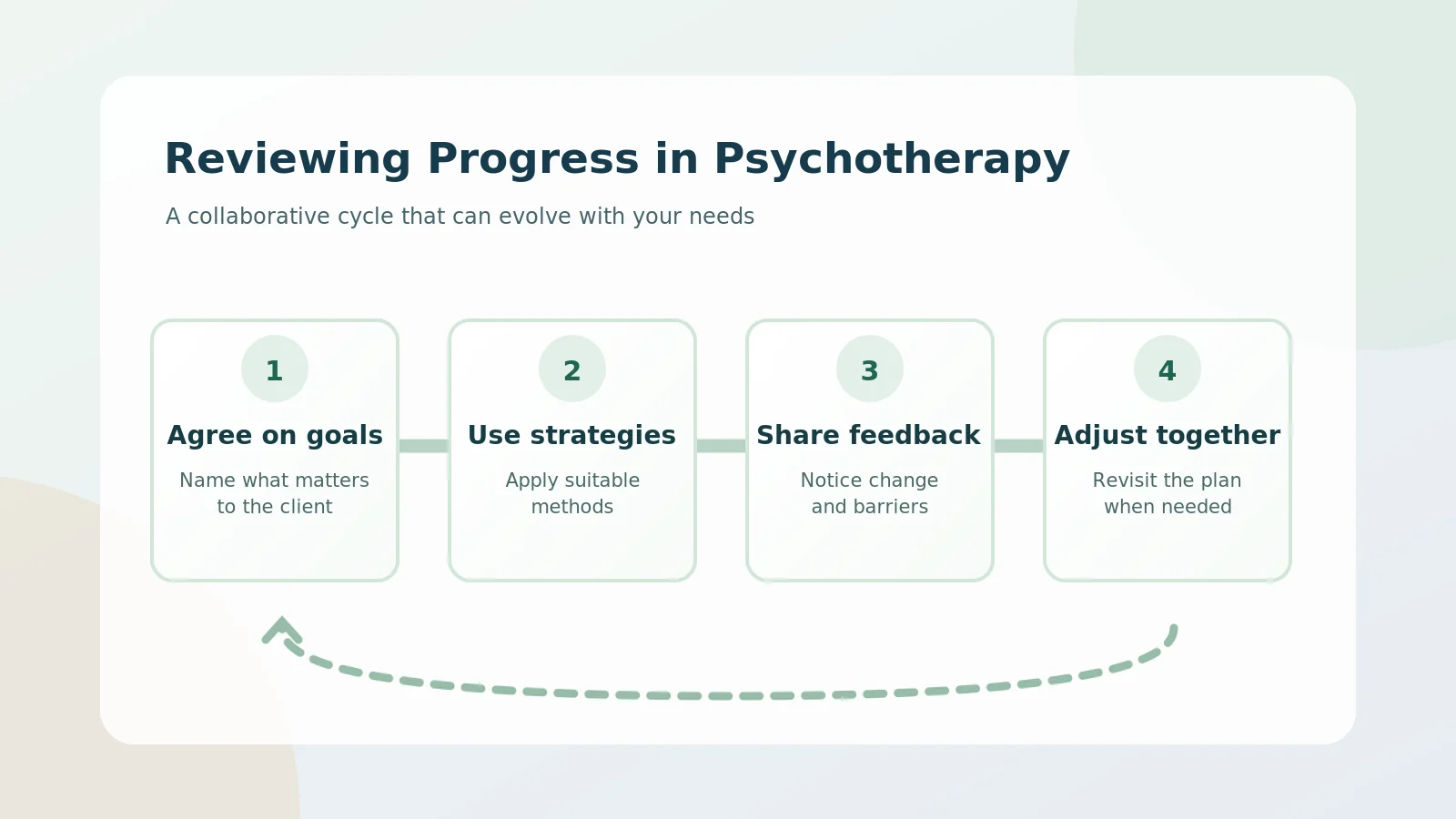
How the Three Elements Work Together
These elements reinforce one another without replacing the need for individualized treatment. A strong working relationship makes it easier to discuss goals. Agreed goals help the therapist choose appropriate activities. Feedback lets both people notice progress and revise the plan when needed.
| Shared element | What you may notice in a session | Question worth asking |
|---|---|---|
| Therapeutic relationship | Respectful listening and a collaborative atmosphere | “Can I raise concerns about our work?” |
| Goals and expectations | A clear explanation of what you are working toward | “How will we review my goals?” |
| Methods and feedback | An approach explained in understandable terms and reviewed over time | “What will we do if progress stalls?” |
These principles can be relevant to individual therapy, couples therapy, family therapy, and group therapy, although each format introduces different relationships, privacy considerations, and treatment needs. It should not be interpreted as a guarantee of a particular outcome.
What If One Element Seems Missing?
You do not have to judge therapy by a single appointment. Trust can take time, and goals may become clearer as the clinician learns about your circumstances. However, ongoing confusion about fees, boundaries, the purpose of treatment, or your ability to ask questions deserves attention.
Try naming the concern directly: “I am not sure what our goal is,” or “Could you explain why we are using this exercise?” A helpful professional can discuss the reasoning behind an approach and consider your feedback. If the concern remains unresolved, you can explore another provider.
For more information about professional titles, read our guide to psychotherapist vs. therapist. Choosing someone with appropriate training and experience matters just as much as understanding general therapy principles.
Exploring Psychotherapy Services in Orange County
If you are considering psychotherapy services in Lake Forest or Orange County, you can explore Heal & Thrive’s therapy services and ask about current availability, therapist credentials, treatment approaches, and fees. The Heal & Thrive homepage also provides information about the practice.
During an initial consultation, consider asking how the clinician builds a collaborative relationship, sets treatment goals, and reviews progress. The answers can help you decide whether the service matches your needs. A good starting point is a professional conversation, not a promise of guaranteed results.
Explore therapy services at Heal & Thrive to learn about available options.
Exploring Psychotherapy in Orange County?
Learn about Heal & Thrive psychotherapy and therapy services in Lake Forest, California. Ask about qualified clinicians, current availability, fees, and appropriate care for your needs.
Sources and Further Reading
- NIMH — Psychotherapies
- APA — What the Evidence Shows About Psychotherapy Relationships
- APA — Better Relationships With Patients Lead to Better Outcomes
- PubMed — The Alliance in Adult Psychotherapy: A Meta-Analytic Synthesis
This article is educational and does not replace a diagnosis or individualized mental health advice. Clinical information should be reviewed by a qualified professional before publication.
Frequently Asked Questions
No. Different psychotherapy models include different techniques and requirements. The three elements in this article are a practical, research-informed framework for understanding common features, not a universal diagnostic checklist or formal classification of all treatments.
A collaborative relationship can make it easier to discuss sensitive concerns, ask questions, and work toward meaningful goals. Research has found an association between the quality of the therapeutic alliance and treatment outcomes, although individual results vary.
Not necessarily. It may take several conversations to understand what you want to address. You and your therapist can establish initial priorities, clarify expectations, and adjust goals as treatment develops.
Progress may be reviewed through discussions of daily functioning, symptom changes, personal goals, and sometimes structured questionnaires. The approach depends on the treatment and your needs. Feedback should help guide decisions, not pressure you to report improvement.
Many of these principles also matter in telehealth: trust, clear goals, evidence-informed care, and feedback. Online services also require appropriate privacy arrangements and professional authorization to serve clients in their location.
You can raise the concern, ask questions, or explore a different qualified clinician. Building trust can take time, but your boundaries and safety matter. Persistent problems with communication or professional conduct should not be ignored.