
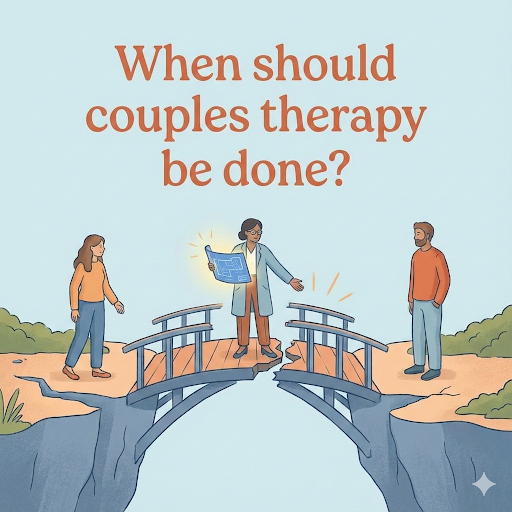
When should couples therapy be done?
You know, one of the most common things I hear from couples is, “We’re not in crisis… but maybe we should try therapy?” And I always pause for a second because honestly, that’s the perfect time to come in. Couples therapy isn’t just for the relationships that are on the brink of breaking; it’s for anyone who wants to connect better, communicate more clearly, and stop running the same arguments in circles.
I remember a couple, let’s call them Maya and Chris, they were stuck in this loop where small disagreements about chores or schedules would explode into full-blown fights. They didn’t think therapy was “for them,” but after a few sessions, they realized the changes weren’t dramatic overnight. It was tiny, consistent shifts, like hearing each other fully and actually pausing before reacting, that made their bond stronger.
If you’re reading this and wondering, “Is couples therapy right for us?” or “Who needs couples therapy anyway?”, you’re already asking the right questions. Because the truth is… recognizing the need early often makes therapy far more effective.

Problem Identification and the need for couples therapy
Here’s something I notice a lot: couples often don’t realize they might benefit from marriage counseling until tensions are high. And by that point, progress is possible, but it takes more effort. So let’s step back and answer the question: “Who really needs couples therapy?”
From my experience, there are a few common scenarios:
The two of you might feel disconnected. Communication is an issue. One partner is feeling unheard while the other partner feels criticized. Neither partner realizes they are discussing the same issue for the fifth time. Incessant arguments concerning finances, household chores, parenting, or clashes of preferences. One partner feels as if they are trapped. Emotional isolation. The two of you feel as if there is an emotional void even when you are together. Secrets. Lies. Unresolved intimacy issues. Disabling issues of trust, betrayal, and infidelity. Shifts in life roles. Stressful changes such as new jobs, moving in together, or having a baby. Heath issues of one or both partners. Unchecked anxiety, depression, or substance use creates emotional barriers. The absence of one partner’s participation and the presence of active domestic violence may unfortunately take priority for other interventions, but the important part is to recognize that if you see yourself in any of these scenarios or even think, “Is couples therapy right for us?” There is a high likelihood that things may be clarified using therapy. Preventive action may substantially reduce the risk of an unhealthy outcome.
Real Client Examples
Let me share a couple of real-life examples (names changed for privacy).

Case 1: Sarah and Mike
Sarah and Mike came to me feeling stuck in the endless cycle of arguments about money, chores, and parenting. Sarah felt like Mike never really heard her, and Mike felt constantly criticized. Initially, they were skeptical about couples therapy, thinking, “Will this actually help us?” In the first few sessions, I guided them through active listening exercises. Mike had to repeat back what Sarah said. (Yes, it was awkward at first. There were some laughs, some eye rolls, and a lot of “Wait, no, actually” moments.) Gradually, small shifts started to happen. Sarah noticed Mike really listened, and Mike realized he didn’t have to react defensively all the time. In the third month, arguments were shorter, appreciation moments increased, and even little gestures like making coffee for each other started to reappear.
Case 2: Alex and Jordan
Alex and Jordan had to deal with infidelity. One partner had been concealing their affair, creating almost constant uneasiness. Therapy provided them with a molded framework to discuss the betrayal, set boundaries, and make a decision to either rebuild trust, or amicably separate. It was an emotional and difficult process, but the clear action steps brought order to the overwhelming history. They celebrated small wins at first such as able to talk to each other without blame or anger very slowly re-establishing their ties.
These examples show that who can benefit from couples therapy isn’t just couples in crisis. Even those who want to improve communication, prevent recurring fights, or deepen emotional connection can gain practical tools and lasting insight.
Practical Therapy Solutions
Honestly, when I start working with couples, I tell them, “Therapy isn’t about fixing everything at once. It’s about tiny, consistent changes.” And yes, I mean tiny. But those small shifts? They add up in ways that surprise most people.
Here are some of the strategies I guide couples through:
- Active Listening
- One partner speaks, the other listens fully ,no interruptions, no rebuttals.
- Reflect back what you hear: “So, what I hear is…”
- Funny thing, at first, couples think it’s silly. But after a few weeks, they often tell me, “Wow, I feel like I’m really being heard for the first time in months.”
- Weekly Check-ins
- Just 20–30 minutes a week can prevent little frustrations from exploding.
- Share wins, annoyances, and even dreams.
- It becomes a safe space, a little ritual to reconnect.
- Structured Problem-Solving
Discussed Problems Using a Structured Problem Solving Framework.
- Identifying the problem. Considering multiple solutions. Deciding which one to act on. Evaluating the outcome.
- The trick is to collaborate instead of blame. I often have to refocus couples arguing.
- Trust-Building Steps
- Transparency matters Sharing schedules and feelings or just being open.
- Small wins are more powerful than big wins. For example, talking about a concern without raising one’s voice.
- Behavioral Experiments
- Implement the new habits suggested during therapy. Evaluate what works and what does not.
- Even awkward attempts, repeated consistently, create real change.
- Mindfulness & Emotional Regulation
- Pause, breathe, reflect before responding during heated moments.
- Couples learn to respond instead of react, which shifts the dynamic entirely.
- Tools & Resources
- Apps, worksheets, or books reinforce what you practice in therapy.
- Think of them as homework that actually improves your relationship.
I’ve seen couples hesitant at first, thinking, “Will this really help us?” And then, after a month or two, small changes compound, less arguing, more laughing, and a feeling of connection they didn’t realize was missing.
Implementation Stories
I remember a couple, let’s call them Lena and David. When they first came to me, even a simple question like, “What’s for dinner?” could turn into a 30-minute argument. They had heard of couples therapy for communication issues, but honestly, they weren’t sure it could work for them.
We started small. I asked them to try weekly 20-minute check-ins and active listening exercises. Lena groaned at first: “I’ve told him how I feel a hundred times…” And David muttered, “Yeah, let’s see if this changes anything.”
The first week? Awkward. Very awkward. There were nervous laughs, fumbling words, and moments of, “Wait… no, actually…” But by week three, I saw a subtle shift. Lena noticed David was really pausing to listen instead of immediately defending himself. David said he felt heard without feeling attacked.
By month two, their weekly check-ins had become something like a safe little ritual. It’s not that arguments disappeared; rather, arguments became shorter, calmer, and more constructive. There were even small, positive, and non-therapeutic actions that started, such as making each other coffee and sending brief thank you texts that showed genuine emotional reconnection. And then came Nina and Sam, who were still struggling because a concern regarding finances had turned into an issue of trust. We instituted frameworks for structured problem solving: define the issue, enumerate the possible solutions, select an action, and assess the outcome. To begin with, it resembled some form of homework, but it soon dawned on them that the arguments that had seemed interminable were now easy to manage. There had even been some form of minor celebration during these instances, as it had felt like progress on some level during the easier situations, such as remaining within the agreed budget and having constructive dialogue. These narratives illustrate an essential point: practical strategies yield results only when they are enacted repeatedly. Even when the strategies are a bit rough around the edges and are not optimally executed, simply having attempts that are sustained over a longer period of time creates genuine and enduring outcomes.
Challenges & Fixes in Couples Therapy
Let me be honest, couples therapy isn’t always smooth sailing. Even couples who are motivated and committed run into roadblocks. And that’s okay, it’s part of the process.

Challenge 1: One Partner is Resistant
I once worked with a couple, Emma and John. Emma was fully on board, John… not so much. He thought therapy was “pointless.” We didn’t force him. Instead, we started with short individual check-ins. Slowly, John realized therapy wasn’t about blame, it was about being heard. Tiny, patient steps made all the difference.
Challenge 2: Communication Breakdowns
Couples often tell me: “We’ve tried talking, but nothing changes.” That’s completely normal. I introduce structured exercises like mirroring and weekly reflections. There are starting difficulties (yes, some eye-rolling, and wait, what?). Yet, partners report less misunderstanding and greater efficiency in their discussions.
Challenge 3: Trust Issues or Infidelity
These cases are tricky. I always emphasize: “This isn’t about rushing forgiveness. It’s about clarity and small, measurable steps.” Couples create clear agreements about transparency, boundaries, and check-ins.
Even minor achievements, like the freedom to articulate feelings and assign no blame, are often experienced like huge breakthroughs. Other Obstacles:
- Financial or access limitations
- High conflict personality or chronic therapy avoidance
- Specific LGBTQ+ stress (discrimination, minority stress, coming out, etc.)
- Differences in life stage (young dating couples or retirees)
- Religious, cultural or language differences
The important part? Therapy does not require perfection, only persistence. Couples who continue to attend, although imperfectly, report more laughter, less frustration, and greater emotional intimacy.
Success Metrics in Couples Therapy
Here’s the thing about measuring success in couples therapy: it’s rarely dramatic, but it’s very real. I often tell couples, “If you notice even small shifts, that’s huge.”
Here’s what I usually see:
Improved Communication
While arguments still occur, the duration, intensity, and productivity of these arguments have all increased over time as clients begin hearing their partner without reacting immediately to them. One client told me that “It feels like we have finally found common ground.” As clients feel safe to express their fears, hopes, and frustrations safely, there is also an increase in small gestures, including text messages, compliments, and even smiles among each other.
There is now a reduction in recurrent issues; clients use to get into a fight over specific subjects but are now able to discuss the same topics calmly.
Couples find ways to negotiate their differences, rather than repeat old patterns of behavior. There is greater trust between couples who have gone through therapy.
Couples experience greater transparency in their relationship, and as a result, they feel more comfortable disclosing their secrets.
Although betrayal may have occurred in the past, clients feel a sense of accomplishment with each new small step toward being honest with one another.
Behaviorally, couples consistently apply learned skills (e.g., actively listening, using a structured process to solve problems, and regulating their emotions). As a result of these accomplishments, couples report increased happiness, connectedness, and feeling supported. Furthermore, they have developed skills to be better able to face the challenges of life together with the help of the tools learned in therapy.
Remember, when measuring success in your relationship, do not strive for perfection; I have witnessed couples who may continue to argue occasionally, but they share a greater amount of laughter, closeness, and appreciation.
Here’s the honest truth: knowing who needs couples therapy is just the first step. The real magic happens when you actually take action.
If anything in this article resonated with you,maybe you saw yourself in Sarah and Mike, or felt the tension like Lena and David,you don’t have to wait until a crisis.
You can take the first step towards a happy, healthy relationship today by utilizing small, incremental changes to your daily life.
At Heal-Thrive.com, our team of licensed therapists is available to assist you in overcoming the many challenges couples face, from communication issues to trust issues, arguments that keep coming back around, and transitions in life.
Now that you’ve taken an interest in couples therapy, you have the opportunity to take these next steps:
- Schedule a session with a qualified therapist to begin your journey towards building a better bond with your partner.
- Review our free resource guide to learn more about when couples therapy may be right for you.
- Take advantage of our hundreds of practical tools and useful information to help strengthen your relationship right now.
It’s important to remember that asking others for assistance is not a sign of weakness but rather takes strength and courage. You may feel anxious or uncomfortable when taking your first step, but once you’ve taken that step toward your goal of having less arguing, more laughter, and a stronger bond between you both, you will find that things improve dramatically. I’ve seen couples improve beyond their original expectations as a result of simply showing up and taking consistent action.
So why wait? You can begin creating a healthier, happier relationship today!